Which Kick Scooter Holds Up Best for Daily Commutes?
Razor A5 Lux stands out for its 200mm wheels and adult-rated frame, suiting most riders. Fuzion Cityglide B200 matches that wheel size for less outlay, and Micro Kickboard Maxi Deluxe leads for younger children thanks to its stable lean-to-steer design.
Razor A5 Lux balances wheel size, weight limit and price best for most riders, Fuzion Cityglide B200 undercuts it on outlay with a similar spec, and parents of younger children should look at Micro Kickboard Maxi Deluxe for its easier-to-balance lean-to-steer design.
Wheel size drives almost everything about how a scooter rides, and a model that glides on smooth tarmac can rattle to a stop on cracked pavement. We compared wheel diameter and material, deck dimensions, folding hardware and stated weight limits, then weighed owner reports on handlebar wobble and bearing life.
The top picks, ranked

Razor A5 Lux Kick Scooter
200mm urethane wheels roll over cracks and small obstacles far better than the small wheels found on children’s scooters. An adult-rated frame supports commuters up to 220 pounds. A single-lever fold collapses the deck in seconds for carrying onto a bus or train.
Pros
- Large wheels roll smoothly over rough pavement
- Frame rated for adult commuters up to 220 pounds
- Single-lever fold collapses quickly for transit
Cons
- Heavier than small-wheeled children’s scooters
- No suspension, so bumps transmit through the deck

Fuzion Cityglide B200 Adult Kick Scooter
An extra-wide deck sets this scooter apart from other 200mm-wheel models, adding real comfort on longer rides. A height-adjustable handlebar suits different rider heights, and the frame supports up to 220 pounds. Bearings ship average out of the box, and the folding latch needs occasional tightening.
Pros
- Wide deck stays comfortable over distance
- Adjustable handlebar suits multiple riders
- Strong specification for the price
Cons
- Folding latch needs occasional tightening
- Bearings are average out of the box

Micro Kickboard Maxi Deluxe Scooter
Three wheels and a lean-to-steer design give young riders far more stability than a conventional two-wheel scooter. Suited to roughly ages 5 to 12, it teaches the weight shift that carries over to skiing and skating. Build quality sits well above typical children’s scooters, and owners report it survives being handed down between siblings.
Pros
- Very stable for younger, less confident riders
- Adjustable T-bar handlebar grows with the child
- Durable enough to pass down between siblings
Cons
- Costs far more than basic children’s scooters
- Most versions do not fold for storage

Razor A Kick Scooter
98mm urethane wheels keep this the simplest, cheapest way to get a child rolling on driveways and smooth paths. A patented folding mechanism collapses it small enough for a car trunk. Riders around age five and up fit the 143-pound weight limit, though small wheels struggle once pavement turns rough.
Pros
- Lowest cost of any scooter in this comparison
- Very light for a child to carry
- Folds small enough for a car trunk
Cons
- Small wheels struggle on rough surfaces
- Narrow deck limits comfort over distance

Hudora 205 Big Wheel Scooter
205mm wheels, the largest in this lineup, roll the smoothest over imperfect pavement of any scooter here. An aluminum frame folds with a carry strap, and a taller stance suits longer legs. Owners report it holds speed noticeably better than 200mm and smaller alternatives over distance, though it folds bulkier and sits higher off the ground.
Pros
- Largest wheels here roll smoothest over cracks
- Aluminum frame holds speed well over distance
- Carry strap simplifies transport when folded
Cons
- Bulkier folded size than smaller-wheel models
- Higher deck increases the step-down distance
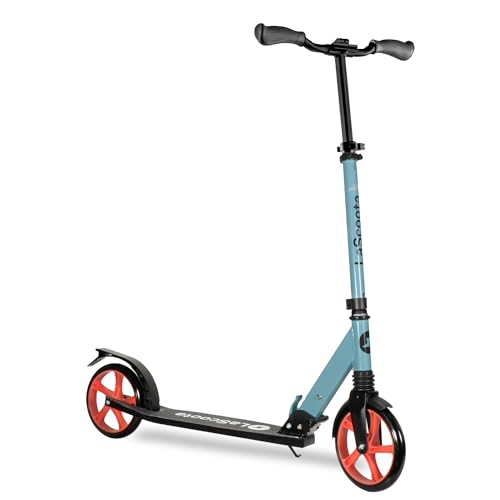
Lascoota 2-Wheel Kick Scooter
A wide handlebar adjustment range targets households sharing one scooter between a teenager and an adult. A non-slip coated deck adds grip in wet weather, and 200mm wheels support riders up to 220 pounds. Shared use means fittings need regular checks, and the rear brake wears faster under heavy mileage.
Pros
- Handlebar range suits several different riders
- Non-slip deck coating helps in wet conditions
- Folds down with a straightforward mechanism
Cons
- Fittings need regular checking under shared use
- Rear brake wears quickly with heavy use

Mongoose Rise 100 Pro Freestyle Scooter
A fixed, non-folding frame trades portability for the strength to survive drops and grinds at a skatepark. 110mm alloy-core wheels resist the flat spots that grinding and hard landings cause. Fixed-height stunt bars keep the build rigid, but that same rigidity limits who the scooter fits and rules out commuting.
Pros
- Rigid frame handles jumps and hard landings
- Alloy-core wheels resist flat spots from grinding
- No folding hinge to loosen under stress
Cons
- Not practical for commuting or long distances
- Fixed bar height limits which riders it fits
How to choose
How wheel size changes where you can ride Wheel size ranks as the single most important spec here. Wheels near 100mm suit smooth driveways and school playgrounds but stop dead on small cracks. Wheels from 180mm to 205mm roll over imperfect pavement, carry speed between kicks, and feel more stable at pace. A commute of any real length calls for at least 180mm, whatever the weight savings of a smaller wheel.
Deck height, width and rider fatigue A low deck shortens the lift on every kick, which adds up over a mile or two. A wide deck lets both feet rest comfortably while coasting. Handlebar height should land between waist and chest while standing on the deck, since bars set too low force a hunch and bars set too high make steering vague.
Folding weight and how you’ll carry it A folding scooter weighing around twelve pounds is manageable on a train or up a flight of stairs. That portability trades off against the folding hinge, which is the part most likely to develop play over time. Checking the latch periodically and tightening clamp bolts prevents most of the wobble owners report.
Commuter scooters vs freestyle scooters Freestyle scooters use fixed bars, rigid welded decks and small hard wheels built to survive impacts. Commuter scooters fold, use larger softer wheels, and prioritize rolling efficiency over durability at a skatepark. Buying one for the other’s job leads to disappointment, since a folding commuter scooter loosens its hinge fast under skatepark abuse. A helmet is essential either way, and wrist guards are worth adding for younger riders.
Compared at a glance
| # | Model | Wheel size | Best for | Score | Price |
|---|---|---|---|---|---|
| 1 | Razor A5 Lux Kick Scooter | 200mm urethane | Best overall | 9.4 | Check price |
| 2 | Fuzion Cityglide B200 Adult Kick Scooter | 200mm | Best value | 9.2 | Check price |
| 3 | Micro Kickboard Maxi Deluxe Scooter | Three wheel configuration | Best for kids | 9.0 | Check price |
| 4 | Razor A Kick Scooter | 98mm urethane | Best budget | 8.8 | Check price |
| 5 | Hudora 205 Big Wheel Scooter | 205mm | Best for commuting | 8.6 | Check price |
| 6 | Lascoota 2-Wheel Kick Scooter | 200mm | Best for teens and adults | 8.3 | Check price |
| 7 | Mongoose Rise 100 Pro Freestyle Scooter | 110mm alloy core | Best for skateparks | 8.0 | Check price |
Good to know
What age is a kick scooter suitable for?
Three-wheel lean-to-steer scooters generally suit children from around two or three years old. Two-wheel folding scooters usually start near age five, once balance develops. Check the specific model’s stated age and weight range rather than assuming.
Are big wheel scooters better?
For commuting and rough pavement, yes. 200mm wheels roll over cracks, drain covers and small debris that stop 100mm wheels dead, and they hold speed between kicks. The trade-off is extra weight and a bulkier folded size.
Can adults use kids’ scooters?
Not safely. Weight limits on children’s models typically sit around 140 pounds, and exceeding that stresses the deck and folding hinge. Adult-rated scooters usually support 220 pounds on longer, wider decks.
How do I stop the handlebars wobbling?
Handlebar play almost always traces back to a loose folding clamp or headset. Tightening the clamp bolt and checking the headset nut, both usually accessible with a basic Allen key, fixes most cases. Doing this every few weeks prevents a small wobble from becoming permanent.
Are kick scooters good exercise?
They deliver decent low-impact cardio, though scooting works one leg harder than the other. Swapping the kicking leg regularly keeps effort balanced and prevents one-sided fatigue on longer rides.
Can I ride a kick scooter in the rain?
You can, but braking distance grows considerably on a rear fender brake, and painted lines turn slippery. Riders who commute year-round should look for a textured deck and slow down noticeably on wet surfaces.
How long do scooter wheels last?
Urethane wheels typically last several hundred miles, depending on surface and rider weight. Rotating them and replacing bearings occasionally extends that life. A wheel with a flat spot from repeated braking should be replaced, since it vibrates at speed.
Do kick scooters need maintenance?
Very little, but check the folding latch and clamp bolts monthly, keep bearings clean and dry, and inspect the brake for wear. Owners report that a loose clamp and worn bearings account for nearly every complaint about a scooter feeling wrong.
Our pick
Razor A5 Lux fits the widest range of riders, with 200mm wheels that handle real pavement and a frame rated for adults. Fuzion Cityglide B200 delivers a near-identical package with a wider deck, and Micro Kickboard Maxi Deluxe earns its premium for stability when buying for younger children.
Derek Holt
Derek has a background coaching recreational and amateur athletes and has worked the sales floor at specialty fitness retailers. He focuses on equipment durability, ergonomics and realistic use cases rather than marketing claims.


