Which treadmill is best for running serious mileage?
NordicTrack Commercial 1750 ranks first, pairing a 22 by 60 inch belt with decline to minus 3 percent. Sole F80 carries a 375 pound frame rating for heavier runners and high weekly mileage. Horizon Fitness 7.4 AT wins on intervals thanks to QuickDial handlebar controls.
NordicTrack Commercial 1750 fits most runners training at home. A 3.5 CHP motor turns a 22 by 60 inch belt, and gradient runs from minus 3 to 12 percent for downhill repeats. Guided programming sits behind a subscription, which is the main reason to look elsewhere.
Treadmills fail at predictable points. Short belts clip your stride, undersized motors heat up on long efforts, and light folding frames flex once you pass 8 mph. We compared continuous horsepower, belt dimensions, gradient range, stated weight limits, cushioning systems and warranty length. Owner reports on deck noise, belt slip after a year and assembly difficulty decided several placements.
Our top picks

NordicTrack Commercial 1750
Belt measures 22 by 60 inches, leaving room for a full stride at race pace. Gradient spans minus 3 to 12 percent, so a course with real descents can be rehearsed indoors. Deck cushioning takes the sting out of landings without the dead, spongy feel of budget decks.
Pros
- 60 inch belt suits runners over 6 feet tall
- Decline setting trains downhill running at home
- Touchscreen tilts and pivots for floor work
Cons
- Guided sessions require an active subscription
- Assembled weight makes repositioning a two-person job

Sole F80
Frame carries a 375 pound rating, second only to the Bowflex here, and that margin reads as steadiness at pace. Cushion Flex Whisper Deck keeps footfall quiet enough for a first-floor flat. Folding runs on a hydraulic assist, lowering the deck instead of dropping it.
Pros
- 375 pound rating supports larger and heavier runners
- Quiet deck suits shared walls and upper floors
- Hydraulic assist controls the deck on the way down
Cons
- Console graphics look dated beside touchscreen rivals
- Gradient starts at zero, with no decline
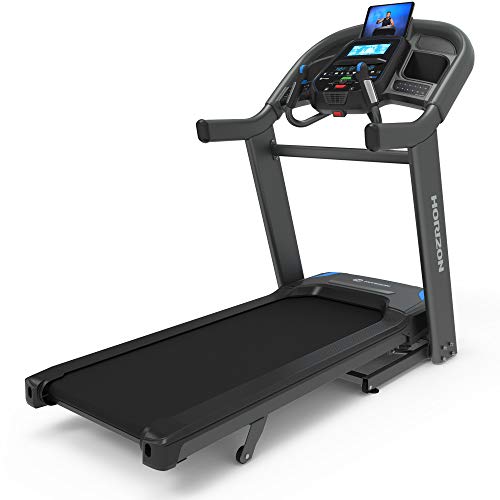
Horizon Fitness 7.4 AT
QuickDial controls sit on the handlebars, so speed and incline change mid-stride without menu hunting. Motor response is quick enough that a 30 second surge reaches target pace early rather than late. Belt width stops at 20 inches, narrower than the Commercial 1750 and F80 decks.
Pros
- Handlebar dials adjust pace without breaking rhythm
- Motor ramps fast enough for short repeats
- Bluetooth speakers and a device shelf come built in
Cons
- 20 inch width feels tight during fast running
- No built-in screen, so supply your own tablet

ProForm Carbon T10
Full 60 inch belt length survives the cost cutting, while motor output drops to 3.0 CHP. Gradient reaches 12 percent, and a 10 inch touchscreen drives guided sessions. Sustained tempo work asks more of this motor than of the 3.5 CHP machines ranked above it.
Pros
- Keeps a 60 inch running surface at lower outlay
- Touchscreen guided sessions built into the console
- SpaceSaver frame folds upright with assisted lift
Cons
- 3.0 CHP is the smallest motor among the running picks
- Class content needs a subscription to unlock

Bowflex Treadmill 10
Gradient swings from minus 5 to 15 percent, the widest span here, covering hill repeats and downhill conditioning on one deck. Hardware numbers lead the group as well, with 4.0 CHP and a 400 pound frame rating. Owner feedback splits on console software rather than the machine underneath it.
Pros
- Widest incline and decline range of the seven
- 4.0 CHP motor paired with 400 pound capacity
- Comfort Tech cushioning runs the length of the belt
Cons
- Console software draws mixed owner reports
- Considerable weight, so settle placement before assembly

XTERRA Fitness TRX3500
XTERRA puts the budget into running parts: a 60 inch belt and a 350 pound frame rating. Preset programs replace streaming classes, and nothing on the console asks for a monthly fee. A 3.0 horsepower motor handles steady miles, though daily sprint work sits outside its comfort zone.
Pros
- Full 60 inch belt without a premium outlay
- 350 pound rating beats several dearer machines
- Built-in programs run with no subscription
Cons
- Small LCD console with basic readouts
- Motor noise climbs noticeably past 8 mph

Echelon Stride
Folded height drops to roughly 10 inches, low enough to slide under a bed. Belt runs 55 inches, five short of the rest, and taller runners notice that above 8 mph. Treat it as a walking and easy-run machine that stores away, not a tempo session platform.
Pros
- Folds flat for storage under furniture
- Lightest frame here to wheel between rooms
- Transport wheels built into the base
Cons
- 55 inch belt shortens a fast stride
- 1.75 CHP motor is underpowered for daily hard running
Before you buy
What to check before buying a treadmill for running Belt length leads every other decision. Running wants 60 inches minimum, and anyone over 6 feet should treat that number as a floor. Motor ratings come next, quoted as continuous horsepower: 3.0 CHP covers steady miles, while 3.5 CHP and above absorbs daily hard sessions. Peak horsepower describes a brief burst and tells you nothing useful. Frame weight ratings work as a proxy for build quality, since higher limits arrive with thicker steel and larger rollers.
How much deck cushioning does a runner actually want? Cushioning reduces the load your knees absorb on landing. Push it too far and the surface feels unstable, which quietly alters your gait. Sole and NordicTrack both damp impact while leaving a firm push-off, the balance most runners settle on. Softer decks also run quieter, a real factor with neighbours below. Anyone training for a road race should lean firm, because tarmac gives nothing back and the deck should reflect that.
Incline, decline and hill training Climbing to 12 or 15 percent covers almost any hill session. Decline is rarer and more useful than its reputation suggests, since downhill running loads the quads eccentrically and shows up as soreness after hilly races. Commercial 1750 reaches minus 3 percent and Treadmill 10 reaches minus 5, the only two here offering it. Skip decline when your races are flat, and spend that budget on belt width instead. Walking at incline also raises effort without the pounding, which suits runners returning from injury.
Best treadmills for small flats and shared floors Folding designs trade running quality for floor space, and the gap between types is wide. Echelon Stride folds to about 10 inches and disappears under a bed, paying for it with a 55 inch belt and a 1.75 CHP motor. Sole F80 and ProForm Carbon T10 fold upright instead, keeping full decks while clearing walking room. Measure ceiling height first, because a 12 percent incline plus your standing height eats more headroom than people expect. Downstairs neighbours make the Whisper Deck on the F80 worth more than any console feature.
How they stack up
| # | Model | Motor | Best for | Score | Price |
|---|---|---|---|---|---|
| 1 | NordicTrack Commercial 1750 | 3.5 CHP | Best overall | 9.4 | Check price |
| 2 | Sole F80 | 3.5 CHP | Best for heavy weekly mileage | 9.2 | Check price |
| 3 | Horizon Fitness 7.4 AT | 3.5 CHP | Best for interval training | 9.0 | Check price |
| 4 | ProForm Carbon T10 | 3.0 CHP | Best value | 8.8 | Check price |
| 5 | Bowflex Treadmill 10 | 4.0 CHP | Best for incline and decline work | 8.6 | Check price |
| 6 | XTERRA Fitness TRX3500 | 3.0 HP | Best budget for regular running | 8.3 | Check price |
| 7 | Echelon Stride | 1.75 CHP | Best folding treadmill for small flats | 8.0 | Check price |
Questions worth asking
What motor size do I need for running on a treadmill?
Look for 3.0 continuous horsepower for steady running and 3.5 CHP or higher for daily hard sessions. NordicTrack, Sole and Horizon all fit 3.5 CHP motors, and Bowflex Treadmill 10 goes to 4.0 CHP.
How long should a treadmill belt be for running?
Sixty inches at least. Shorter decks force a clipped stride once speed rises. Runners over 6 feet should also want 22 inch width, as fitted to the Commercial 1750, Sole F80 and Bowflex Treadmill 10.
Is a folding treadmill good enough for running?
Some are. Sole F80 and ProForm Carbon T10 fold upright and keep full 60 inch decks. Flat-folding machines like the Echelon Stride shorten the belt and cut motor power to hit that storage height.
Which treadmill is best for interval training?
Horizon Fitness 7.4 AT. QuickDial handlebar controls change pace without menu navigation, and the motor reaches target speed early enough that a 30 second repeat is spent at pace, not accelerating.
Do I need a treadmill with decline?
Only when you race on hills. Downhill running loads the quads eccentrically, a stress flat running never applies. Commercial 1750 goes to minus 3 percent and Treadmill 10 to minus 5.
Are treadmill subscriptions required to use the machine?
No. NordicTrack and ProForm machines run manually without one, losing only the guided content. Sole, Horizon and XTERRA ship preset programs on the console with no membership attached.
How much space does a running treadmill need?
Allow the machine footprint plus roughly 3 feet of clear run-off behind it. Ceiling height counts too, since a 12 percent incline lifts your head position by several inches.
What weight limit should I look for on a treadmill?
Read the rating as a build-quality signal rather than a hard ceiling. Sole F80 states 375 pounds and Bowflex Treadmill 10 states 400, numbers that come with heavier frames and larger rollers.
NordicTrack Commercial 1750 vs Sole F80: which should I buy?
Both use 3.5 CHP motors and 22 by 60 inch belts. NordicTrack adds decline and a pivoting touchscreen; Sole adds 75 pounds of frame rating and a quieter deck. Screen features or durability decides it.
Can you run on a treadmill in an apartment without disturbing neighbours?
Yes, with care. Quieter decks such as the Whisper Deck on the F80 help most, and a rubber mat under the frame cuts transmitted vibration. Keep hard sessions out of early mornings.
Our pick
NordicTrack Commercial 1750 takes the recommendation, since one machine delivers a 22 by 60 inch belt, decline to minus 3 percent and a 3.5 CHP motor. Runners logging heavy weekly mileage, or anyone near that 300 pound limit, get longer service from the Sole F80 and its 375 pound frame. Choose the Echelon Stride only when storage space decides the purchase, then plan easy runs on it rather than tempo work.
Derek Holt
Derek has a background coaching recreational and amateur athletes and has worked the sales floor at specialty fitness retailers. He focuses on equipment durability, ergonomics and realistic use cases rather than marketing claims.


