Tire Repair Kits: Plug Kits Compared Against Sealants
Boulder Tools Heavy Duty takes the top spot overall thanks to solid T-handle tools and a complete case. ARB Speedy Seal is built for overland and off-road travel. Slime 1034-A suits drivers who want the simplest possible roadside fix with no technique required.
Boulder Tools Heavy Duty is the safest single kit for a trunk, ARB Speedy Seal earns its place on serious off-road trips, and Slime 1034-A covers drivers who want the least complicated fix available.
Comparing these kits gets tricky because cheap and good versions list the same parts on paper, and the difference only shows up when a reamer meets steel-belted tread at the roadside. We compared tool construction, plug materials, handle design and case organization. Recurring failure points that owners report carried real weight, and the final ranking reflects performance under the awkward conditions where these kits actually get used.
What matters most
Plug kits and sealants solve different problems A plug kit physically fills the puncture and can hold for the tire’s remaining tread life when installed properly. Sealant from a bottle coats the inside of the tire instead, sealing small holes as air escapes faster but often complicating a later professional repair and fouling pressure sensors. Anyone willing to spend ten minutes at the roadside should choose plugs. Drivers wanting the least involvement possible reach for sealant instead.
Tool quality separates good kits from bad ones Every kit contains a reamer, an insertion tool and plugs, so the real difference sits in whether handles transmit force without flexing or twisting off. Steel shafts bonded into moulded T-handles hold up under pressure. Thin rods pressed into hollow plastic handles are where cheap kits fail, usually mid-repair. Check handle construction before counting plugs, since more plugs never fix a broken handle at the roadside.
Which punctures a plug can safely repair Plugs suit punctures in the tread area, roughly up to six millimetres across. Sidewall or shoulder damage should never get plugged, since those areas flex constantly and no plug holds there. A tire that ran flat for any distance may already have internal damage even when the puncture looks simple. Treat a plug as a way to reach a tire shop when in doubt, not as a final repair.
Air still matters after the plug goes in Sealing the hole does nothing about pressure already lost, so a kit without an inflator strands a driver almost as effectively as no kit at all. Storing a small twelve volt compressor beside the repair kit turns it into a complete roadside solution. Test it occasionally, since compressors left in a trunk for years sometimes fail on first use.
The shortlist, ranked

Boulder Tools Heavy Duty Tire Repair Kit
Tool quality, not plug count, is why this kit ranks first. Thick T-handles with a real grip push a reamer through tread without flexing or punishing a palm. Case layout stays clear even in poor light. Owners report it handles truck and SUV tires that defeat lighter kits.
Pros
- Handles do not flex under real force
- Enough plugs for multiple repairs
- Clear case layout for roadside work
Cons
- Bulkier than compact kits
- No inflator included
ARB Speedy Seal Tire Repair Kit
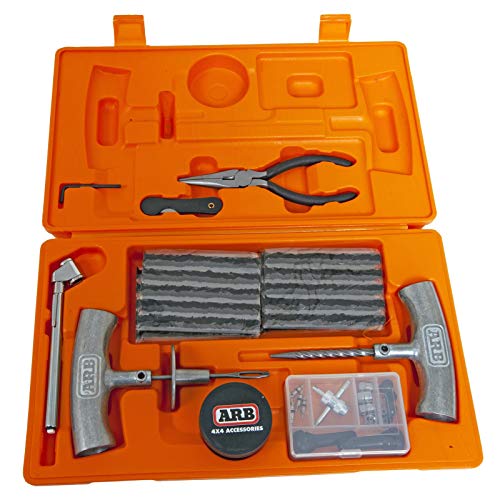
ARB designed this for punctures far from help, pairing durable tools with a case built to survive years of rattling around a vehicle. Valve tools and spare valve cores ship inside, extras that matter once you are in the field. Specifications point toward larger off-road tires rather than compact car rubber.
Pros
- Built for remote repairs
- Includes valve servicing tools
- Case survives long-term vehicle storage
Cons
- More kit than most road drivers need
- Priced above basic plug kits

Slime 1034-A Flat Tire Puncture Repair Kit
Slime keeps things deliberately basic, useful for drivers who never want to learn plug technique under pressure. Standard reamer and plug steps come with clear instructions. Tools weigh less than heavy-duty kits, so expect more effort on stiff truck tread, and treat this as a car and small SUV solution.
Pros
- Very easy for first-time users
- Compact enough for a glovebox
- Low cost for basic coverage
Cons
- Lighter handles strain on thick tread
- Limited plug supply

Tooluxe 50002 Universal Tire Repair Kit
A large piece count fits inside a compact case, including spare plugs, valve tools and lubricant. Drivers covering cars, motorcycles and trailers get one kit instead of several separate sets. Tool quality lands as decent rather than exceptional, so steady technique matters more than brute force here.
Pros
- Covers several vehicle types
- Generous accessory selection
- Stores easily under a seat
Cons
- Handles less robust than premium kits
- Case latches feel light

Dynaplug Micro Pro Tubeless Tire Repair Kit
A pointed metal-tipped plug pushes straight in without reaming, which makes single-handed roadside repairs realistic. This suits tubeless bicycle and motorcycle tires, where a heavy T-handle kit becomes impractical to use. Refill cartridges cost more than standard strips, marking this as a specialist tool rather than a general choice.
Pros
- Extremely fast repairs
- Works one handed at the roadside
- Small enough for a jersey pocket or tank bag
Cons
- Refills cost more than strip plugs
- Not designed for large car punctures

Safety Seal Tire Repair Kit
Professional shops favor Safety Seal plugs because the cord and rubber construction seals reliably and resists working loose over time. Straightforward tools accompany the kit, with most of the value sitting in the consumables. Drivers wanting a repair that stays sealed for the tire’s remaining life should look here first.
Pros
- Plugs seal reliably long term
- Trusted in professional use
- Refill packs easy to source
Cons
- Basic tool handles
- Case is plain and unstructured

Stop and Go 1075 Pocket Tire Plugger
Mushroom-style plugs insert from a compact tool here, suiting motorcycle riders and anyone with very limited storage space. Versatility drops compared with a strip plug kit, and results depend on staying within the tire sizes it was designed around. Owners describe it as a reliable get-home fix rather than a permanent repair.
Pros
- Takes almost no storage space
- Quick to deploy
- Good match for motorcycle use
Cons
- Less versatile than strip plug kits
- Proprietary plug refills needed
How they stack up
| # | Model | Tools | Best for | Score | Price |
|---|---|---|---|---|---|
| 1 | Boulder Tools Heavy Duty Tire Repair Kit | Heavy T-handle reamer and insertion tool | Best overall | 9.4 | Check price |
| 2 | ARB Speedy Seal Tire Repair Kit | Overland and off-road focused | Best for off-road | 9.2 | Check price |
| 3 | Slime 1034-A Flat Tire Puncture Repair Kit | Reamer and plug insertion tool | Best budget | 9.0 | Check price |
| 4 | Tooluxe 50002 Universal Tire Repair Kit | Large multi-piece kit | Best value | 8.8 | Check price |
| 5 | Dynaplug Micro Pro Tubeless Tire Repair Kit | Pointed plug, no reaming | Best for cyclists and motorcycles | 8.6 | Check price |
| 6 | Safety Seal Tire Repair Kit | Cord reinforced rubber inserts | Best plug material | 8.3 | Check price |
| 7 | Stop and Go 1075 Pocket Tire Plugger | Mushroom plug insertion | Best compact kit | 8.0 | Check price |
Common questions
How long does a tire plug actually last?
A correctly installed plug in the tread area can last the remaining life of the tire, and many shops treat this as standard practice. Still, a plug counts as an outside repair. A tire shop patch applied from the inside is the more thorough fix and is worth doing when convenient.
Can I plug a sidewall puncture myself?
No. Sidewalls flex constantly and a plug will not hold there. A sidewall puncture means the tire needs replacing, and the same rule applies near the shoulder where tread curves into the sidewall.
Do I need to remove the tire from the wheel to plug it?
No. Plug kits work with the tire still mounted on the vehicle, which is their main advantage over patch repairs that require dismounting the tire entirely.
Is tire sealant bad for the tire itself?
It is not damaging on its own, but it can complicate later repairs, and some formulations interfere with tire pressure monitoring sensors. Tell the tire shop if sealant was used, so they can clean the interior before patching.
What size puncture is safe to repair?
Punctures up to roughly six millimetres in the tread area are generally considered repairable. Larger holes, cuts and anything irregular in shape need professional assessment and usually a new tire.
Do I still need an air compressor after plugging?
Yes, unless a spare tire is carried instead. The plug seals the hole, but the tire stays flat until air goes back in. A compact twelve volt inflator is the natural companion purchase alongside any plug kit.
Can a car tire repair kit work on a motorcycle tire?
Sometimes, though motorcycle tires run thinner with tighter geometry. Compact plug systems built for motorcycles prove easier to use and less likely to over-ream the hole. Never plug a motorcycle sidewall under any circumstance.
How do I confirm the plug actually worked?
Reinflate the tire, then spray soapy water over the repair and watch for bubbles, which mean the seal is incomplete. Recheck pressure after a few miles and again the next day, since a slow leak often only shows up over hours.
Our pick
Boulder Tools Heavy Duty deserves a spot in most trunks, since its handles hold up when a reamer meets steel belting and the case stays organized through years of storage. ARB Speedy Seal justifies the step up for off-road and remote travel, while Slime 1034-A handles occasional urban driving fine. Store a compact inflator beside whichever kit gets chosen, since a plug without air only solves half the problem.
Tony Russo
Tony trained as an automotive technician and spent years in service and parts retail before moving into writing. He focuses on garage tools, car care products and accessories from a hands-on maintenance perspective.