Which Tire Pressure Gauge Reads the Most Accurately
JACO ElitePro leads on stated accuracy and a rubber boot that protects calibration. AstroAI’s backlit digital gauge suits routine checks at a lower cost. Milton’s S-921 pencil gauge needs no battery, making it a smart glovebox backup. Together these three cover precision, convenience and reliability.
A cheap gauge reading three psi high hides underinflation until a tire wears unevenly or grip fades in the wet. JACO’s ElitePro corrects for that with a tight accuracy claim, a swivel chuck and a rubber boot that keeps the dial aligned after drops. AstroAI’s digital gauge covers everyday checks at a friendlier cost, and Milton’s pencil gauge rides in the glovebox because it never needs a battery.
Gauge shopping looks simple until two units disagree by several psi on the same valve stem. We compared stated accuracy tolerances, chuck and hose designs, display type and lighting, plus what owners report about drift after repeated drops. Pressure range and build material factored in too, since a gauge rated only for passenger cars will not serve a truck or trailer.
The shortlist, ranked
JACO ElitePro Tire Pressure Gauge
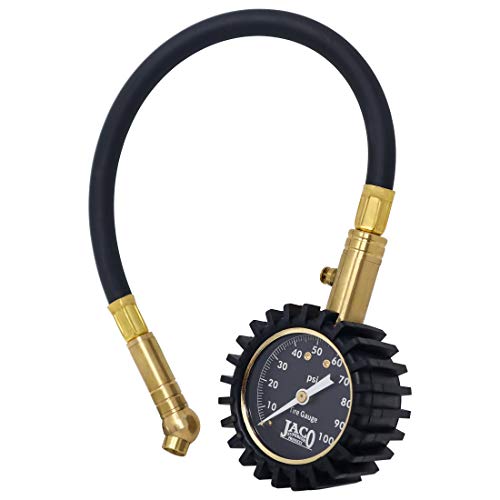
JACO states a tight accuracy tolerance on this mechanical dial gauge, then protects that calibration with a thick rubber boot. A 360 degree swivel chuck seats squarely on recessed valve stems found on many alloy wheels. Careful owners keep this in a toolbox because readings stay repeatable across attempts, according to the listing.
Pros
- Readings repeat closely across attempts
- Swivel chuck reaches recessed valve stems
- Rubber boot shields the dial from knocks
Cons
- Larger and heavier than pocket gauges
- No backlight for checks after dark
AstroAI Digital Tire Pressure Gauge
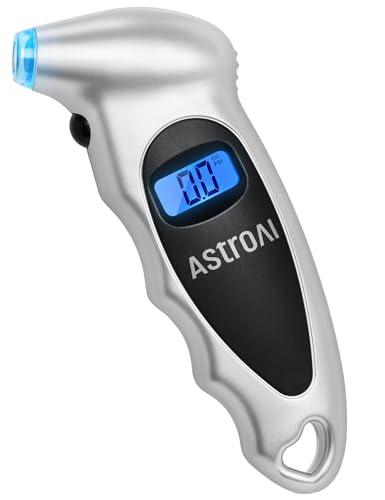
AstroAI packs a backlit LCD, a lit nozzle and four selectable pressure units into a compact digital body. Finding the valve stem in a dark driveway becomes easy with the illuminated tip. Owners report consistent readings trip after trip, though the plastic housing will not survive the drops a boot protected dial gauge shrugs off.
Pros
- Lit nozzle simplifies checks in low light
- Switches between four pressure units
- Priced well for a digital gauge
Cons
- Plastic body dents or cracks if dropped
- Battery will eventually need replacing

Accutire MS-4021B Digital Tire Gauge
Accutire angles its display toward the user while the chuck stays seated on the valve. Crouching beside a wheel arch to read a straight faced gauge becomes unnecessary. A rubberised grip stays comfortable even in cold weather, and the one button design has kept this model popular for years.
Pros
- Angled head stays readable mid measurement
- Rubberised grip works well in cold weather
- Single button keeps operation simple
Cons
- Pressure range suits cars, not trucks
- Nozzle has no backlight

Rhino USA Heavy Duty Tire Pressure Gauge
Rhino USA pairs a braided hose with a bleed valve, letting drivers release air in controlled amounts rather than guessing. Trail drivers who air down for sand or rock crawling depend on that control. A large glow in the dark dial adds visibility, though the extra hose and housing add bulk compared with a pocket gauge.
Pros
- Bleed valve airs down tires precisely
- Braided hose reaches dual rear wheels easily
- Large dial reads clearly outdoors
Cons
- Too bulky to carry in a glovebox
- More gauge than daily commuting needs

TEKTON 5941 Digital Tire Gauge
TEKTON fits a large backlit display and a lit tip onto a straightforward digital gauge. Numbers stay legible without reading glasses, and the reading holds on screen long enough to jot down. Auto shutoff conserves the battery, though the plastic housing feels lighter than metal bodied alternatives.
Pros
- Large display reads at a glance
- Hold function keeps the number visible
- Auto shutoff extends battery life
Cons
- Housing feels light compared with metal gauges
- Offers fewer unit options than rivals

Milton S-921 Pencil Tire Gauge
Milton’s pencil gauge skips batteries entirely, so it works whenever it is picked up, even after years in a glovebox. Trade mechanics have relied on this metal bodied design for decades. Reading the sliding scale takes a steadier eye than a digital display, and precision trails dial and digital gauges, but it never goes dead.
Pros
- Never needs a battery to work
- Metal body resists years of glovebox abuse
- Costs little enough to keep in every car
Cons
- Sliding scale is less precise than digital
- Scale is hard to read in dim light

Slime 20017 Digital Tire Gauge
Slime keeps this digital gauge pocket sized and priced for casual use. A backlit display covers ordinary passenger car pressures for monthly checks. Tolerance runs wider than the professional gauges in this lineup, so a surprising reading is worth double checking on a second gauge.
Pros
- Lowest cost digital gauge in this lineup
- Small enough for any door pocket
- Backlit display suits quick monthly checks
Cons
- Wider accuracy tolerance than premium gauges
- Build feels light compared with rivals
Side by side
| # | Model | Type | Best for | Score | Price |
|---|---|---|---|---|---|
| 1 | JACO ElitePro Tire Pressure Gauge | Mechanical dial | Best overall | 9.4 | Check price |
| 2 | AstroAI Digital Tire Pressure Gauge | Digital | Best value | 9.2 | Check price |
| 3 | Accutire MS-4021B Digital Tire Gauge | Digital | Best for ease of use | 9.0 | Check price |
| 4 | Rhino USA Heavy Duty Tire Pressure Gauge | Mechanical dial with bleed valve | Best for trucks and off road | 8.8 | Check price |
| 5 | TEKTON 5941 Digital Tire Gauge | Digital | Best display clarity | 8.6 | Check price |
| 6 | Milton S-921 Pencil Tire Gauge | Pencil stick gauge | Best glovebox backup | 8.3 | Check price |
| 7 | Slime 20017 Digital Tire Gauge | Digital | Best budget digital | 8.0 | Check price |
How to choose
What tire pressure gauge accuracy actually means Manufacturers state accuracy as either a percentage of the reading or a fixed psi figure. A gauge accurate to one percent behaves very differently from one accurate to three psi at typical passenger pressures. Small errors compound over time, since underinflation wears tread unevenly at the shoulders and stretches braking distance in wet weather. Treat a gauge with no stated tolerance as unreliable by default.
Digital vs dial vs pencil gauges Digital gauges display numbers plainly and stay accurate until the battery fails or the unit gets dropped. Dial gauges work mechanically, hold calibration well inside a protective boot, and remain standard equipment in many workshops. Pencil gauges sacrifice precision for a design that needs no power source and survives decades of glovebox storage. Many drivers keep one dial gauge at home and a pencil gauge in each vehicle.
How chuck design affects a clean seal Inconsistent readings usually trace back to a chuck that never seated squarely on the valve stem. Air escapes during the reading, and the number drops before you can note it. A swivel or angled chuck reaches recessed valves on alloy wheels far more reliably than a straight one. Press the chuck on firmly in a single motion, and reseat it if hissing continues instead of trusting that reading.
When to check pressure and which number to trust Tires heat up as they roll, so pressure readings climb within a few minutes of driving. Check pressure cold, meaning before the vehicle moves or after it has sat for at least three hours. Use the figure printed on the driver’s door jamb placard rather than the maximum psi molded into the tire sidewall, which is a load limit rather than a recommendation. Recheck monthly, since tires lose pressure gradually even without a leak.
Common questions
How accurate does a tire pressure gauge need to be?
Quality gauges typically state accuracy within one to two percent of the reading, which keeps errors under half a psi at normal pressures. Cheaper gauges can run several psi off and drift further after a drop. Comparing two gauges against each other on the same valve is a quick way to catch a bad reading.
Which tire pressure gauge is most accurate?
Mechanical dial gauges with a protective boot, like JACO’s ElitePro, tend to hold calibration longest because impacts do not shift internal components as easily. Quality digital gauges come close when new but can drift once dropped. No gauge stays accurate forever, so periodic comparison against a second gauge is worth doing.
Should I trust the pressure number on my tire’s sidewall?
No. That number is the maximum pressure the tire can safely hold, not the pressure your vehicle needs. Use the figure on the driver’s door jamb placard or in the owner’s manual instead, since it accounts for the vehicle’s weight and suspension.
How often should tire pressure be checked?
Monthly checks catch the gradual pressure loss that happens naturally through the rubber. Check again before long trips and whenever outdoor temperature swings sharply, since cold air lowers indicated pressure measurably.
Is a digital tire gauge better than a dial gauge?
Digital gauges are easier to read at a glance and stay accurate while the battery lasts. Dial gauges tend to hold calibration longer in a working environment when protected by a rubber boot. Either type beats an old gauge of unknown history sitting loose in a trunk.
Do I still need a gauge if my car has tire pressure monitoring?
Yes. Factory monitoring systems usually warn only after pressure drops around 25 percent below target, well past the point where handling and tread wear suffer. A gauge lets you correct pressure before the warning light ever appears.
Why does my tire gauge give a different reading every time I check?
The chuck is most likely not seating squarely on the valve stem, letting air escape mid reading. Press straight on in one confident motion rather than repositioning partway through. Checking pressure after driving also raises the number, since heat expands the air inside.
Can I check tire pressure right after driving?
You can, but the reading will run several psi higher than the tire’s true cold pressure. Wait until the vehicle has been parked for at least three hours, or check first thing before driving, for a number worth comparing against the door placard.
What does a bleed valve do on a tire pressure gauge?
It releases air in small, controlled amounts while you watch the reading drop. Off road drivers use it to air down for sand or trail conditions, then air back up afterward. Everyday drivers rarely need it, since most checks only involve adding air at a pump.
What is the best tire pressure gauge for trucks and trailers?
Gauges with a braided hose and bleed valve, such as Rhino USA’s heavy duty model, reach dual rear wheels and let you release air precisely. A large glow in the dark dial also helps in dim garages or roadside stops.
Our take
JACO’s ElitePro earns the top spot here because its stated tolerance and rubber boot keep readings honest for years, not just out of the box. AstroAI’s digital gauge handles routine monthly checks well at a friendlier cost, and its lit nozzle helps in a dark driveway. Keep a Milton S-921 pencil gauge in each vehicle too, since it never runs out of battery when you need it most.
Tony Russo
Tony trained as an automotive technician and spent years in service and parts retail before moving into writing. He focuses on garage tools, car care products and accessories from a hands-on maintenance perspective.