Heavy Duty Tire Pressure Gauges Mechanics Actually Rely On
For mechanics who need a gauge that survives drops, grease, and constant use, the Milton S-504 Single Head Tire Gauge stands out as the top pick. It combines a solid brass body with a geared mechanism for accuracy, and it reads from 5 to 100 PSI in one pound increments. Its main limitation is the lack of a bleeder valve, which means releasing air requires pressing the tire valve core with the gauge head, an extra step.
A tire pressure gauge is a small tool that makes a big difference in a shop. A flimsy gauge can give false readings, slow you down, and break after a few weeks. Heavy duty models are built with metal cases, reinforced hoses, and precise internals to handle daily abuse.
The best heavy duty gauges for mechanics offer clear dials, reliable accuracy, and comfortable grips. Some include bleeder valves for precise pressure adjustment, while others focus on simple, tough construction. Here are seven models that stand up to real shop work.
How to choose
The best picks, ranked
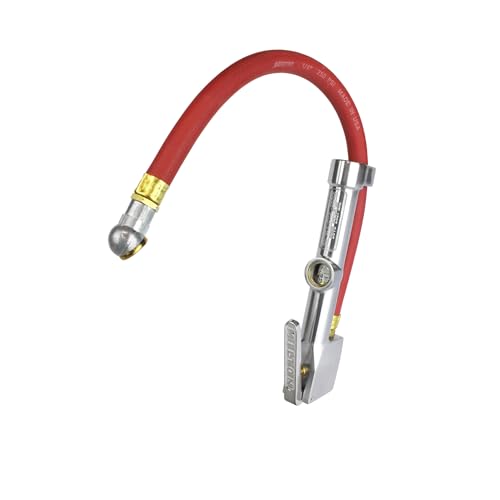
Milton S-504 Single Head Tire Gauge
The Milton S-504 is a classic analog gauge with a brass body and a geared movement that resists shock. It reads 5 to 100 PSI with a 2 inch dial and a 6 inch hose. Mechanics appreciate its solid feel and repeatable accuracy.
Pros
- Accurate and repeatable
- Durable brass construction
- Easy to read dial
Cons
- No bleeder valve
- Hose may be short for some uses

Accu-Gage 33155-2 Precision Dial Tire Gauge
Accu-Gage is known for accuracy, and this model has a 2.5 inch dial with a dual scale (PSI and kPa). It has a bleeder valve for adjusting pressure down. The case is chrome plated for corrosion resistance.
Pros
- High accuracy
- Bleeder valve for easy adjustment
- Large dial for readability
Cons
- Price is higher
- Chrome finish can scratch
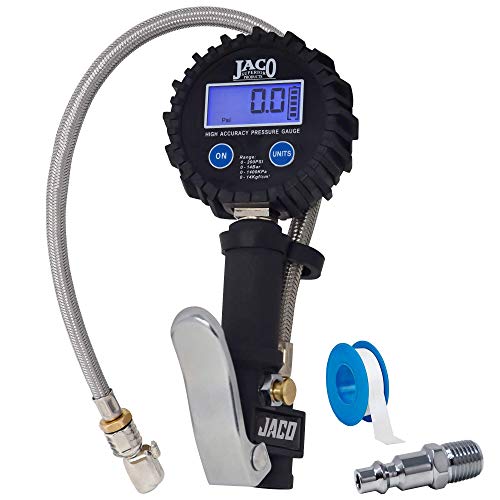
JACO FlowPro Tire Pressure Gauge
The JACO FlowPro has a 360 degree swivel head and a 14 inch hose, making it easy to reach dual wheel valves. It features a built in bleeder valve and an anti shock button. The gauge is calibrated to plus/minus 1% accuracy.
Pros
- Swivel head for awkward angles
- Long hose for dual wheels
- Bleeder valve included
Cons
- Slightly bulky
- Plastic housing on head

Tire Gauge by Slime 70045 Heavy Duty
Slime’s heavy duty gauge offers a solid metal case and a 2 inch dial at a very accessible price. It has a range of 5 to 100 PSI and a simple push on chuck. While not as refined as pricier models, it performs reliably for basic shop tasks.
Pros
- Low cost
- Durable metal case
- Simple to use
Cons
- Less accurate than premium
- No bleeder valve
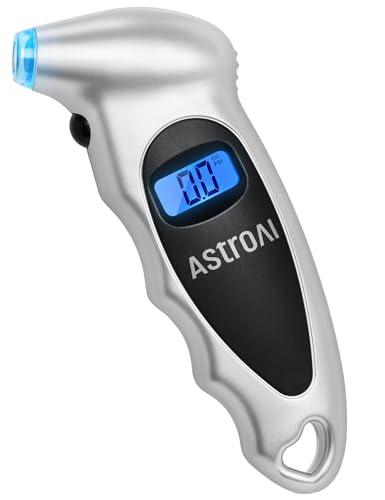
AstroAI Digital Tire Pressure Gauge
For mechanics who prefer a digital readout, the AstroAI offers a backlit LCD and measures up to 150 PSI. It has a 90 degree angled head and a rubberized grip. The unit auto powers off to save battery.
Pros
- Easy to read digital display
- Measures up to 150 PSI
- Angled head for valve access
Cons
- Requires battery
- Not as rugged as analog

QuickGrip 20515 Heavy Duty Tire Gauge
QuickGrip’s gauge features a rubber armored case that protects against drops. It has a dual foot chuck for straight or angled use, and the dial reads 5 to 100 PSI. The large dial and grip make it easy to handle.
Pros
- Shock absorbing rubber guard
- Dual foot chuck versatility
- Comfortable grip
Cons
- Heavier than others
- Bleeder valve not included

K Tool International KTI-79217 Tire Pressure Gauge
This K Tool gauge is designed for professional mechanics. It has a heavy duty brass body, a 2.5 inch dial, and a bleeder valve for precise pressure setting. The chuck is angled for easy access, and the gauge is calibrated to plus/minus 1%.
Pros
- Precision bleeder valve
- Angled chuck
- Brass construction
Cons
- Higher price point
- No hose attached
Compared at a glance
| # | Model | Range | Best for | Score | Price |
|---|---|---|---|---|---|
| 1 | Milton S-504 Single Head Tire Gauge | 5-100 PSI | Best overall for shop durability | 9.4 | Check price |
| 2 | Accu-Gage 33155-2 Precision Dial Tire Gauge | 5-100 PSI | Best for precise readings | 9.1 | Check price |
| 3 | JACO FlowPro Tire Pressure Gauge | 5-100 PSI | Best with angled head | 9.0 | Check price |
| 4 | Tire Gauge by Slime 70045 Heavy Duty | 5-100 PSI | Best budget pick | 8.6 | Check price |
| 5 | AstroAI Digital Tire Pressure Gauge | 0-150 PSI | Best digital option | 8.8 | Check price |
| 6 | QuickGrip 20515 Heavy Duty Tire Gauge | 5-100 PSI | Best with rubber guard | 8.4 | Check price |
| 7 | K Tool International KTI-79217 Tire Pressure Gauge | 5-100 PSI | Best with bleeder valve | 8.9 | Check price |
Frequently asked questions
What is the most accurate type of tire pressure gauge?
Generally, digital gauges offer the highest accuracy, often within 0.5 to 1 PSI. However, high quality analog gauges with geared movements can be equally accurate if properly calibrated. For shop use, both types can serve well.
How often should I calibrate my tire pressure gauge?
It depends on usage. For daily shop use, check calibration every few months against a master gauge. Dropping a gauge can affect its accuracy, so test after any impact. If readings seem off, replace or recalibrate.
Can I use a truck tire gauge for car tires?
Yes, but be aware of the pressure range. A gauge designed for truck tires may have a higher maximum pressure, which can reduce resolution for lower car pressures. For best accuracy, choose a gauge with a range that matches your typical tire pressures.
What does a bleeder valve do?
A bleeder valve allows you to release air from the tire while the gauge is attached. This lets you fine tune the pressure to the exact desired PSI without repeatedly removing and reattaching the gauge.
Are digital gauges as durable as analog ones?
Typically, analog gauges are more durable because they have fewer delicate electronic components. They are less likely to break when dropped. However, some digital gauges are built with rugged cases and can survive shop conditions.
What is the ideal PSI range for a mechanic’s gauge?
Most passenger car tires require 30 to 35 PSI, but trucks and trailers may need up to 80 PSI or more. A gauge that reads 5 to 100 PSI covers most shop needs. For heavy commercial trucks, a 0 to 150 PSI gauge is better.
Why do some gauges have a hose and others do not?
A hose provides flexibility and allows you to reach valves that are recessed or at awkward angles. It also keeps the gauge away from the hot tire. Gauges without hoses are often more compact and may be more accurate because they have a direct reading mechanism.
How do I know if my gauge is reading incorrectly?
Compare your gauge to a known accurate digital gauge or a master gauge. If there is a consistent difference, your gauge may be off. Also, check for physical damage like a bent stem or cracked dial, which can affect accuracy.
Our take
For most mechanics, the Milton S-504 is the best all around heavy duty gauge because it offers a proven track record of durability and accuracy at a reasonable price. If you frequently need to adjust pressure precisely, consider the K Tool International KTI-79217 with its bleeder valve. Digital fans should get the AstroAI, but keep a backup analog for rough days.
Tony Russo
Tony trained as an automotive technician and spent years in service and parts retail before moving into writing. He focuses on garage tools, car care products and accessories from a hands-on maintenance perspective.
