Which Thumbtacks Hold Best on Cork and Fabric?
Officemate Giant Push Pins top the ranking for cork, pairing a long steel point with a half inch head that pulls out cleanly. Amazon Basics Push Pins cover classroom boards in bulk tubs. Officemate Steel Thumb Tacks sit flattest under posters and wall maps.
Officemate Giant Push Pins handle most cork boards. Long steel points reach through layered handouts, and the oversized head gives fingers something to grab on the way out. Looks are the tradeoff, since plain plastic heads read as office supply. Decorating a bedroom board instead? U Brands coordinates its colours with fabric and linen panels.
Pins feel like a trivial purchase until a poster peels off overnight and creases at the corner. Board material, paper thickness and re-pinning frequency all change what actually holds. We compared listed point lengths, head diameters, head materials and pack counts, then weighed recurring owner reports about bent points, cracked plastic and tacks pulling free under weight.
What matters most
What separates a good push pin from a bad one Three things decide it: point length, head grip and steel quality. Points under a quarter inch handle soft cork with a single sheet and little else. Laminated schedules or stacked handouts want closer to three eighths. Grip matters as much as holding power, because a pin you cannot remove gets levered sideways and bent. Cheap steel announces itself by the second or third use, when the point curls instead of sliding straight back in. Heads are the other failure point, and moulded plastic cracks long before steel bends.
Matching point length to your board Standard cork tiles run about a quarter inch thick, and most office pins were designed around exactly that. Self healing cork and dense fibreboard backing swallow more of the point. Foam core feels soft and forgiving at first, then crumbles after repeated pinning in one spot. Count every layer for stacked material: four pages plus a laminate sleeve can consume most of a short tack before the steel ever reaches cork. When in doubt, buy the longer point, since excess length costs nothing on a thick board.
Push pins for classrooms and shared offices Volume and visibility drive these picks. Bulk tubs like the Amazon Basics set keep a supply drawer stocked through a school year. Giant heads help in shared spaces because anyone can pull them free without a fingernail or a tack lifter. Colour coding earns its keep on rota and duty boards, and single colour packs from JAM Paper make that system easy to maintain month after month. Keep a small dish or a magnet nearby too, because loose pins on a classroom floor are the real hazard, not the board itself.
Drywall, fabric panels and other awkward surfaces Bare drywall accepts a pin but holds almost nothing, and every hole crumbles a little wider. Anything heavier than one sheet belongs on a hook. Fabric cubicle panels normally hide a fibreboard core, so longer steel is essential to reach past the weave. Painted wood trim resists most pins outright and needs a hammer driven tack. On plaster or brick, stop pinning altogether: adhesive strips do less damage and carry far more weight. Renters checking a deposit clause should note that pin holes in drywall usually count as repairable, unlike anchor holes.
The shortlist, ranked

Officemate Giant Push Pins, 100 Count
Heads span roughly half an inch, which gives dry fingers real leverage against dense cork. Steel points run about three eighths of an inch, enough to pass through several stapled sheets and still anchor behind them. Assorted colours let one tub serve two or three projects without a second purchase.
Pros
- Half inch head pulls out without a fingernail
- Point reaches cork through layered handouts
- Colour mix sorts projects at a glance
Cons
- Utility styling looks wrong on a decor board
- Heads can crack if pried with pliers

Amazon Basics Push Pins, 100-Pack
Round heads measure close to a quarter inch, a size most thumbs push without complaint. Steel points anchor cleanly in cork tiles and foam board backing. Packing is a lidded tub rather than a paper box, which survives a shared supply closet far longer.
Pros
- One tub stocks a full classroom board
- Lid keeps loose pins off the floor
- Quarter inch head suits daily re-pinning
Cons
- Head offers less grip than giant style pins
- Colour mix leans heavily on primaries

Officemate Steel Thumb Tacks, 100 Count
Flat steel heads sit nearly flush, keeping a poster tight instead of tenting around every pin. With no plastic anywhere, nothing snaps when a tack comes out under pressure. Points are short by design, matched to soft cork and bulletin backing rather than thick stacks.
Pros
- Flush head holds paper flat to the board
- All metal build survives repeated removal
- Small footprint frees space on crowded boards
Cons
- Removal needs a fingernail or a tack lifter
- Short point cannot reach through layered paper

U Brands Fashion Push Pins
Head colours are drawn from the U Brands cork, linen and fabric board range rather than an office palette. Low profile heads sit close to the surface, so photo corners stay down instead of curling. Counts run below classroom tubs, which shows once you cover a whole wall.
Pros
- Colours match linen and fabric board ranges
- Low heads keep photo corners flat
- Points cope with fabric covered panels
Cons
- Smaller counts than classroom tubs
- Low profile is harder to grip than giant pins

Mr. Pen Clear Push Pins
Clear heads all but vanish against pale prints, leaving attention on the artwork rather than a grid of coloured dots. Steel points slide through matte photo paper without tearing an obvious hole. Invisibility cuts both ways, since a dropped pin disappears into carpet too.
Pros
- Reads as invisible against light prints
- Leaves a clean entry hole in photo paper
- Neutral look suits mood and vision boards
Cons
- Dropped pins are genuinely hard to find
- Heads cloud and scuff after repeated handling

MyLifeUNIT Map Tacks
Bead heads sit near an eighth of an inch, small enough to mark one city without covering its neighbours. Points are short, sized for the thin cork backing behind a framed map. Several colours let you code routes, sales territories or places already visited.
Pros
- Eighth inch head marks a precise location
- Colour coding suits trips and territories
- Low bead clears frame glass
Cons
- Tiny head is awkward with cold fingers
- Short point will not hold documents
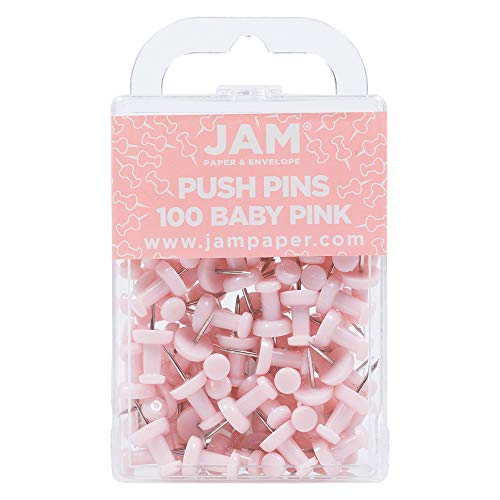
JAM Paper Colorful Push Pins
Every pack arrives in a single solid colour, which is exactly the point when each team, deadline or family member gets a dedicated shade. Heads use the familiar round office profile, so nothing about pushing them feels unusual. Two or three packs build a working colour system without hand sorting an assorted tub.
Pros
- Single colour packs skip the sorting step
- Familiar round head needs no adjustment
- Restocking one shade is straightforward
Cons
- A lone pack gives you no variety at all
- Head size is standard rather than oversized
How they compare
| # | Model | Head material | Best for | Score | Price |
|---|---|---|---|---|---|
| 1 | Officemate Giant Push Pins, 100 Count | Plastic | Best overall | 9.4 | Check price |
| 2 | Amazon Basics Push Pins, 100-Pack | Plastic | Best value | 9.2 | Check price |
| 3 | Officemate Steel Thumb Tacks, 100 Count | Steel | Best budget | 9.0 | Check price |
| 4 | U Brands Fashion Push Pins | Plastic | Best for decorative boards | 8.8 | Check price |
| 5 | Mr. Pen Clear Push Pins | Clear plastic | Best for photos and artwork | 8.5 | Check price |
| 6 | MyLifeUNIT Map Tacks | Round bead | Best for wall maps | 8.3 | Check price |
| 7 | JAM Paper Colorful Push Pins | Plastic | Best for colour coding | 8.0 | Check price |
Questions worth asking
What is the difference between thumbtacks and push pins?
A thumbtack carries a flat metal head on a short point and sits almost flush. Push pins use a raised plastic or metal head with a longer point. Flat tacks pull paper tighter; push pins come out far more easily.
How long should a push pin point be?
A quarter inch covers one sheet on standard cork. Three eighths is the safer pick for layered paper, laminate sleeves or dense fibreboard. Map tacks deliberately use shorter points, since they sit behind thin backing.
Can you put thumbtacks in drywall?
Yes, though only for light paper. Gypsum gives almost no grip, and every removal widens the hole. Owners report pins letting go within days once anything heavier than a poster hangs on them. Use adhesive strips or a picture hook for real weight.
Which pins work best on fabric cubicle panels?
Longer steel, every time. Fabric eats length before the core even starts, so short tacks sit proud and fall out. Giant style push pins solve both problems, since the wide head also gives leverage for removal.
Are clear push pins strong enough for photos?
For prints and photo paper, comfortably. Clear heads sit on the same steel points as coloured ones, so holding power is identical. Only visibility changes, and that cuts both ways on a carpeted floor.
How many push pins do you need for a classroom board?
A hundred count tub covers a typical board for a school year with spares left. Weekly display changes burn through more, mostly via loss rather than breakage. Keeping a second tub in the drawer avoids a mid term scramble.
Do thumbtacks damage cork boards?
Cork self heals to a point, which is why it became the standard surface. Wear shows when one spot takes hundreds of pins, or when tacks get levered sideways instead of pulled straight. Rotating pin positions across the board stretches its life noticeably.
Are metal or plastic head push pins better?
Metal survives prying and never cracks, which suits heavy daily use. Plastic offers bigger, more colourful heads and costs less to replace. Steel tacks also sit flatter, so posters stay smooth instead of tenting.
Push pins vs map tacks: which should you buy?
Map tacks win when precision beats grip, such as marking cities on a wall map. Push pins win when actual paper has to stay up. Map tack points are short by design and will not anchor a document.
How do you remove a flat thumbtack without breaking a nail?
Slide a butter knife or a credit card edge under the head and lever gently. A staple remover works on stubborn ones. Prying with pliers tends to bend the point, which is why flat tacks are best left in low traffic spots.
Our take
Officemate Giant Push Pins are the set to buy for a working cork board, since the long point holds layered paper and the wide head releases cleanly every time. Posters that must sit perfectly flat call for Officemate Steel Thumb Tacks instead, and artwork looks better under Mr. Pen Clear Push Pins where the pin should disappear. U Brands wins only where the board is decoration first and noticeboard second.
Marcus Chen
Marcus covered consumer electronics for enthusiast tech publications for six years before joining ChoiceCrest. He specializes in translating manufacturer spec sheets into plain-language buying advice, with a focus on audio, computing accessories and smart-home gear.

