How to Match a Tapestry Needle to Your Fabric Count
John James Gold Plated Tapestry Needles suit most stitchers, covering sizes 13 through 26 in one tube. DMC Tapestry Needles give dependable value for 14 count Aida, and Dritz Tapestry Needles cover general craft use on a smaller budget. Fabric count decides the right needle size.
John James Gold Plated Tapestry Needles cover sizes 13 through 26 in a single tube, handling rug canvas through fine 32 count linen. That range comes at the cost of a tube that can spill loose needles if it opens upside down in a bag. Stitchers who only work one fabric count may prefer a fixed-size pack instead.
Eye size, tip angle, and plating all affect how a needle handles thread and fabric. A rounded blunt tip slides between woven threads instead of piercing them, while a gold-plated eye resists tarnish and catches light for easier threading. We compared listed specifications and owner feedback on smoothness across cross stitch, needlepoint, and yarn projects.
The top picks, ranked
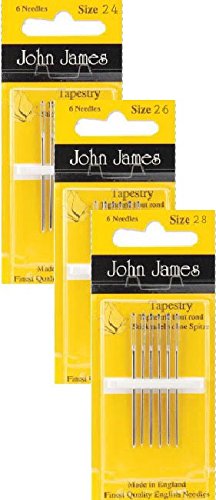
John James Gold Plated Tapestry Needles Assorted Pack
A sliding tube holds every size from 13 to 26, spanning rug canvas down to fine 32 count linen. Each needle carries a gold-plated eye alongside a rounded, blunt tip that parts woven threads instead of piercing them. Manufacturing takes place in England using nickel-plated steel with a gold flash on the eye.
Pros
- Full size range covers most fabric counts
- Gold eye resists tarnish and threads easily
- Slide tube keeps sizes sorted
Cons
- Tube can pop open if dropped
- Smallest sizes are easy to misplace

DMC Tapestry Needles Size 24 Pack of 6
Size 24 is the fixed size in this DMC pack, matched to 14 to 16 count Aida, the most common cross stitch fabric. Nickel-plated steel gives a smooth, blunt point that separates threads without splitting them. Six needles ship per pack, enough for typical kit refills.
Pros
- Matches the most common Aida counts directly
- Consistent quality between needles
- Widely stocked replacement size
Cons
- Single size only, no assortment
- Nickel eye can dull faster than gold plate

Dritz Tapestry Needles Assorted Sizes
General sewing and craft rooms are the target for this Dritz set, bundling sizes 18 to 24 in nickel-plated steel. Blunt tips suit needlepoint canvas and basic mending where thread splitting is a concern. Needles ship flat on a card rather than in a tube.
Pros
- Affordable entry point for beginners
- Covers common needlepoint canvas sizes
- Easy to find in craft stores
Cons
- No sizes below 18 for fine linen
- Flat card storage is less secure than a tube

Clover Gold Eye Tapestry Needles Size 24
Threading gets easier under weak light with this set, since Clover plates the entire eye area in gold. Size 24 needles arrive in a labeled plastic case instead of a tube. A nickel-plated steel body carries a rounded, blunt tip suited to 14 count Aida.
Pros
- Gold eye is easy to spot for threading
- Snap case protects needles in a bag
- Consistent blunt tip quality
Cons
- Single size limits use beyond 14 count
- Case holds fewer needles than a bulk pack
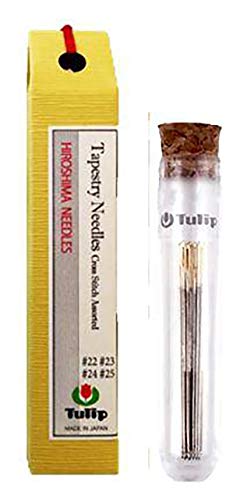
Tulip Hiroshima Tapestry Needles Size 22-26
Polished steel gives this Tulip set a smoother surface that reduces drag through tightly woven fabric. Manufacturing happens in Hiroshima, Japan, and sizes run 22 through 26 for higher count linen and silk gauze. Blunt tips still separate fibers rather than piercing them.
Pros
- Smooth surface reduces thread fraying
- Sizes suit high count linen and silk gauze
- Consistent Japanese manufacturing tolerances
Cons
- No larger sizes for canvas or yarn work
- Costs more per needle than domestic brands

Bohin Tapestry Needles Assorted Sizes 18-26
A French needle maker, Bohin plates this assortment in nickel with a slightly longer eye built for wool and crewel thread bundles. Sizes 18 to 26 cover needlepoint canvas through mid count linen. Needles ship in a resealable tube with size markings printed on the label.
Pros
- Elongated eye suits thicker wool threads
- Broad size range for canvas and linen
- Resealable tube keeps needles organized
Cons
- Nickel eye can tarnish over years of storage
- Elongated eye is oversized for single strand floss

Susan Bates Yarn and Tapestry Needle Set
Both plastic and metal needles come in this Susan Bates set, sized for worsted weight yarn rather than embroidery floss. Large eyes and blunt bent or straight tips suit plastic canvas, afghan finishing, and knit seam work. Metal needles use nickel-plated steel.
Pros
- Large eyes thread yarn without splitting plies
- Mix of plastic and metal covers more projects
- Bent tip option helps with tight seams
Cons
- Too large for cross stitch floss work
- Plastic needles can flex under tough canvas
How to choose
How Tapestry Needle Sizing Works Tapestry needle numbers run in reverse: a higher number means a thinner, shorter needle. Size 13 handles rug canvas and heavy yarn, while size 26 fits fine linen or silk gauze. Most 14 count Aida cross stitch uses a size 24 or 26 needle. Matching size to fabric count keeps threads from splitting and holes from stretching.
Matching Needle Material and Plating to Your Project Nickel-plated steel is the standard finish and resists rust in normal storage. Gold-plated eyes offer a small threading advantage, since gold reflects light differently than nickel under a lamp. Plating changes visibility and tarnish resistance, not strength. Stitchers working in dim rooms often prefer a gold eye for that reason alone.
Best Needles for Cross Stitch and Needlepoint A size 24 needle fits 14 to 16 count Aida, the range both DMC and Clover offer as a fixed size. Needlepoint canvas in 10 to 13 mesh needs a larger size 18 to 20 needle to carry thicker wool or cotton thread. Assorted packs like John James or Bohin cover both ranges without buying separate boxes. Blunt tips matter most here, since a sharp point can pierce and split canvas threads.
Choosing Needles for Plastic Canvas and Yarn Crafts Plastic canvas and afghan stitch projects use thicker yarn than embroidery floss, so a large-eyed yarn needle like the Susan Bates set fits better than a standard tapestry needle. Bent tips help reach tight corners when finishing plastic canvas edges. Plastic needles feel lighter in hand during long projects but flex more under stiff canvas. Metal yarn needles hold their shape better through repeated seaming.
How they stack up
| # | Model | Size range | Best for | Score | Price |
|---|---|---|---|---|---|
| 1 | John James Gold Plated Tapestry Needles Assorted Pack | 13 to 26 | Best overall | 9.4 | Check price |
| 2 | DMC Tapestry Needles Size 24 Pack of 6 | 24 (fixed) | Best value | 9.1 | Check price |
| 3 | Dritz Tapestry Needles Assorted Sizes | 18 to 24 | Best budget | 8.8 | Check price |
| 4 | Clover Gold Eye Tapestry Needles Size 24 | 24 (fixed) | Best for cross stitch beginners | 8.5 | Check price |
| 5 | Tulip Hiroshima Tapestry Needles Size 22-26 | 22 to 26 | Best for fine linen and silk gauze | 8.3 | Check price |
| 6 | Bohin Tapestry Needles Assorted Sizes 18-26 | 18 to 26 | Best for wool embroidery | 8.1 | Check price |
| 7 | Susan Bates Yarn and Tapestry Needle Set | Plastic and metal | Best for plastic canvas and yarn crafts | 8.0 | Check price |
Questions worth asking
What size tapestry needle should I use for cross stitch?
Size 24 fits 14 to 16 count Aida, the most common cross stitch fabric. Move up to size 26 for higher counts like 18 or 22, and down to size 22 for lower counts like 11.
How are tapestry needles different from embroidery needles?
Tapestry needles carry a blunt tip that slides between woven threads instead of piercing fabric. Embroidery needles have a sharp point built to punch through tightly woven cloth.
Can tapestry needles be used for plastic canvas?
Yes, though a large-eyed yarn needle like the Susan Bates set threads worsted yarn more easily than a fine tapestry needle. Size 13 to 16 tapestry needles work too if the eye fits the yarn.
Are gold-plated tapestry needles worth the extra cost?
Gold-plated eyes are easier to spot for threading, especially under dim light, and resist tarnish longer than plain nickel. Stitching performance matches nickel-plated needles otherwise.
Which tapestry needle is best for beginners?
A DMC or Clover size 24 needle matches the most common Aida fabric, avoiding the guesswork of a full assortment. An assorted pack like John James works too once fabric counts start to vary.
Do tapestry needles work for needlepoint?
Yes, needlepoint canvas needs a blunt tapestry needle in a larger size, typically 18 to 20, to carry wool or cotton thread through the mesh without splitting it.
John James vs DMC tapestry needles: which is better?
John James ships a full 13 to 26 size assortment in one tube, useful for stitchers working across multiple fabric counts. DMC sells a fixed size 24 pack, simpler for stitchers who only work 14 count Aida.
How many tapestry needles come in a typical pack?
Single-size packs like DMC usually include 6 needles. Assorted packs like John James or Bohin include one or two needles per size across the full range, often 14 to 26 needles total.
What is the best tapestry needle for wool embroidery?
Bohin Tapestry Needles use an elongated eye sized for wool and crewel thread bundles, spanning sizes 18 to 26 for canvas through mid count linen.
Final word
John James Gold Plated Tapestry Needles take the top spot, since one tube covers rug canvas through fine linen and removes the need for separate size packs. Stitchers who only work 14 count Aida can save a little with the DMC size 24 pack instead. Anyone doing plastic canvas or afghan finishing should skip both and choose the Susan Bates yarn needle set for its larger eye.
Jake Monroe
Jake worked as a residential contractor for over a decade before shifting to full-time writing. He evaluates power tools, hand tools and workshop gear through the lens of someone who has actually used them on job sites, not just read the box.