Which Tactical Flashlight Holds Output the Longest
Streamlight ProTac HL-X is the all round pick, running on two CR123A primaries or one 18650 and dropping unwanted modes through Ten Tap programming. Fenix PD36R Pro fits everyday carry with USB C charging. For searching open ground, Nitecore P20iX throws further.
Streamlight ProTac HL-X answers most buyers, because one body accepts CR123A primaries or a rechargeable 18650 and the tail switch runs a mode set you choose yourself. Programming it down to high only removes any chance of landing on strobe. Beam shape is the limit: output spreads wide rather than reaching far, so anyone scanning a field should pick the Nitecore P20iX.
Headline lumens describe a turbo mode that survives about two minutes before thermal stepdown, which is why two lights quoting the same number behave nothing alike. We compared sustained output, candela figures, switch ergonomics, battery chemistry and ingress ratings. Owner feedback on mode cycling under pressure decided the ranking between close models.
The top picks, ranked

Streamlight ProTac HL-X
Two CR123A cells or a single 18650 drop into the same tube, which ends the usual argument about battery logistics. Ten Tap programming offers three mode sets, including high only, so a hard press never lands on strobe. An anti roll bezel keeps it still on a vehicle bonnet at a roadside stop. Its pocket clip mounts either direction for bezel up or bezel down carry.
Pros
- Lithium primaries cover you when charging is impossible
- Stripping the mode set removes accidental strobe
- Anti roll bezel stops it sliding off sloped surfaces
Cons
- Base model has no onboard charging port
- Beam favours spread over long distance reach
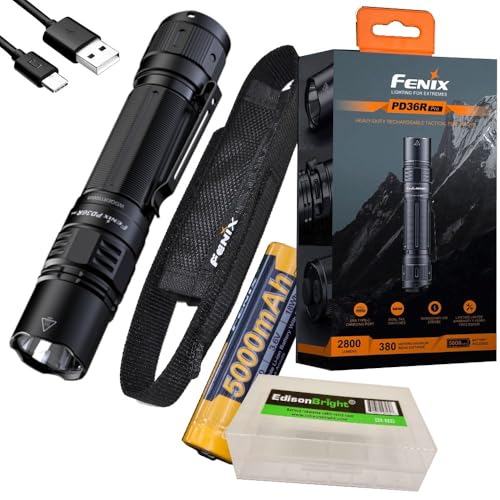
Fenix PD36R Pro
A proprietary 21700 pack charges through a USB C port in the body, so nothing extra travels with the light. Mode changes live on a side switch while the tail switch stays reserved for instant high. An IP68 rating covers heavy rain, dust and a dropped light in a puddle. Girth is the compromise, since a 21700 cell sits noticeably fatter in a pocket than an 18650.
Pros
- Any phone cable recharges it, no cradle needed
- Split switches keep mode changes off the main press
- IP68 sealing handles rain, dust and brief submersion
Cons
- Proprietary cell narrows your spare battery options
- Fatter in the pocket than 18650 class lights

Olight Warrior 3S
A proximity sensor in the head cuts output when something blocks the beam, which stops a holstered light cooking itself. Charging happens through a magnetic cable that snaps onto the tail, one handed and with no cap to unscrew. Mode switching sits under the thumb on a side button, and a lockout kills the light in a bag. Knurling runs deep enough to hold with wet gloves.
Pros
- Magnet finds the contacts without hunting for a port
- Proximity sensor prevents holster heat build up
- Lockout stops the light waking up inside a pack
Cons
- Losing the magnetic cable means ordering another
- Proximity sensor can dim the beam during close work

SureFire G2X Pro
Two output levels and a tail click make up the whole interface, which is why agencies keep issuing it. Nitrolon polymer takes impact well and does not pull heat out of a bare hand in January. CR123A primaries sit in storage for years without meaningful self discharge. Leave one in a glovebox and it still fires on the first press next winter.
Pros
- Interface cannot be fumbled under pressure
- Polymer stays comfortable to hold in freezing air
- Primaries hold charge through years of storage
Cons
- This configuration offers no rechargeable option
- Output trails newer rechargeable rivals

Nitecore P20iX
Four emitters fire together for a burst bright enough to search open ground, then step down as the head warms. An i series 21700 cell ships with it and charges through an onboard USB C port. Dual tail buttons separate momentary high from strobe, so the wrong output never hits a wall. Head diameter is the trade, and it fills a trouser pocket awkwardly.
Pros
- Burst output reaches ground other lights leave dark
- Onboard charging removes the external cradle
- Separate tail buttons keep strobe deliberate
Cons
- Peak output drops away quickly as the head heats
- Wide head makes pocket carry awkward

Klarus XT11GT Pro
Klarus splits the tail cap into two buttons, one for instant high and one for cycling modes. That layout keeps a strobe off the wall when your hand is shaking. An 18650 cell comes included and charges through a port on the body. Beam profile balances a defined hotspot with enough spill to clear a room, which suits indoor sweeps as well as a back yard.
Pros
- Instant high never lands on strobe by mistake
- Standard 18650 cell is cheap and easy to replace
- Beam works indoors and across a yard
Cons
- Finding two tail buttons by feel takes practice
- Knurling grips less than rivals once wet

ThruNite Archer 2A V3
Two AA cells make this the practical choice for a glovebox, a camp bag or anyone done with lithium logistics. A side switch cycles four levels, and the firefly setting runs dim enough to read a map without killing night vision. Memory returns to your last level on the next press. Output sits below the 18650 class, which is the price of cells sold in every corner shop.
Pros
- AA cells are stocked in every country you travel to
- Firefly mode preserves night vision for map reading
- Slim tube disappears in a jacket pocket
Cons
- Peak output falls below lithium powered rivals
- Alkaline cells sag under sustained high mode current
How to choose
What to check before buying a tactical flashlight Sustained output tells you more than any figure on the box. Turbo modes usually hold for a couple of minutes, then thermal regulation pulls them back to protect the emitter and the cell. Aluminium sheds that heat faster than polymer, so a metal body holds a higher level for longer. Look for a stated runtime at a named output rather than one peak number. Ingress rating matters next, because a light that fails in rain is no light at all.
Throw vs spill: how far the beam really reaches Candela measures intensity at the centre of the beam, and that figure governs distance. A wide reflector floods a hallway beautifully and dies halfway across a field. Deeper reflectors, as on the Nitecore P20iX, squeeze output into a tight hotspot that reaches much further. Indoors and around vehicles, spill does the work. Across open ground, candela wins. Decide where you will use the light before you compare any lumen claims.
CR123A, 18650 and 21700 batteries compared CR123A primaries sit for years without self discharge, which makes them right for glovebox and emergency roles. Rechargeable 18650 cells are the common standard, cheap to replace and stocked everywhere. A 21700 carries more capacity for longer runtime, at the cost of a fatter tube in your pocket. Dual fuel bodies such as the ProTac HL-X take both chemistries, and that flexibility is worth more than raw output when you cannot predict charging access.
Best tactical flashlight for home defence and duty carry Indoors, spill beats throw and simplicity beats features, so a two mode SureFire G2X Pro is hard to improve on. Duty carry rewards a light you can program or split across two buttons, which is where the ProTac HL-X and Klarus XT11GT Pro earn their place. Strobe divides people: some policies require it, plenty of owners remove it, and nobody wants it on the first press. If the light lives in a bag, treat lockout as essential, since an activated light in a pack drains the cell and gets hot enough to worry about.
Compared at a glance
| # | Model | Power | Best for | Score | Price |
|---|---|---|---|---|---|
| 1 | Streamlight ProTac HL-X | Two CR123A cells or one 18650 | Best overall | 9.4 | Check price |
| 2 | Fenix PD36R Pro | 21700 rechargeable pack, USB C charging | Best for everyday carry | 9.2 | Check price |
| 3 | Olight Warrior 3S | Magnetic tail charging cable | Best one handed operation | 9.0 | Check price |
| 4 | SureFire G2X Pro | Two levels, high and low | Best simple duty light | 8.8 | Check price |
| 5 | Nitecore P20iX | Four LED emitters | Best for long distance throw | 8.6 | Check price |
| 6 | Klarus XT11GT Pro | Dual tail buttons for output and modes | Best dual switch control | 8.3 | Check price |
| 7 | ThruNite Archer 2A V3 | Two AA cells | Best AA powered option | 8.0 | Check price |
Common questions
What is the best tactical flashlight overall?
Streamlight ProTac HL-X, since it runs on CR123A primaries or a rechargeable 18650 and its mode set can be programmed down to high only. Fenix PD36R Pro is the better pick for everyday carry.
How many lumens should a tactical flashlight have?
Between 500 and 1000 sustained lumens covers duty and home use comfortably. Peak figures step down within minutes, so runtime at a stated level tells you far more than the number on the packaging.
Is a rechargeable or CR123A flashlight better?
Rechargeables cost less to run and suit daily use. CR123A primaries hold charge for years, which makes them right for a glovebox light or a kit you hope never to open.
What does candela mean on a flashlight?
Candela measures beam intensity at the centre, which sets how far the light reaches. Two lights quoting identical lumens can differ hugely in throw, depending on reflector depth and emitter size.
Streamlight vs SureFire: which is better for duty use?
SureFire keeps the interface simple and proven, which several agencies still prefer. Streamlight adds programmable modes and dual fuel bodies at higher output, and that suits most individual buyers.
Do I need strobe on a tactical flashlight?
Some duty policies require it. Many owners program it out, because an accidental strobe is worse than no strobe at all. Choose a light where reaching strobe takes a deliberate action.
Which tactical flashlight is best for home defence?
SureFire G2X Pro, because spill lights a whole room better than a tight hotspot and two modes cannot be fumbled at three in the morning.
Are AA tactical flashlights worth buying?
Yes, for backup and travel roles. ThruNite Archer 2A V3 runs on cells sold in every shop, which counts for more than peak output once you are days from a charger.
Can a tactical flashlight get hot enough to burn you?
An aluminium head on turbo warms quickly, which is why thermal stepdown exists. Trouble starts when a light switches on inside a pocket or bag, so use the lockout on any model that offers one.
How long do tactical flashlight batteries last in storage?
CR123A lithium primaries hold most of their charge for around a decade. Rechargeable 18650 and 21700 cells self discharge over months, so top them up a few times a year if the light sits unused.
Our pick
Streamlight ProTac HL-X is the light to buy if one flashlight must cover duty, vehicle and household use without battery compromises. Everyday carry buyers should take the Fenix PD36R Pro for its onboard USB C charging, and anyone scanning open ground at distance gets more from the Nitecore P20iX. For a light bought purely for home defence, skip the high mode count models and choose the two mode SureFire G2X Pro.
Dana Whitfield
Dana spent eight years buying and merchandising for a regional kitchenware retailer before moving into editorial work. She has handled thousands of SKUs across cookware, small appliances and kitchen organization, and focuses on the practical differences that matter once a product is actually in daily use.

