Table Tennis Paddles Ranked by Blade, Rubber and Sponge
The STIGA Pro Carbon suits attacking players chasing speed with usable spin, thanks to carbon blade layers and thick sponge. STIGA Evolution is the value pick for club level control, while the Palio Expert 3.0 is where beginners actually build proper technique before moving up.
Attacking players belong with the STIGA Pro Carbon, club players find balance in the STIGA Evolution, and beginners improve fastest on the Palio Expert 3.0.
Star ratings printed on packaging are a manufacturer’s own marketing scale, not a shared standard, so a five star paddle from one brand can play nothing like a five star from another. We compared blade layer construction, rubber grade and sponge thickness, added handle shape, then weighed what owners and coaches report about how each paddle rewards or punishes developing technique. Rankings here follow playing style, not the star count on the box.
What we recommend

STIGA Pro Carbon Performance Ping Pong Paddle
Two carbon layers inside a seven ply blade widen the sweet spot and speed up response compared with an all wood build. S5 rubber over a thick sponge generates real topspin rather than raw pace alone. Beginners will struggle to keep shots on the table, so this suits a player with a developed stroke.
Pros
- Carbon layers widen the sweet spot noticeably
- Generates genuine topspin, not just speed
- ITTF approved rubber for tournament play
Cons
- Too fast for developing players to control
- Blocking requires an adjusted, softer touch

STIGA Evolution Performance Ping Pong Paddle
A six ply all wood blade with a slightly thinner sponge sits one notch below the Pro Carbon, trading a little speed for much easier control. Crystal technology stiffens the blade surface for a cleaner strike. Club players consistently report settling on this after finding faster paddles unmanageable.
Pros
- Balanced speed and control for club play
- Easier to keep on the table than carbon paddles
- Comfortable flared handle with shock damping
Cons
- Less outright speed than carbon blades
- Rubber wears faster than premium grades
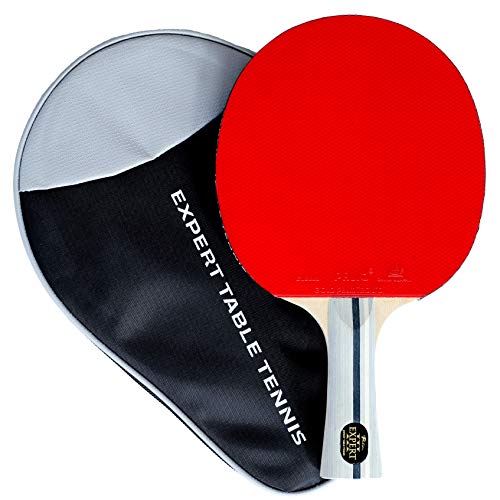
Palio Expert 3.0 Table Tennis Racket
Coaches keep recommending the Expert 3.0 because it rewards a correct stroke instead of masking a bad one. The blade favors control over speed, and the rubber grips just enough to teach spin. Both parts carry ITTF approval, so nothing needs replacing when a player enters a first competition, and a case ships in the box.
Pros
- Rewards correct technique as it develops
- ITTF approved rubber suits early competition
- Case included in the box
Cons
- Not fast enough for developed attacking players
- Plain appearance compared with branded rivals

Killerspin JET800 Speed N1
Five wood plies plus two carbon layers make this the fastest paddle in the group, aimed at aggressive loopers who finish points early. Nitrx rubber on both faces supplies the grip needed to keep that speed on the table. Late or lazy strokes go unpunished nowhere near as often, and the price sits above what most newcomers should spend.
Pros
- Fastest paddle in this comparison
- Excellent grip for aggressive looping
- Premium finish and presentation
Cons
- Very unforgiving of imprecise technique
- Among the most expensive options here

JOOLA Infinity Overdrive
A carbon reinforced blade adds speed without the harshness of a full carbon setup, keeping this paddle between offence and control. Shots stay on the table even when the stroke is not perfect, which suits an improving player starting to attack. Handle comfort holds up well over long sessions.
Pros
- Adds speed without becoming uncontrollable
- Comfortable handle over long sessions
- Suits players transitioning to attacking play
Cons
- Neither the fastest nor the most controlled option
- Rubber is less grippy than premium tournament sheets

Butterfly 401 Table Tennis Racket
Butterfly brings its engineering reputation to a controlled, all round build rather than a speed weapon here. Yuki rubber over a thinner sponge keeps the ball predictable, suiting defensive and blocking players and anyone on a smaller home table. Players wanting to hit through opponents should look elsewhere.
Pros
- Very predictable ball response
- Suits blocking and defensive play
- Trusted brand engineering throughout
Cons
- Limited speed for attacking players
- Thinner sponge reduces spin generation

DHS Hurricane-II Table Tennis Racket
DHS rubbers carry a tacky surface that grips the ball long enough to impart heavy spin, the defining trait of the Chinese playing style. This version brings that feel to a ready assembled paddle instead of a custom build. Tacky rubber needs regular cleaning to keep working, and it feels distinctly different from the springier European rubbers used elsewhere in this group.
Pros
- Tacky surface generates heavy spin
- Ready assembled version of a respected setup
- Distinctive feel worth trying for spin players
Cons
- Tacky rubber needs frequent cleaning to stay effective
- Feels unfamiliar to players used to European rubbers
Compared at a glance
| # | Model | Blade | Best for | Score | Price |
|---|---|---|---|---|---|
| 1 | STIGA Pro Carbon Performance Ping Pong Paddle | Seven ply with two carbon layers | Best overall | 9.4 | Check price |
| 2 | STIGA Evolution Performance Ping Pong Paddle | Six ply light wood with crystal technology | Best value | 9.2 | Check price |
| 3 | Palio Expert 3.0 Table Tennis Racket | Five ply wood, control oriented | Best for beginners | 9.0 | Check price |
| 4 | Killerspin JET800 Speed N1 | Seven layer with two carbon plies | Best for speed | 8.8 | Check price |
| 5 | JOOLA Infinity Overdrive | Carbon reinforced multi ply | Best all round performance | 8.6 | Check price |
| 6 | Butterfly 401 Table Tennis Racket | Five ply all wood | Best for control | 8.3 | Check price |
| 7 | DHS Hurricane-II Table Tennis Racket | Multi ply wood | Best for spin | 8.0 | Check price |
What to look for
Why the star ratings on the packaging don’t matter Each brand sets its own star scale internally, with no industry standard tying them together, so a five star paddle from one maker can play slower than a four star from another. Blade construction, rubber grade and sponge thickness actually determine how a paddle performs. Read those three specifications and treat the stars printed on the box as decoration.
Matching paddle speed to your current technique Buying the fastest carbon blade available is the most common mistake newcomers make. A fast paddle sends shots long before a stroke is consistent, so players stop attacking just to keep the ball on the table, and technique regresses. Start controlled, build the stroke, then step up. Coaches agree on this near universally, and players routinely ignore them anyway.
How sponge thickness changes the way a paddle plays A thicker sponge, around two millimetres, stores more energy for extra speed and spin, but dulls the feel of the ball and makes touch shots harder. A thinner sponge, near one and a half millimetres, gives a more direct connection and better control at the cost of power. Attacking players want thick sponge; blockers, defenders and beginners are usually better served by thinner.
When ITTF approval on the rubber actually matters Rubbers used in sanctioned competition must appear on the ITTF approved list, while paddles sold for casual play sometimes use rubber that does not. Anyone considering a league or club tournament should buy approved rubber now rather than replace it later. Look for the approval marking printed near the edge of the blade.
Frequently asked questions
What do the star ratings on paddles mean?
They reflect each brand’s own marketing scale with no shared standard behind them. Compare blade construction, rubber grade and sponge thickness instead, since those determine how a paddle actually plays.
Should a beginner buy an expensive paddle?
No. A fast carbon paddle sends shots long before technique is consistent, discouraging proper stroke development. A controlled paddle such as the Palio Expert 3.0 builds better habits for far less money.
What sponge thickness should I choose?
Around two millimetres for attacking play with more speed and spin, and about one and a half millimetres for control, blocking and touch shots. Thicker sponge dulls the feel of the ball on soft shots.
What is the difference between flared and straight handles?
A flared handle widens toward the base and locks into the hand, suiting most players and forehand dominant styles. Straight handles allow easier grip rotation, which some players prefer for switching between forehand and backhand.
How long does paddle rubber last?
Owners report roughly six months to a year of regular play before grip noticeably declines. Rubber that has lost its tack stops generating spin, usually the first change a player notices.
How should I clean a table tennis paddle?
Wipe the rubber with a damp sponge or a dedicated cleaner after each session and let it air dry fully. Store the paddle in a case with protective sheets, since dust and light degrade the surface fastest.
Does a paddle need to be ITTF approved?
Only for sanctioned competition, where rubber must appear on the ITTF list. Home and casual club play makes no such demand, but buying approved rubber keeps that option open later.
Can I replace the rubber instead of the whole paddle?
On better paddles, yes, and serious players do exactly this. Rubber sheets are glued to the blade and can be swapped when worn. Cheaper pre assembled paddles are generally not worth recovering.
Which table tennis paddle is best for spin?
The DHS Hurricane-II uses tacky Chinese style rubber built specifically for heavy spin, while the STIGA Pro Carbon adds spin through a thick sponge and carbon layered blade for attacking players.
Attacking versus control paddles: how do I know which style I play?
If shots regularly fly off the end of the table, a control paddle like the STIGA Evolution or Palio Expert 3.0 fits better. If the ball reliably lands but lacks pace, an attacking blade such as the Pro Carbon or JET800 rewards that consistency.
The verdict
The STIGA Pro Carbon suits a developed attacking player best, since its carbon layers widen the sweet spot without killing the spin the rubber generates. Most club players actually enjoy the STIGA Evolution more, because it keeps the ball on the table while still allowing an attacking shot. Anyone learning the sport should start with the Palio Expert 3.0.
Derek Holt
Derek has a background coaching recreational and amateur athletes and has worked the sales floor at specialty fitness retailers. He focuses on equipment durability, ergonomics and realistic use cases rather than marketing claims.