Survival Kits Compared for Car, Home, and Trail Emergencies
Uncharted Supply Co.’s Seventy2 Pro Survival System is the strongest all-around pick, pairing a rugged three-day kit with power and water tools for two people. Ready America’s 72 Hour Emergency Kit covers similar ground for less, and Prepared Hero’s Deluxe Survival Backpack fits tighter household budgets without dropping core supplies.
Uncharted Supply Co.’s Seventy2 Pro Survival System suits buyers who want one kit covering power, water, and shelter for two people over three days. Its rugged MOLLE backpack and hand-crank tools outlast lighter kits, though the added weight makes it a poor fit for solo hikers.
Piece counts across these kits range from a handful of integrated tools to more than a hundred first aid items, so listed contents alone rarely tell the full story. Case construction, owner feedback on durability, and fit for car, home, or trail use carried more weight in this comparison than price.
The top picks, ranked

Uncharted Supply Co. The Seventy2 Pro Survival System
A hand-crank power bank with flashlight and radio anchors this three-day kit built for two people. Water filtration straw, fire-starting tools, and first aid supplies round out the water-resistant MOLLE backpack. Owners report packed weight near 12 pounds, better suited to vehicle storage than long hikes.
Pros
- Hand-crank power bank charges phones without batteries
- Water filtration straw removes bacteria and protozoa
- MOLLE webbing lets owners attach extra gear
Cons
- Packed weight is heavy for backpacking trips
- Refill items like water pouches need periodic replacement
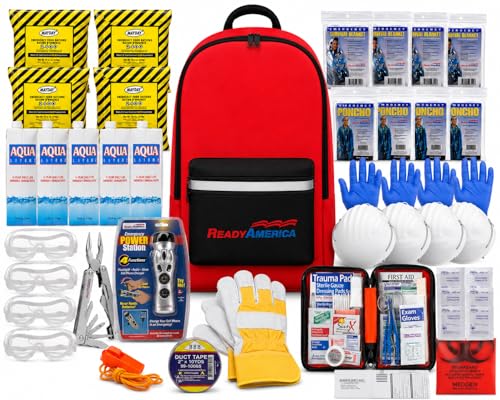
Ready America 70385 Deluxe Emergency Kit, 2 Person 3 Day Backpack
Three days of food bars, water pouches, and emergency blankets fill this two-person nylon backpack. A hand-crank flashlight and radio, dust masks, and a first aid pouch round out the listed contents. Fewer MOLLE straps than premium kits keep this design simpler and lighter.
Pros
- Covers two people at a lower cost than premium bundles
- Hand-crank radio doubles as a flashlight
- Compact enough for a closet or trunk
Cons
- First aid contents are basic compared to dedicated kits
- No water filtration straw for restocking supply

Prepared Hero Deluxe Survival Backpack, 4 Person Family Kit
Food and water rations for four people fill this canvas backpack, along with ponchos and a basic tool set. Extras like a power bank are skipped here to keep the price down, according to the listing. A whistle, dust masks, and emergency blankets round out coverage for the whole family.
Pros
- Covers a full family of four in one bag
- Includes ponchos and blankets for varied weather
- Lower cost entry point for first-time buyers
Cons
- No power bank or radio included
- Heavier than kits built for fewer people

Sustain Supply Co. Comfort2 Two Person Emergency Survival Kit
A compact duffel sized for a trunk holds three days of food and water for two people in this kit. Tube tent, hand-crank light, and a basic tool roll round out the contents, based on specifications. Owners note the duffel handles double as tie-down points.
Pros
- Duffel shape fits trunk storage better than boxy kits
- Tube tent adds shelter most car kits skip
- Hand-crank light needs no batteries
Cons
- Duffel material is thinner than backpack-style cases
- Food bars require rotation before expiration

Echo-Sigma Get Home Bag, 72-Hour Survival Backpack
Weight trims down considerably in this hiker-focused kit, built around a compact tarp, water purification tablets, and a fire starter. Lightweight mylar and tablets replace bulkier filtration units, based on the listing. Compression straps keep the low-profile backpack stable and close to the back on the trail.
Pros
- Lightest packed weight in this roundup
- Compression straps keep the load stable on trails
- Compact tarp doubles as ground cover or rain shelter
Cons
- Purification tablets need replacing after the count runs out
- Single-person design does not cover a group

SOL Origin Survival Tool
Fire, signal, and navigation tools condense into a single waterproof case small enough for a pocket or glove box here. A magnesium fire starter and whistle pair with a button compass and LED light, according to the product listing. Food, water, and first aid are skipped entirely, so this functions as a tool rather than a full kit.
Pros
- Small enough to carry daily without added bulk
- Waterproof case protects tools in wet conditions
- Magnesium starter works even when damp
Cons
- No food, water, or first aid supplies included
- Best paired with a separate kit for longer emergencies

Surviveware Premium Survival First Aid Kit
Medical supplies take priority here, with over 100 first aid items packed into a MOLLE-compatible pouch with labeled compartments. Trauma pads, burn gel, and tweezers round out the contents, based on specifications, making this a strong add-on to a broader preparedness plan. Food, water, and fire-starting tools are left out entirely.
Pros
- Labeled compartments make items easy to find quickly
- MOLLE straps attach to an existing bag or kit
- Covers more first aid scenarios than kits with basic bandages
Cons
- No food, water, or shelter items included
- Works best paired with a separate survival kit
How to choose
What a Solid Survival Kit Actually Includes Most complete kits group supplies into six categories: water treatment, fire starting, shelter, first aid, tools, and communication or power. Piece counts range from a handful of integrated tools to more than 100 individual first aid items. Case type matters as much as contents; a nylon backpack survives rough handling better than a thin duffel. Checking which categories a kit skips, food or power for instance, sets realistic expectations before relying on it.
Car Kits vs Home Kits vs EDC Kits Compact duffels or low-profile bags fit a trunk without eating into cargo space, which favors car kits. Home kits scale up for a full family, adding more food bars, water pouches, and blankets per person. EDC tools like the SOL Origin drop food and water entirely, focusing on fire, signal, and navigation in a pocket-sized case. Matching kit type to where it will actually sit prevents buying more bulk than a situation calls for.
Weight and Packability for Backpacking Hikers gain more from shaving ounces than from adding extra components. Echo-Sigma’s Get Home Bag keeps packed weight near 6 pounds by swapping bulky filtration units for purification tablets and a compact tarp. Compression straps and a low-profile frame matter more on a trail than a high piece count. Strapping a 12-pound kit built for a car trunk onto a hiking pack rarely works well.
Matching a Kit to Power Outages or Wilderness Emergencies Hand-crank radios and power banks matter most during power outages, a category the Seventy2 Pro and Ready America kits both cover. Wilderness emergencies lean more on water purification, fire starting, and signaling tools, areas where the SOL Origin and Echo-Sigma bag focus their contents. Families sheltering at home benefit more from the Surviveware first aid pouch and Prepared Hero’s four-person rations. Reading the specific scenario first narrows the choice faster than comparing price or piece count alone.
Compared at a glance
| # | Model | Components | Best for | Score | Price |
|---|---|---|---|---|---|
| 1 | Uncharted Supply Co. The Seventy2 Pro Survival System | 32 tools and supplies | Best overall | 9.4 | Check price |
| 2 | Ready America 70385 Deluxe Emergency Kit, 2 Person 3 Day Backpack | 30+ pieces for 2 people | Best value | 9.1 | Check price |
| 3 | Prepared Hero Deluxe Survival Backpack, 4 Person Family Kit | 40+ items for 4 people | Best budget | 8.8 | Check price |
| 4 | Sustain Supply Co. Comfort2 Two Person Emergency Survival Kit | 30+ pieces for 2 people | Best for car emergency | 8.5 | Check price |
| 5 | Echo-Sigma Get Home Bag, 72-Hour Survival Backpack | 25+ pieces, single person | Best for hiking/backpacking | 8.3 | Check price |
| 6 | SOL Origin Survival Tool | 5 integrated tools | Best compact/EDC | 8.1 | Check price |
| 7 | Surviveware Premium Survival First Aid Kit | 100+ first aid items | Best for home first aid preparedness | 8.0 | Check price |
Questions worth asking
How many days should a survival kit cover?
Most kits in this roundup cover 72 hours, the standard window for waiting out short-term outages or evacuation delays. Larger household kits like Prepared Hero’s stretch food and water further by covering four people over the same period.
Bug out bag vs survival kit, what is the difference?
A bug out bag is packed for leaving home quickly, prioritizing shelter and mobility, similar to the Echo-Sigma Get Home Bag. A survival kit often stays fixed in a car or closet and can include bulkier items like a tube tent, as seen in the Sustain Supply Comfort2 kit.
Which survival kit works best for a car?
Sustain Supply Co.’s Comfort2 fits well in a car because its compact duffel shape stores flat in a trunk. Its tube tent and hand-crank light cover a stranded scenario without the added bulk of a full family kit.
Can a survival kit replace a dedicated first aid kit?
General survival kits usually include only basic bandages and gauze, not the 100-plus items in a dedicated kit like Surviveware’s Premium Survival First Aid Kit. Pairing a general kit with a focused first aid pouch covers more medical scenarios.
Is a hand-crank radio worth having in an emergency kit?
A hand-crank radio provides power and information without relying on batteries, which matters during extended outages. Both the Seventy2 Pro and Ready America kits include one, while lighter backpacking kits often skip it to save weight.
How much should a family emergency kit weigh?
Family kits built for four people, like Prepared Hero’s Deluxe Survival Backpack, typically run around 15 pounds once packed. That weight works fine for storage at home but is too heavy to carry on a hiking trail.
What tools come in a basic EDC survival kit?
A compact EDC tool like the SOL Origin typically bundles a fire starter, whistle, compass, and LED light in one waterproof case. Food, water, and first aid are left out, so it functions as a supplement rather than a full kit.
Pre-built survival kit vs individual gear, which is better?
Pre-built kits save time and guarantee baseline coverage across water, fire, and first aid categories. Buying gear individually costs more effort but lets someone swap in higher-capacity items, like a larger water filter, where a bundled kit falls short.
What is the best survival kit for hiking and backpacking?
Echo-Sigma’s Get Home Bag keeps packed weight near 6 pounds, the lightest option in this roundup, by trading bulky filtration units for purification tablets. Its low-profile frame and compression straps also ride closer to the back on the trail.
The bottom line
Uncharted Supply Co.’s Seventy2 Pro Survival System remains the top pick for combining a hand-crank power bank, water filtration straw, and rugged MOLLE backpack built for two people. Buyers on a tighter budget should look at the Ready America 72 Hour Emergency Kit, which covers similar categories with fewer extras. Hikers who need to shave weight are better served by the Echo-Sigma Get Home Bag instead.
Sierra Daniels
Sierra's background is in landscape design and nursery retail. She focuses on lawn and garden equipment, outdoor furniture and gear durability, weighing published specs against how materials actually hold up outside.