Stud Finders That Actually Find the Right Stud
The Franklin Sensors ProSensor 710 is the strongest all-around pick, using 13 sensors to show stud edges and center position in one pass without calibration. The Zircon MultiScanner i520 suits buyers who also want to detect live wiring before drilling, while the CH Hanson 03040 fits anyone who wants a simple magnetic backup with no batteries.
The Franklin Sensors ProSensor 710 stands out because its 13 sensor array detects stud edges and center position in a single pass, avoiding the repeated re-scanning that single-sensor stud finders often require. Its main limitation is that it only detects studs, not live wiring or pipes, which a multi-function scanner would catch.
We compared published sensor types, detection depths, calibration requirements and display designs across each listing rather than running our own wall tests.
What we recommend

Franklin Sensors ProSensor 710
Instead of a single sensor swept across the wall, this stud finder uses 13 sensors across its width to detect studs simultaneously, lighting up LED indicators that show stud edges and center position at once. That design avoids the common need to re-scan an area multiple times to confirm a stud’s exact location. No calibration step is required before use, unlike many single-sensor electronic stud finders.
Pros
- 13 sensor array shows stud edges and center in a single pass
- No calibration step needed before each use
- Reduces the need to re-scan the same area multiple times
Cons
- Cannot detect wiring or pipes behind the wall like multi-function scanners
- Wider sensor housing is less precise in narrow spaces near corners
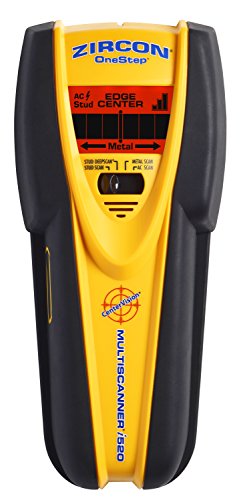
Zircon MultiScanner i520
This scanner detects studs, metal and live AC wiring in a single pass, useful before drilling into a wall where any of the three could be present. A backlit LCD screen displays detection results more clearly in dim rooms than simple LED indicator lights. SpotLite pointing technology marks the exact spot to drill once a target is detected.
Pros
- Detects studs, metal and live wiring in a single pass
- Backlit LCD screen reads clearly even in dim rooms
- SpotLite technology marks the exact drilling spot
Cons
- Multi-function detection is slower than single-purpose stud finders
- Requires calibration against a stud-free section of wall before scanning

Bosch GMS120 Digital Multi-Detector
Bosch builds this detector to find wood, metal and live wiring at a greater detection depth than most consumer-grade scanners, suited to thicker walls found in commercial or older construction. A digital display shows a graduated signal strength indicator rather than a simple detected or not-detected light. The rugged housing is built to handle repeated job site use better than lighter consumer models.
Pros
- Greater detection depth suits thicker walls in older or commercial construction
- Graduated signal display gives more detail than simple detected lights
- Rugged housing holds up to repeated professional job site use
Cons
- Higher cost than consumer-focused stud finders
- More features than most homeowners need for basic wall hanging

Zircon StudSensor HD55
This single-sensor electronic stud finder covers the basics of stud detection without the multi-function sensors found on pricier models. A simple LED and audible beep confirm when the sensor passes over a stud edge. It requires a quick calibration against the wall before each scan, a minor extra step compared to the always-ready Franklin Sensors ProSensor 710.
Pros
- Lower cost than multi-function or multi-sensor stud finders
- LED and beep indicators confirm stud edges clearly
- Covers basic stud detection needs for simple wall hanging tasks
Cons
- Requires calibration before each scan, unlike always-ready models
- Shallower detection depth than premium stud finders

CH Hanson 03040 Magnetic Stud Finder
Rather than electronic sensors, this stud finder uses strong rare earth magnets that detect the metal screws or nails holding drywall to a stud behind it. With no batteries or calibration step, it works immediately by sliding across the wall until the magnet pulls toward a fastener. Its compact size and lack of electronics make it a reliable backup even after years of storage.
Pros
- No batteries or calibration needed, ready to use immediately
- Rare earth magnets reliably detect screws and nails in studs
- Compact size makes it easy to store and carry
Cons
- Only detects studs with existing metal fasteners nearby
- Slower to use across large wall areas than electronic scanners

Walabot DIY Pro
This device pairs with a smartphone app to generate a visual image of what is behind drywall, going beyond simple stud detection to show pipes, wiring and stud spacing visually. Unlike single-purpose stud finders, it can image a wider area at once rather than requiring a slow horizontal sweep. The tradeoff is a more involved setup process, since it requires pairing with a compatible smartphone before each use.
Pros
- Visual imaging shows a wider view than a simple stud detection light
- Detects pipes and wiring in addition to studs behind drywall
- Images a broader wall area instead of a slow narrow sweep
Cons
- Requires a compatible smartphone and app setup before each use
- Higher cost than basic single-purpose stud finders

Tavool TS200 Multi-Function Stud Finder
This scanner covers stud, metal and live wire detection at a lower cost than premium multi-function brands like Zircon or Bosch. An LCD display with sound alerts confirms detection results clearly during a scan. It requires calibration against the wall before use, a common step across most multi-function electronic stud finders.
Pros
- Lower cost than premium multi-function stud finders
- LCD display and sound alerts confirm detection results clearly
- Covers stud, metal and live wire detection in one device
Cons
- Detection depth trails premium models like the Bosch GMS120
- Requires calibration before each scan like most multi-function units
How to pick the right one
What to look for in a stud finder Sensor type sets the baseline capability, from a single sweeping sensor to the multi-sensor array used in the Franklin Sensors ProSensor 710. Detection depth decides how thick a wall surface the tool can see through, with professional-grade units like the Bosch GMS120 reaching deeper than basic consumer models. Calibration requirements affect how quickly a scan can start, since some electronic stud finders need a stud-free reference section of wall before each use. Additional detection types, like live wiring or metal pipes, matter most before drilling into a wall where safety is a concern.
Single-function versus multi-function detection A single-function stud finder like the Franklin Sensors ProSensor 710 focuses entirely on locating studs quickly and accurately, without the added complexity of detecting other materials. Multi-function scanners, including the Zircon MultiScanner i520 and Bosch GMS120, add the ability to detect live wiring and metal, which matters before drilling into a wall where electrical lines could be present. Anyone hanging simple shelving or artwork rarely needs multi-function detection, while renovation work near outlets or plumbing benefits from the added safety check.
Electronic versus magnetic stud finders Electronic stud finders, which make up most of this list, detect density changes behind the wall surface and typically need batteries and sometimes calibration. The CH Hanson 03040 instead uses rare earth magnets to find the metal fasteners already holding drywall to a stud, working without batteries or calibration but only where fasteners happen to be nearby. A magnetic stud finder makes a reliable backup tool, especially for anyone who wants something that still works after years sitting unused in a drawer.
Detection depth and wall thickness Standard drywall over wood studs rarely challenges basic detection depth, which is why budget electronic models like the Zircon StudSensor HD55 handle most home tasks fine. Thicker walls, older plaster construction, or commercial building materials benefit from the deeper detection range of professional-grade tools like the Bosch GMS120. The Walabot DIY Pro takes a different approach entirely, using RF imaging to show a visual picture of what lies behind the wall rather than relying on depth alone.
The lineup, side by side
| # | Model | Sensor Type | Best for | Score | Price |
|---|---|---|---|---|---|
| 1 | Franklin Sensors ProSensor 710 | 13 sensor array | Best Overall | 9.3 | Check price |
| 2 | Zircon MultiScanner i520 | Wood studs, metal, live AC wiring | Best Multi-Function | 9.0 | Check price |
| 3 | Bosch GMS120 Digital Multi-Detector | Wood, metal, live AC wiring | Best for Professionals | 9.1 | Check price |
| 4 | Zircon StudSensor HD55 | Single sensor, edge detection | Best Budget Electronic | 8.3 | Check price |
| 5 | CH Hanson 03040 Magnetic Stud Finder | Rare earth magnets, detects embedded fasteners | Best Simple and No Batteries | 8.1 | Check price |
| 6 | Walabot DIY Pro | RF imaging via smartphone app | Best for Wall Imaging | 8.8 | Check price |
| 7 | Tavool TS200 Multi-Function Stud Finder | Wood studs, metal, live AC wiring | Best Value Multi-Function | 8.5 | Check price |
Common questions
How does an electronic stud finder actually work?
Most detect changes in wall density as the sensor passes over a stud, signaling the change through an LED light, a beep, or both, as seen on the Zircon StudSensor HD55.
Why do some stud finders need calibration before use?
Single-sensor models like the Zircon StudSensor HD55 need a stud-free reference point to set a baseline density reading before detecting changes accurately.
Can a stud finder detect live electrical wiring?
Multi-function models like the Zircon MultiScanner i520 and Bosch GMS120 can detect live AC wiring in addition to studs and metal.
Does a magnetic stud finder work without batteries?
Yes. The CH Hanson 03040 uses rare earth magnets to detect metal fasteners in a stud, requiring no batteries or calibration.
Is a multi-sensor stud finder more accurate than a single sensor?
Generally yes for locating exact stud edges. The Franklin Sensors ProSensor 710’s 13 sensor array shows edges and center position in one pass.
What is Walabot DIY Pro’s wall imaging feature?
It uses RF imaging paired with a smartphone app to generate a visual picture of studs, pipes and wiring behind drywall, rather than a simple detection light.
How deep can a stud finder detect through a wall?
It varies by model. Basic electronic finders detect roughly 0.75 to 1.5 inches deep, while professional tools like the Bosch GMS120 reach up to 2.4 inches for metal.
Do I need a multi-function stud finder for basic shelving?
Not usually. A single-function model like the Franklin Sensors ProSensor 710 covers basic stud location for shelving and artwork without added complexity.
Is a budget stud finder reliable for occasional home use?
For basic tasks, yes. The Zircon StudSensor HD55 and Tavool TS200 both cover typical home project needs without the cost of professional-grade tools.
Our take
The Franklin Sensors ProSensor 710 earns the top recommendation for most buyers, since its 13 sensor array locates stud edges and center position accurately without any calibration step. Anyone drilling near outlets or in walls that might hide live wiring should choose the Zircon MultiScanner i520 instead, since detecting wiring before drilling matters more there than simple stud speed. Buyers who want a reliable no-battery backup for occasional use should skip the electronic options and pick the CH Hanson 03040.
Jake Monroe
Jake worked as a residential contractor for over a decade before shifting to full-time writing. He evaluates power tools, hand tools and workshop gear through the lens of someone who has actually used them on job sites, not just read the box.


