Stud Finders That Actually Replace Old Favorites
For most homeowners replacing an old stud finder, the Franklin Sensors M100 is the top pick because it displays the entire stud edge across a 4-inch sensor array, making it more forgiving for beginners, though it lacks a dedicated metal mode. Its main limitation is that it cannot distinguish between metal and wood without manual switching.
If your old stud finder has become unreliable or you simply want a more advanced model, the market is full of replacements. We compared the most popular options to help you choose.
From basic magnetic detectors to multi-mode digital finders, each product offers distinct features. This guide covers seven top-rated stud finders, highlighting their strengths and weaknesses.
What matters most
The top picks, ranked

Franklin Sensors M100
The Franklin Sensors M100 uses a 4-inch wide sensor array to show the entire stud edge, eliminating guesswork. It detects wood and metal studs, but you must manually select the mode. Owner reports praise its accuracy on drywall and paneling, but some note it gives false positives on foil-backed insulation.
Pros
- Shows full stud edge
- Simple one-button operation
- Accurate on various surfaces
Cons
- No dedicated metal mode
- Requires manual mode switching

Bosch GMS120
The Bosch GMS120 is a professional-grade stud finder that detects wood, metal, and live AC wires. Its center-find mode helps locate the exact edge of a stud. Users appreciate the clear LCD display and audible alerts. However, some find it less intuitive than simpler models.
Pros
- Detects live wires
- Three scanning modes
- Center-find function
Cons
- Steeper learning curve
- Requires two-hand operation

Zircon StudSensor e50
The Zircon StudSensor e50 is a straightforward stud finder that detects wood and metal studs up to 1.5 inches deep. It features a SpotLite pointer that illuminates the exact center of the stud. Owners say it is reliable for drywall and paneling, but it lacks wire detection.
Pros
- Affordable
- Simple operation
- SpotLite pinpointing
Cons
- Shallow scan depth
- No wire detection
Zircon MultiScanner i520
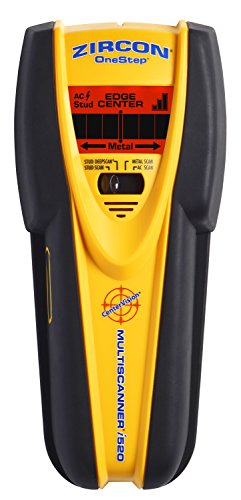
The Zircon MultiScanner i520 offers five scanning modes: stud, deep stud, metal, AC wire, and a dedicated metal mode that distinguishes between ferrous and non-ferrous metals. It has a bright display and audible alerts. Users like its depth capabilities, but some mention it can be sensitive to uneven surfaces.
Pros
- Multiple modes for different tasks
- Deep scan option
- Distinguishes ferrous metals
Cons
- More complex to operate
- May need calibration on textured walls

CH Hanson 03040 Magnetic Stud Finder
The CH Hanson 03040 is a magnetic stud finder that uses powerful rare-earth magnets to locate screws or nails in studs. It is simple to use: slide it across the wall until it sticks to a fastener. It is extremely reliable and never needs batteries, but it requires you to find a fastener, which may be sparse in some walls.
Pros
- No batteries required
- Works on all surfaces
- Accurate for locating fasteners
Cons
- Only detects metal fasteners
- May miss studs with no screws

Studpop Stud Finder
The Studpop is a compact, magnetic stud finder that pops up when it detects a screw or nail. It is incredibly easy to use and fits in your pocket. It works on any wall surface, including tile and plaster. However, it only finds fasteners, not the center of the stud.
Pros
- Instant visual indication
- No calibration
- Works on tough surfaces
Cons
- Limited to fastener detection
- Small size may be easy to lose

CRAFTSMAN CMHT77635 Stud Finder
The CRAFTSMAN CMHT77635 offers stud detection with a live wire warning feature. It has a clear LED display and a compact design. Users appreciate the low price and wire detection, but some report that it occasionally gives false positives on foil-backed drywall.
Pros
- Live wire detection
- Affordable
- Ergonomic grip
Cons
- Shallow detection depth
- False positives possible
How they compare
| # | Model | Scanning Depth | Best for | Score | Price |
|---|---|---|---|---|---|
| 1 | Franklin Sensors M100 | 1.5 inches | Easiest to use for beginners | 9.4 | Check price |
| 2 | Bosch GMS120 | 3 inches | Multi-material scanning with metal detection | 9.2 | Check price |
| 3 | Zircon StudSensor e50 | 0.75 inches | Budget-friendly basic detection | 8.8 | Check price |
| 4 | Zircon MultiScanner i520 | 1.5 inches (deep mode 2 inches) | Versatile scanning with multiple modes | 9.0 | Check price |
| 5 | CH Hanson 03040 Magnetic Stud Finder | N/A (detects metal fasteners) | No batteries or calibration needed | 8.5 | Check price |
| 6 | Studpop Stud Finder | N/A | Quick and simple magnetic detection | 8.3 | Check price |
| 7 | CRAFTSMAN CMHT77635 Stud Finder | 0.75 inches | Basic stud detection with live wire alert | 8.6 | Check price |
Frequently asked questions
What is the difference between a magnetic and electronic stud finder?
Magnetic stud finders detect metal fasteners like screws or nails that attach drywall to studs. They are simple, require no batteries, and work on any surface. Electronic stud finders use sensors to detect changes in wall density, allowing them to find wood or metal studs even if there are no fasteners. They often have additional features such as live wire detection.
How deep can stud finders scan?
Scanning depth varies by model. Basic electronic stud finders typically scan up to 0.75 inches, while advanced models can scan up to 1.5 inches or more. Some deep-scan modes go up to 2 inches. Magnetic finders do not have a depth rating as they detect fasteners on the surface of the drywall.
Can stud finders detect live wires?
Some electronic stud finders have a dedicated AC wire detection mode that alerts you to live electrical wires behind the wall. This is a valuable safety feature. However, it is not foolproof, and you should always turn off power when working near wires.
Why does my stud finder give false readings?
False readings can occur on walls with foil-backed insulation, metallic wallpaper, or uneven surfaces. Additionally, not calibrating the device properly or moving it too fast can cause errors. Try using a different mode or a magnetic finder if issues persist.
How do I find the center of a stud?
With an electronic stud finder, move it slowly until it indicates an edge, then mark that spot. Continue moving to find the opposite edge and mark that. The center is halfway between the two marks. Some finders have a center-find function that highlights the middle automatically.
Are magnetic stud finders accurate?
Magnetic stud finders are very accurate at locating metal fasteners. However, they only detect fasteners, so if a stud has no screws or nails in that area, you might miss it. They work well on most walls, including tile and plaster, as long as fasteners are present.
Can I use a stud finder on ceilings?
Yes, stud finders can be used on ceilings, but you may need to calibrate them differently due to the orientation. Magnetic finders are particularly easy to use overhead because they stick to fasteners. Electronic models may require you to hold them firmly against the ceiling.
What is the best stud finder for plaster walls?
Magnetic stud finders are often recommended for plaster walls because they do not rely on density changes and can detect fasteners through the thick surface. Electronic finders may struggle with plaster due to its irregular density. However, some advanced electronic models with deep scan capabilities can work.
Do stud finders work on metal studs?
Yes, electronic stud finders with a metal mode can detect metal studs. Some models can also distinguish between ferrous and non-ferrous metals. Magnetic finders will not work on metal studs unless there are ferrous fasteners, which is uncommon.
How often should I replace the battery in my stud finder?
Battery life depends on usage. Most stud finders use a 9V battery and should last for several months of regular use. If you notice dim lights or inconsistent readings, replace the battery. Magnetic finders never need batteries.
The bottom line
For most people replacing an old stud finder, the Franklin Sensors M100 offers the best combination of accuracy and ease, making it the top recommendation. If you frequently work with metal studs or need live wire detection, the Bosch GMS120 is a strong alternative. Budget-conscious users will find the Zircon StudSensor e50 reliable for basic tasks. Ultimately, choose the Franklin if you want a hassle-free replacement that works well on standard drywall.
Jake Monroe
Jake worked as a residential contractor for over a decade before shifting to full-time writing. He evaluates power tools, hand tools and workshop gear through the lens of someone who has actually used them on job sites, not just read the box.