Top Stud Finders for Pros: Accurate Picks for Framing
For contractors who need reliable depth and speed, the Franklin Sensors XTI is the top pick due to its 13 sensor array that instantly shows stud edges on a bright display. It excels at finding studs through thick drywall and avoids false positives, but it is pricier than simpler models and lacks a dedicated metal mode.
Finding studs quickly and accurately is non-negotiable for contractors. Hanging cabinets, installing shelving, or framing walls demands a tool that doesn’t waste time on false reads. A quality stud finder can mean the difference between a clean install and costly drywall repairs.
We compared top-rated models that pros rely on, focusing on sensor technology, depth capabilities, and rugged construction. Whether you need deep scan for thick walls or edge detection for precise placement, these tools are built for the job site.
The best picks, ranked

Franklin Sensors XTI Professional Stud Finder
The Franklin Sensors XTI uses 13 sensors to display studs in real time, showing edges and center clearly. It scans up to 1.5 inches deep through drywall and up to 3 inches in deep mode. Owners report minimal false positives and a bright LED display that works in dim areas.
Pros
- Shows stud edges and center simultaneously
- Deep scan mode for thick walls
- Reduces false positives with wide sensor array
Cons
- Bulkier than some competitors
- No dedicated metal scanning mode

Bosch GMS120-27 Digital Multi-Scanner
The Bosch GMS120-27 detects wood, metal, and live AC wires with a center finder for accuracy. It offers three scanning modes and a backlit display. Contractors appreciate its reliable wire detection, which helps avoid electrical hazards. The tool is compact and fits in a pouch.
Pros
- Detects live wires to avoid hazards
- Three modes for different materials
- Compact and easy to carry
Cons
- Requires calibration on each wall surface
- Battery not included
DeWalt DCT1200 Stud and Wire Detector
The DeWalt DCT1200 is built for job sites with a rugged housing and a bright LED display. It detects studs up to 1 inch deep and also senses live wires. Users note the audio beep gets louder as you near the edge, which helps in noisy environments. The device is easy to calibrate by holding against the wall.
Pros
- Rugged construction for job site abuse
- Loud audible alerts
- Simple one-button operation
Cons
- Shallow scanning depth compared to others
- No metal detection
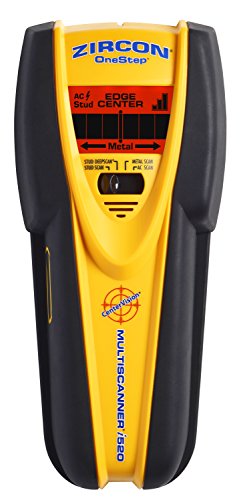
Zircon MultiScanner i520 OneStep
The Zircon i520 offers a balance of performance and price. It scans up to 1.5 inches for studs and also detects metal and live AC wires. The OneStep calibration simplifies use, and the bright display shows the exact center. Contractors find it reliable for most interior walls, though it may struggle on thicker plaster.
Pros
- Accurate center finding
- Deep scan mode
- Affordable for the features
Cons
- Calibration can be sensitive on textured walls
- Audio beep not very loud

Franklin Sensors ProSensor 710
The Franklin Sensors ProSensor 710 is a simpler version of the XTI, with 7 sensors that show stud detection in real time. It has no deep scan but is perfect for standard drywall. It offers a bright display and is easy to use right out of the box. Owners like the price for basic stud finding.
Pros
- Instant stud detection without scanning back and forth
- Simple interface
- Very affordable
Cons
- Limited depth for thick walls
- No deep scan or metal mode

CH Hanson 03040 Magnetic Stud Finder
The CH Hanson magnetic stud finder is a simple mechanical tool that locates screws or nails in studs. It requires no batteries and works on any surface, including plaster and tile. Contractors often keep one as a backup because it never gives false reads. It is especially useful for finding stud edges precisely.
Pros
- No false positives
- Works on any wall surface
- No batteries required
Cons
- Only finds fasteners, not the center of stud
- Requires slow sweeping to locate nails
Bosch DMF10 Zoom Digital Wall Scanner
The Bosch DMF10 Zoom is a professional-grade scanner that auto-calibrates and detects wood, metal, and live wires. It offers a depth of up to 2.4 inches for metal and 1.2 inches for wood. The ‘Zoom’ function allows for precise center finding. It is known for its accuracy on challenging surfaces like plaster.
Pros
- Auto calibration for consistent accuracy
- Zoom function for precise edges
- Works on irregular surfaces
Cons
- Shallow wood scanning depth
- Higher price point
What matters most
The lineup, side by side
| # | Model | Scanning depth | Best for | Score | Price |
|---|---|---|---|---|---|
| 1 | Franklin Sensors XTI Professional Stud Finder | 1.5 in (standard), 3 in (deep) | Instant edge detection with deep scanning | 9.4 | Check price |
| 2 | Bosch GMS120-27 Digital Multi-Scanner | Up to 3.75 in for wood, 2.4 in for metal | Versatile scanning of wood, metal, and live wires | 9.2 | Check price |
| 3 | DeWalt DCT1200 Stud and Wire Detector | 1 in (stud), up to 2 in for wire | Rugged build with clear audio and visual alerts | 9.1 | Check price |
| 4 | Zircon MultiScanner i520 OneStep | Up to 1.5 in (stud), 3 in (deep mode) | Accurate center finding on standard walls | 8.9 | Check price |
| 5 | Franklin Sensors ProSensor 710 | 0.75 in standard | Budget-friendly with instant stud display | 8.7 | Check price |
| 6 | CH Hanson 03040 Magnetic Stud Finder | Magnetic pull | Zero false positives for metal and studs | 8.5 | Check price |
| 7 | Bosch DMF10 Zoom Digital Wall Scanner | Up to 2.4 in (metal), 1.2 in (wood) | High precision with auto calibration | 8.3 | Check price |
Good to know
What is the best stud finder for thick walls?
The Franklin Sensors XTI and Zircon i520 have a deep scan mode that can detect studs up to 3 inches deep. For plaster walls, a magnetic stud finder like the CH Hanson can be more reliable because it locates the nails directly.
Do stud finders detect live wires?
Many electronic stud finders, such as the Bosch GMS120 and Zircon i520, have a dedicated AC wire detection mode. This is essential for avoiding electrical hazards when drilling into walls.
How does a magnetic stud finder work?
A magnetic stud finder uses a magnet to detect the steel screws or nails that hold drywall to studs. When you sweep it across the wall, it pulls toward the fastener, indicating the stud edge. It does not require calibration or batteries.
What is the difference between stud edge and center detection?
Edge detection shows the outer boundaries of a stud, allowing you to mark both sides. Center detection often uses an arrow to indicate the center, which is useful for drilling pilot holes. Some models like Franklin Sensors show the entire stud width at once.
Why does my stud finder give false positives?
False positives can occur due to textured walls, metal mesh, or if you do not calibrate properly. Ensure the device is flat on the wall and move slowly. On textured walls, use a piece of cardboard as a shim for consistent contact.
Can I use a stud finder on tile or plaster?
Yes, but you need a model with deep scanning capabilities. Magnetic stud finders work well on tile because they detect the screws behind the tile. Electronic finders may have trouble with dense materials, so check the depth rating.
Do expensive stud finders really work better?
Higher-priced models often have more sensors, deeper scanning, and additional features like wire detection. They also tend to have better build quality. However, a mid-range option like the Zircon i520 offers great performance for most tasks.
How do I calibrate a stud finder?
Place the stud finder flat against the wall in a clear area (no studs or wires). Press the calibration button and hold until it beeps or the indicator shows ready. Move the tool slowly horizontally. Some models auto-calibrate when you press against the wall.
What is the maximum depth a stud finder can detect?
Consumer stud finders typically scan between 1.5 and 3 inches for wood. Deep scan modes can detect through thicker walls, but accuracy may decrease. For metal, some can scan up to 3 inches or more.
Are there stud finders that also detect metal pipes?
Yes, many models have a metal detection mode that can find copper or metal pipes. The Bosch DMF10 and DeWalt DCT1200 are examples. This is useful for avoiding plumbing and electrical lines.
Final word
For most contracting jobs, the Franklin Sensors XTI is the best choice because its instant edge display speeds up work and reduces errors. If you often work around wires or need metal detection, the Bosch GMS120-27 offers the best versatility. For a budget-friendly backup that never lies, the CH Hanson magnetic stud finder is a must-have.
Jake Monroe
Jake worked as a residential contractor for over a decade before shifting to full-time writing. He evaluates power tools, hand tools and workshop gear through the lens of someone who has actually used them on job sites, not just read the box.