Which Inflatable Paddle Board Actually Stays Stable?
Atoll’s 11 Foot inflatable stands out for its rigid dual-layer build and 21 pound carry weight. Bluefin’s Cruise 10’8 adds a tougher 1000 denier shell for rocky launches. Paddlers on a budget do well with the iROCKER Nautical 10’6, which ships a complete kit at a lower price tier.
Most paddlers do best with the Atoll 11 Foot, while the Bluefin Cruise 10’8 suits rockier put-ins and the FunWater 11 Foot fits a tighter budget.
Product photos make every inflatable look alike, yet width, shell layers, and drop-stitch density decide whether a board feels solid or spongy. We compared seven boards on dimensions, construction, listed capacity, and what owners report about pumps, fins, and seam wear.
The top picks, ranked
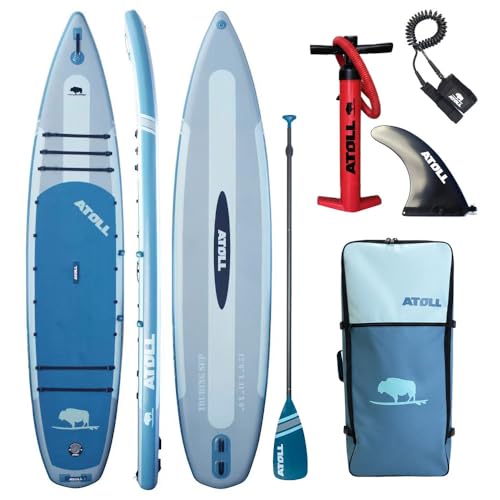
Atoll 11 Foot Inflatable Stand Up Paddle Board
A dual-layer PVC shell wraps this board’s drop-stitch core, cutting flex more than single-layer builds manage. Standing at 11 feet by 32 inches by 6 inches, it tracks straight without feeling twitchy underfoot. Paddle, pump, backpack, and leash ship in the box, so a rider can launch the same day it arrives.
Pros
- Dual-layer shell resists dings and pressure flex
- Multiple D-rings plus a front bungee secure gear
- Long waterline glides efficiently across flat water
Cons
- Turning tightens up less easily at 11 feet long
- Hand pump needs real effort to hit full pressure

Bluefin Cruise 10’8 Inflatable SUP
Bluefin wraps a pro-weave drop-stitch core in a 1000 denier shell built to survive rocky landings. Six inches of thickness keeps the 10 foot 8 inch deck steady when chop rolls through or weight shifts suddenly. Mounting points let owners swap in a kayak seat for a sit-down paddle session.
Pros
- Thick shell shrugs off rocks and dock scrapes
- Wide, stable platform suits bigger riders and dogs
- Kayak seat option turns it into a sit-down craft
Cons
- Carrying weight runs higher than lighter boards here
- Firm deck takes longer to reach full pressure
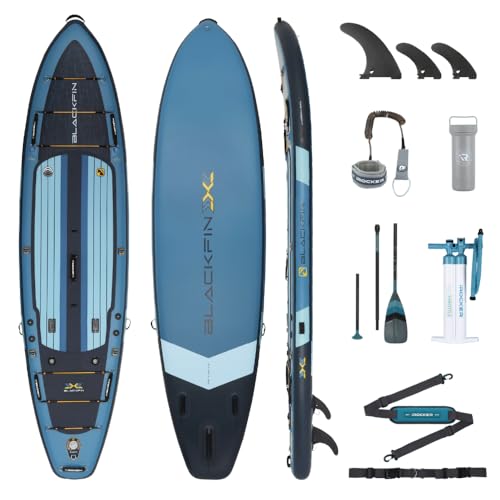
iROCKER Nautical 10’6 Inflatable Paddle Board
iROCKER built the Nautical to deliver its usual fit and finish at a lower price point. Dimensions run 10 feet 6 inches by 32 inches by 6 inches, with a listed capacity of 240 pounds. Triple fins help the hull hold a straight line better than most entry-level boards.
Pros
- Triple fin setup tracks straighter than single-fin rivals
- Full kit covers paddle, pump, bag, and leash
- Size suits lakes, bays, and slow moving rivers
Cons
- 240 lb capacity limits heavier riders carrying gear
- Single-layer skin flexes more than the Atoll’s shell
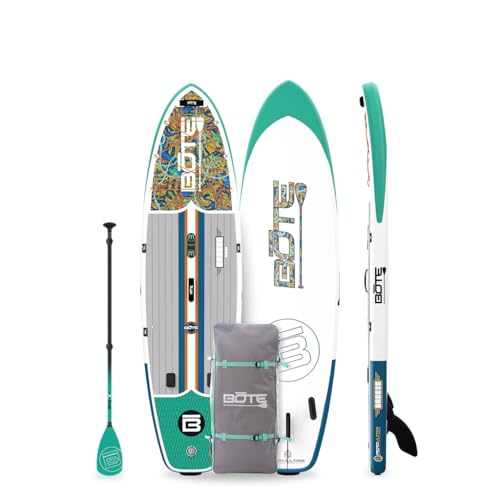
BOTE Breeze Aero 10’8 Inflatable SUP
Comfort drives this board’s shape, with a 33 inch wide deck that forgives sloppy footwork. Full-length deck padding makes sitting or kneeling breaks pleasant on longer outings. Paddle, pump, and travel bag round out a package built for weekend trips.
Pros
- Extra width steadies beginners and casual paddlers
- Padded deck suits seated breaks and passengers
- Valve and seam construction holds up well
Cons
- Wider outline trades away speed versus touring shapes
- Fewer cargo attachment points than the Atoll offers

ROC Inflatable Stand Up Paddle Board
Weighing roughly 18 pounds, ROC’s board carries easily from car to shoreline alone. Listed capacity reaches 350 pounds, well above what most first-time paddlers need. Its wide deck and generous pad flatter unsteady balance during early sessions, and a paddle, pump, leash, and dry bag round out the kit.
Pros
- Light carry weight suits solo transport
- Wide, forgiving deck helps first-timers find balance
- Dry bag in the kit protects phones and keys
Cons
- Underfoot flex increases as rider weight climbs
- Aluminum paddle weighs more than fiberglass upgrades

Retrospec Weekender 10 Foot Inflatable SUP
Rolled up, the Weekender fits a backpack sized for a car trunk or checked airline bag. Military-grade PVC keeps its shorter 10 foot by 30 inch hull taut once pumped to pressure. A removable center fin simplifies both packing and launches from shallow, rocky shorelines.
Pros
- Smallest pack size of the group for travel
- Shorter length turns easily on tight, small lakes
- Removable fin avoids damage in shallow launches
Cons
- 30 in width feels tippier for tall, heavy riders
- Shorter waterline gives up glide on longer paddles
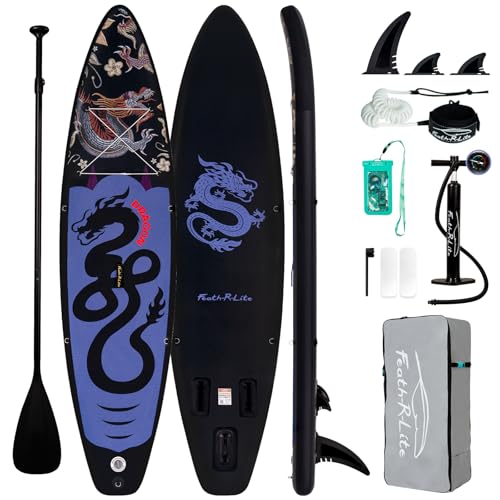
FunWater 11 Foot Inflatable Paddle Board
FunWater’s 11 foot board weighs about 18 pounds despite a listed capacity up to 330 pounds. A 33 inch wide deck helps beginners stay upright during early outings. The bundle adds a paddle, pump, backpack, leash, and repair kit, and owners report it performs well on calm lakes.
Pros
- Lowest cost entry point with a full kit included
- Light hull loads and carries with little effort
- Wide, long deck adds stability for new paddlers
Cons
- Single-layer skin flexes and scuffs sooner than premium builds
- Accessories are functional rather than built to last
What matters most
What actually makes a paddle board feel stable? Four measurements decide most of the feel underfoot. Width between 32 and 34 inches suits most adult riders. Length near 10 to 11 feet balances glide with easy handling for everyday use. Six inch thickness keeps an inflatable rigid at full pressure, while thinner 4 inch boards sag under adult weight. Always weigh listed rider capacity against body weight plus paddle, dog, or child riding along.
Why do some inflatable boards feel stiffer than others? Every board in this group uses a drop-stitch core, threads that hold the top and bottom skins parallel under pressure. Shell material decides how that core behaves under load. Dual-layer and woven builds, like the Atoll and Bluefin Cruise, resist puncture and stay rigid longer. Single-layer skins on budget picks such as the FunWater save weight and cost but flex more and scuff sooner.
Which board size fits your weight and the water you paddle? Riders above roughly 200 pounds do better on 11 foot, 6 inch thick, dual-layer boards, since flex grows with load. Lighter or shorter paddlers can enjoy the nimbler 10 foot Retrospec Weekender instead. Open bays and choppy water reward the extra width of the Bluefin and BOTE. Calm lakes let a longer, narrower hull glide with less effort. Keep total weight, gear included, under the listed capacity with room to spare.
What comes in the box, and what is worth upgrading first? A workable bundle needs a three-piece paddle, a hand pump with a pressure gauge, a backpack, a leash, and a repair kit with a valve wrench. Most boards here ship with nearly all of that list, though paddle material ranges from basic aluminum to lighter fiberglass. Upgrade the paddle first if strokes feel tiring, since a lighter shaft changes every stroke. An electric pump comes second, saving real effort at the put-in.
Compared at a glance
| # | Model | Size | Best for | Score | Price |
|---|---|---|---|---|---|
| 1 | Atoll 11 Foot Inflatable Stand Up Paddle Board | 11 ft x 32 in x 6 in | Best overall | 9.4 | Check price |
| 2 | Bluefin Cruise 10’8 Inflatable SUP | 10 ft 8 in long, 6 in thick | Best for tough conditions | 9.2 | Check price |
| 3 | iROCKER Nautical 10’6 Inflatable Paddle Board | 10 ft 6 in x 32 in x 6 in | Best value | 9.0 | Check price |
| 4 | BOTE Breeze Aero 10’8 Inflatable SUP | 10 ft 8 in long, 33 in wide | Best for calm-water comfort | 8.8 | Check price |
| 5 | ROC Inflatable Stand Up Paddle Board | 10 ft 5 in long, 6 in thick | Best for beginners | 8.5 | Check price |
| 6 | Retrospec Weekender 10 Foot Inflatable SUP | 10 ft x 30 in x 6 in | Best for travel | 8.3 | Check price |
| 7 | FunWater 11 Foot Inflatable Paddle Board | 11 ft x 33 in x 6 in | Best budget | 8.0 | Check price |
Common questions
What is the best stand up paddle board for beginners?
The ROC inflatable suits beginners best, pairing an 18 pound carry weight with a forgiving, wide deck and a full kit. Riders wanting room to grow can size up to the stiffer Atoll 11 Foot instead.
How wide should a paddle board be for stability?
Most adults feel steadiest between 32 and 34 inches wide. The 33 inch BOTE Breeze Aero and FunWater favor stability, while the 30 inch Retrospec Weekender trades steadiness for quicker turns and a smaller pack size.
Are inflatable paddle boards as stable as hard boards?
A quality 6 inch inflatable at full pressure feels nearly as rigid as a hard board for recreational paddling. Hard boards still hold an edge for surfing and racing, where hull shape and stiffness matter more.
Can heavier riders use an inflatable SUP?
Yes, provided listed capacity and construction match rider weight. ROC lists up to 350 pounds and FunWater up to 330, though heavier riders get a drier, stiffer ride from dual-layer builds like the Atoll and Bluefin Cruise.
How much does a stand up paddle board weigh?
Quality inflatables typically weigh between 17 and 24 pounds. Boards near 18 pounds, such as the ROC and FunWater, carry easily solo. Heavier options like the Bluefin Cruise trade carry comfort for a tougher shell.
Atoll 11 Foot vs Bluefin Cruise 10’8, which is the better buy?
Atoll wins on glide, cargo space, and lighter handling across flat water. Bluefin wins on abrasion resistance, chop stability, and its kayak seat option. Calm lakes favor the Atoll; rougher, mixed conditions favor the Cruise.
Does a longer paddle board go faster?
Generally yes on flat water, since a longer waterline glides farther per stroke and tracks straighter. That is why the 11 foot Atoll outpaces the 10 foot Weekender, which counters with easier turning and a smaller pack size.
What PSI should an inflatable paddle board reach?
Most boards here perform best between 12 and 15 PSI, printed near the valve on each board. Under-inflation is the top cause of a flexy, unstable feel, so pump to the recommended figure every session.
Which paddle board packs down smallest for travel?
The Retrospec Weekender rolls into the most compact backpack of the group, fitting a car trunk or an airline bag allowance. Its shorter 10 foot hull sacrifices some glide for that portability.
Which paddle board offers the best value for the money?
The iROCKER Nautical 10’6 lands the sweet spot, with a full kit, triple fin tracking, and a 240 pound capacity at a lower price tier than premium dual-layer builds. It suits lakes, bays, and slow rivers well.
Our pick
Atoll’s 11 Foot inflatable is the board most paddlers should buy, since its rigid dual-layer hull removes the wobble that turns beginners off inflatables. Rocky launches and heavier loads favor the tougher Bluefin Cruise 10’8, while the FunWater 11 Foot proves a first season on the water can start cheap. Match listed capacity and construction to your weight and water before you check price on Amazon.
Sierra Daniels
Sierra's background is in landscape design and nursery retail. She focuses on lawn and garden equipment, outdoor furniture and gear durability, weighing published specs against how materials actually hold up outside.