How to Choose an Oscillating Spindle Sander for Your Shop
RIKON 50-2000 leads with a 1/2 HP motor, five spindle sizes, and a tilting cast iron table for beveled edges. Ridgid EB4424 suits heavier shop use by combining an edge belt with a spindle station. WEN 6510T delivers variable speed oscillation at hobbyist cost without a stationary tool’s footprint.
RIKON 50-2000 fits hobbyists and small shops needing multiple spindle diameters on one machine. Its 1/2 HP motor and five included spindle sizes cover tight curves through broad edges. A 13 inch table limits work on larger panels, a tradeoff for buyers building bigger projects.
Spindle sanders range from simple benchtop units to combo stationary machines, and spindle interchangeability, table tilt, and dust port size vary widely between models. We compared motor power, spindle size ranges, oscillation rates, table dimensions, and dust collection specifications from manufacturer listings to rank these seven picks.
How to choose
What to Look for in a Spindle Sander Spindle size range matters most, since more interchangeable spindles mean fewer passes on tight inside curves. Table tilt up to 45 degrees lets a single pass handle beveled edges on cabinet doors or trim. Motor power between 1/3 HP and 1/2 HP covers most hobbyist and small shop tasks. Dust port diameter, typically 2 to 2-1/2 inches, decides whether a standard shop vacuum hose connects directly or needs an adapter.
Oscillating vs Non-Oscillating: What’s the Difference? Oscillation moves the spindle up and down while it spins, spreading wear evenly across the sandpaper sleeve instead of concentrating it at one height. Non-oscillating spindle sanders, often drill press attachments, cost less but wear sandpaper faster and leave visible ring marks on hardwood. A drill press spindle sanding kit can serve as a cheaper alternative for occasional trim work. Anyone sanding curved hardwood edges regularly benefits more from oscillation’s slower wear and smoother finish.
Benchtop or Stationary: Which Fits Your Shop? Benchtop models like the RIKON 50-2000 or WEN 6510T suit shops with limited floor space and occasional curve sanding needs. Stationary combo machines such as the Ridgid EB4424 add belt sanding capacity but need a permanent spot on the shop floor. Weight matters too, since benchtop units under 65 pounds store on a shelf between uses. Shops running spindle sanders daily on hardwood generally justify the extra footprint of a stationary combo unit.
Is a Combo Edge Belt and Spindle Sander Worth It? Combining edge belt and spindle functions in one machine, like the Ridgid EB4424, saves floor space compared to buying two separate tools. Hobbyists who only sand curved profiles occasionally may find the added belt capacity goes unused and prefer a simpler benchtop sander. Cast iron construction in combo units adds weight, which cuts vibration during extended spindle use but rules out portability. Shops doing both straight edge work and curve sanding regularly see the clearest return from a combo design.
The best picks, ranked
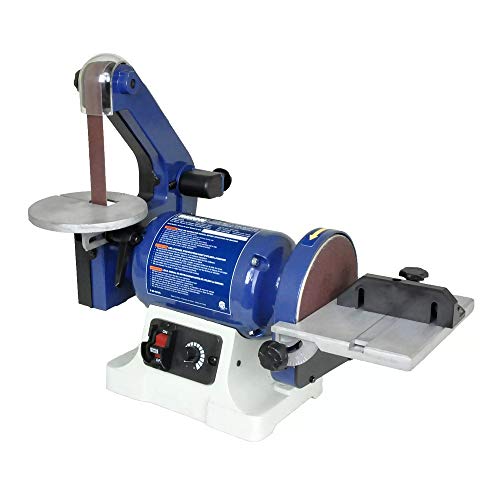
RIKON 50-2000
RIKON pairs a 1/2 HP motor with five spindle sizes from 1/4 inch to 1-1/2 inch, covering tight curves and broad edges on one benchtop unit. Oscillation runs near 58 strokes per minute, spreading wear evenly across sandpaper sleeves. Cast iron construction keeps the table flat, and it tilts cleanly to 45 degrees for beveled edges, according to owner reports.
Pros
- Five spindle sizes cover most curve work
- Cast iron table resists warping over time
- Dust port fits standard shop vacuum hoses
Cons
- No variable speed control
- 13 inch table limits large panel work

Ridgid EB4424
Ridgid combines a 4 by 24 inch oscillating edge belt with a spindle sander station, covering two tools in one footprint. A larger table and sturdier base handle repeated use on hardwood edges and curved cuts. Interchangeable spindles take inside curves while the belt handles straight edges and flat stock.
Pros
- Two sanding functions in one stationary machine
- Handles repeated shop use without overheating
- Sturdy base cuts vibration at higher spindle speeds
Cons
- Larger footprint than benchtop-only models
- Heavier build makes relocating it impractical
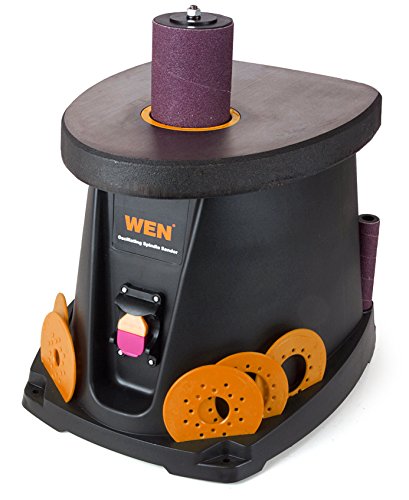
WEN 6510T
WEN keeps cost down while still offering oscillation and a tilting table, a common first spindle sander for hobbyists. Variable speed control slows oscillation for delicate profiles or speeds it up for stock removal. A 2-1/2 inch dust port connects to shop vacuums for basic dust control.
Pros
- Variable speed suits different materials and grits
- Light weight simplifies benchtop storage
- Tilting table handles beveled edges
Cons
- Lighter table stock flexes under heavy pressure
- Fewer spindle sizes included than pricier models
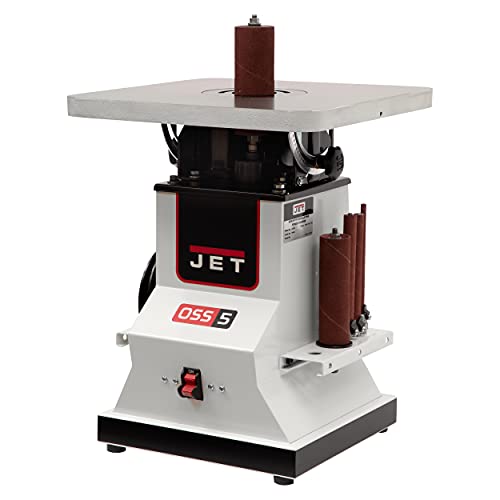
JET JBOS-5
JET targets woodworkers who prioritize table flatness and spindle accuracy over raw power. A 14 by 14 inch cast iron table supports wide curved panels and cabinet doors during sanding. Oscillation combined with spindle rotation reduces burn marks on fine hardwood edges.
Pros
- Larger table supports wide panel sanding
- Oscillation reduces sanding marks on hardwood
- Spindle range covers tight and broad curves
Cons
- Lower motor power than combo stationary units
- Premium cost compared to benchtop competitors
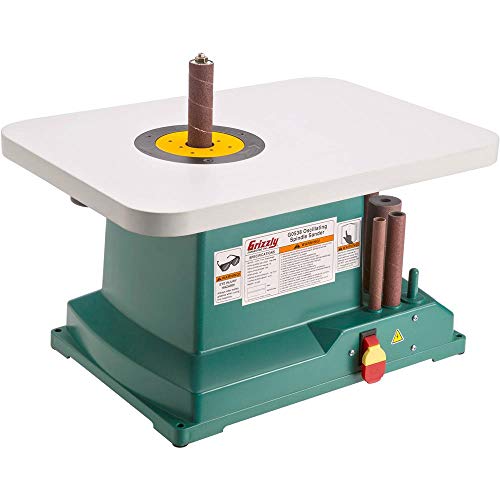
Grizzly G0538
Grizzly matches the spindle assortment and table size of pricier competitors at a lower relative cost. A 1/2 HP motor drives oscillation while the cast iron table tilts to 45 degrees for beveled work. Included spindle sizes cover common curve radii for cabinetry and trim, and assembly stays straightforward.
Pros
- Spindle range matches costlier competitors
- Cast iron table adds stability for the cost
- Straightforward assembly out of the box
Cons
- Dust collection less efficient than dedicated shop models
- No digital speed or oscillation readout
RIKON 50-2010
RIKON adds a digital speed readout and broader spindle range to its standard 50-2000 design, useful for shops running multiple wood types. A compact footprint keeps it practical where stationary tools won’t fit. Oscillation rate adjusts to match spindle diameter and material hardness.
Pros
- Digital readout simplifies speed adjustments
- Compact footprint suits limited shop space
- Spindle range covers small and wide curves
Cons
- Costs more than the standard 50-2000
- 13 inch table still limits large panel support

PORTER-CABLE PCB375OS
PORTER-CABLE keeps weight lower than cast iron competitors, easing storage or moves between benches. A tilting table and assorted spindle sizes cover typical hobbyist curve work without a stationary tool commitment. Oscillation combined with spindle rotation still reduces sanding marks despite the lighter build.
Pros
- Light weight simplifies storage and transport
- Tilting table handles common bevel angles
- Affordable entry point for occasional use
Cons
- Lighter table may flex under sustained pressure
- Fewer spindle sizes than premium benchtop models
How they compare
| # | Model | Motor | Best for | Score | Price |
|---|---|---|---|---|---|
| 1 | RIKON 50-2000 | 1/2 HP | Best overall | 9.4 | Check price |
| 2 | Ridgid EB4424 | Combo edge belt and spindle sander | Best for heavy duty use | 9.1 | Check price |
| 3 | WEN 6510T | 1/3 HP | Best budget | 8.9 | Check price |
| 4 | JET JBOS-5 | 1/3 HP | Best for fine woodworking | 8.7 | Check price |
| 5 | Grizzly G0538 | 1/2 HP | Best value | 8.5 | Check price |
| 6 | RIKON 50-2010 | 1/2 HP | Best for small shop | 8.3 | Check price |
| 7 | PORTER-CABLE PCB375OS | Lighter than cast iron benchtop models | Best for portability | 8.0 | Check price |
Questions worth asking
What is a spindle sander used for?
Spindle sanders smooth curved edges and inside cutouts on wood, using a rotating and oscillating drum sleeve that a router or jigsaw can’t easily reach.
Are oscillating spindle sanders worth it over fixed spindle models?
Oscillation spreads sandpaper wear across the sleeve height, cutting ring marks and extending sandpaper life compared to fixed, non-oscillating spindles.
Can a spindle sander work on metal or plastic?
Most benchtop spindle sanders target wood, though light plastic sanding works at slower oscillation speeds with the right sandpaper grit.
What spindle size fits tight curves?
Spindles between 1/4 inch and 1/2 inch diameter handle tight inside curves, while 2 to 3 inch spindles suit broader radii on cabinet doors.
Benchtop vs stationary spindle sander, which fits a small shop better?
Benchtop models fit small shops better since they store on a shelf, while stationary combo units suit shops with dedicated floor space for daily use.
How much dust collection does a spindle sander need?
A shop vacuum rated for a 2 to 2-1/2 inch hose connects to most spindle sander dust ports, though airborne dust still calls for a mask.
Is a drill press spindle sanding kit a good alternative?
Drill press kits cost less and suit occasional trim work, but they skip oscillation and wear sandpaper faster on regular curved sanding jobs.
How much motor power does hardwood sanding need?
Motors between 1/3 HP and 1/2 HP handle most hardwood curve sanding, while heavier combo edge belt machines add power for continuous shop use.
RIKON 50-2000 vs Ridgid EB4424, which should I buy?
RIKON 50-2000 suits hobbyists needing spindle variety in a small footprint, while Ridgid EB4424 fits shops that also need edge belt sanding daily.
Our take
RIKON 50-2000 takes the top spot for its five-spindle range, tilting cast iron table, and balance between price and capability for hobbyist and small shop use. Shops running both straight edges and curves daily should look at the Ridgid EB4424 combo machine instead, since its added belt capacity justifies the larger footprint. Buyers on a tighter budget who sand occasionally can start with the WEN 6510T and add spindle sizes later.
Jake Monroe
Jake worked as a residential contractor for over a decade before shifting to full-time writing. He evaluates power tools, hand tools and workshop gear through the lens of someone who has actually used them on job sites, not just read the box.


