How to Choose a Crimping Tool for Reliable Connections
The Knipex 97 52 04 leads on jaw precision and a ratchet that will not release early on insulated terminals. The Wirefy Crimping Tool is the value pick for heat shrink connectors. The Klein Tools VDV226-110 is the one to buy for RJ45 and telephone data work.
Knipex’s 97 52 04 tops this roundup because its ratchet will not release until the crimp finishes, and the jaws stay parallel under load. That combination separates a gas-tight joint from one that pulls apart within months. Wirefy’s Crimping Tool is the value pick for heat shrink butt connectors and ring terminals. Klein’s VDV226-110 handles RJ45 and modular data plugs as a specialist choice.
Crimping tools are harder to shop for than they look, since the word covers at least four unrelated jobs: insulated automotive terminals, open barrel connectors, network plugs and ferrules. A tool built for one connector family will mangle another. We compared die profiles and connector coverage, ratchet and release behaviour, jaw alignment, handle leverage and whether dies swap out, then weighed that against what owners report about long-term wear.
The shortlist, ranked

Knipex 97 52 04 Crimping Pliers
A self-adjusting ratchet and precision-ground dies stay parallel through the full stroke, so crimp quality stays consistent from the first terminal to the thousandth. The release lever exists for correcting mistakes, not as a shortcut. Based on specifications it targets insulated terminals across common wire gauges, which is why professionals reach for it when a failed joint means a return visit.
Pros
- Ratchet enforces a complete crimp every time
- Jaw alignment holds up after heavy use
- Comfortable leverage for repetitive work
Cons
- Costs several times more than basic crimpers
- Limited to one connector family
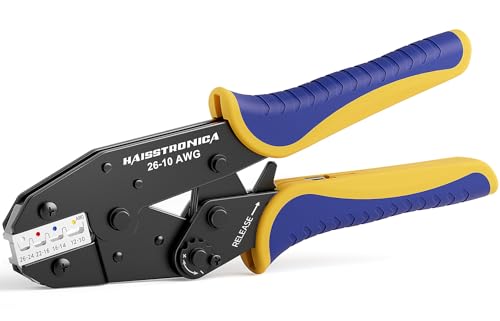
Wirefy Crimping Tool for Heat Shrink Connectors
Wirefy pairs this crimper with its own heat shrink connector line, and colour-coded die stations match the connector colours directly. The ratchet feels firm, and the release lever sits within easy reach. Owners report it handles common automotive and marine gauges well, though heavy battery lugs sit outside its range.
Pros
- Colour coding removes guesswork on gauge
- Consistent crimps on heat shrink butt connectors
- Strong value against professional tools
Cons
- Not suited to heavy battery lugs
- Ratchet feel trails premium units

Klein Tools VDV226-110 Ratcheting Modular Data Cable Crimper
Network plugs need a completely different die profile, one that presses eight gold contacts through conductor insulation at once. This Klein handles both RJ45 and smaller telephone plugs. An integrated stripper and cutter cover the whole termination in one tool. It is a specialist, so do not expect it to touch ring terminals.
Pros
- Reliable eight-contact seating on RJ45
- Strip and cut built into the same tool
- Ratchet prevents partial crimps
Cons
- Handles data connectors only
- Standard plugs only, not pass-through style

IWISS SN-28B Crimping Tool
Open barrel pins used in Dupont, JST and similar connector systems need dies that fold two sets of wings independently. Most electronics builders reach for the SN-28B to do exactly that. Placement is fiddly for the first few crimps until the pin position clicks. Hobby wiring harnesses and repairs benefit from a job nothing else here handles.
Pros
- Correct double-wing die profile for pin connectors
- Inexpensive for a specialist tool
- Handles very fine signal wire
Cons
- Steep learning curve on pin placement
- Useless for insulated automotive terminals

Titan 11477 Ratcheting Wire Terminal Crimper
Several die stations on one head cover insulated, non-insulated and ignition-style terminals, suiting a general workshop drawer over a single specialism. The ratchet feels firm and the tool weighs more than its price suggests. Precision trails the Knipex, but the connector coverage runs broader.
Pros
- Covers several terminal families in one tool
- Solid feel for the price
- Good general-purpose workshop choice
Cons
- Less precise than single-purpose crimpers
- Die stations can be awkward to reach

Klein Tools 1005 Wire Crimper Cutter Stripper
Most electricians carry a plier like this one, combining crimp stations for insulated and non-insulated terminals with stripping holes, a bolt cutter and a shear. No ratchet means crimp quality depends on grip strength and technique. One tool covering an entire rough-in without swapping is where it wins.
Pros
- Replaces several tools in a pouch
- Very durable under daily site use
- Bolt shear is genuinely useful
Cons
- Crimp quality depends on hand pressure
- No ratchet to enforce full compression

Platinum Tools EZ-RJPRO HD Crimp Tool
Pass-through RJ45 plugs let conductors exit the front so wire order gets verified before crimping, and this tool crimps and trims the protruding ends in one squeeze. That workflow beats trimming eight conductors to length by eye. It is a premium purchase that only pays off with regular network termination.
Pros
- Verify wire order before committing to the crimp
- Flush trim leaves a clean plug face
- Built for repeated professional use
Cons
- Expensive for occasional network jobs
- Works best with matching pass-through plugs
What to look for
Which crimp family are you actually buying for? Crimping covers unrelated jobs depending on the connector. Insulated spade and ring terminals need a die that compresses the sleeve without splitting it. Open barrel pins need a die that folds two sets of wings at different heights. Network plugs need a die that drives eight contacts down at once, and ferrules need a square or hexagonal profile. No single tool does all four well, so buy for the work you do most.
Why does ratcheting matter more than it sounds? A ratcheting crimper will not open until the jaws travel through the full compression cycle, removing the biggest variable: how hard the user squeezed. A non-ratcheting plier can produce a perfect crimp in strong hands and a loose one late in a long day. For anything carrying current in a vibrating environment, the ratchet is the single most valuable feature.
How do you judge a finished crimp? A good crimp is gas-tight, meaning no air gap remains between conductor strands and terminal barrel. Pull firmly on the wire as a practical test; it should not move the terminal at all. Look for a symmetrical indent, an unsplit insulation sleeve and no stray strands outside the barrel. Owners report most crimp failures trace back to the wrong die station, not the tool itself.
What details matter for wire gauge and strip length? Match the die station to the terminal colour, which encodes gauge range on insulated terminals. Strip only as much insulation as the barrel will cover, since exposed copper outside the crimp corrodes. Never tin stranded wire with solder before crimping; solder creeps under pressure and loosens the joint over time. Pair marine or automotive crimps with adhesive-lined heat shrink for extra protection.
How they stack up
| # | Model | Type | Best for | Score | Price |
|---|---|---|---|---|---|
| 1 | Knipex 97 52 04 Crimping Pliers | Ratcheting, insulated terminals | Best overall | 9.4 | Check price |
| 2 | Wirefy Crimping Tool for Heat Shrink Connectors | Ratcheting, insulated and heat shrink | Best value | 9.2 | Check price |
| 3 | Klein Tools VDV226-110 Ratcheting Modular Data Cable Crimper | RJ45, RJ12, RJ11 | Best for network cable | 9.0 | Check price |
| 4 | IWISS SN-28B Crimping Tool | Open barrel, non insulated pins | Best for open barrel pins | 8.8 | Check price |
| 5 | Titan 11477 Ratcheting Wire Terminal Crimper | Insulated, non insulated, ignition | Best for mixed terminal work | 8.6 | Check price |
| 6 | Klein Tools 1005 Wire Crimper Cutter Stripper | Compound plier, non ratcheting | Best for electricians | 8.3 | Check price |
| 7 | Platinum Tools EZ-RJPRO HD Crimp Tool | Pass through and standard RJ45 | Best for pass through plugs | 8.0 | Check price |
Frequently asked questions
What is the difference between a ratcheting and non-ratcheting crimper?
A ratcheting crimper locks through a full compression cycle and only releases once the crimp finishes, giving repeatable results regardless of hand strength. A non-ratcheting plier depends entirely on squeeze force, which makes quality inconsistent across a long job.
Can one crimping tool handle every connector type?
No. Insulated terminals, open barrel pins, network plugs and ferrules all need different die geometry. Multi-station tools cover two or three related families, but a tool claiming to do everything usually does none of it well.
Do I need to solder after crimping?
No, and it is generally worse. A proper crimp is gas-tight and mechanically sound on its own. Solder wicks up the strands and creates a stiff point where the wire fatigues and breaks, which is why aviation and automotive standards favor crimping alone.
How do I know if my crimp is good?
Pull firmly on the wire; a correct crimp will not let the terminal move. Check for a symmetrical indent, insulation that is gripped but not split, and no strands escaping the barrel. Cut it off and redo it if the terminal slides at all.
What size crimper do I need for battery cable?
Heavy battery lugs sit outside the range of hand crimpers in this list. Anything above roughly 8 gauge needs a hydraulic or hammer crimper with matching hex dies, since hand leverage cannot generate enough force.
Are cheap crimping tools worth buying?
For occasional light work, yes. The risk with the cheapest tools is jaw misalignment, which produces an off-centre crimp that looks fine and fails under vibration. Spend more if the joint carries meaningful current or lives in a vehicle.
What are pass-through RJ45 plugs?
They let conductors pass out the front of the plug so wire order gets confirmed visually before crimping, then a matching tool trims them flush. Network termination moves considerably faster this way, but it needs a compatible crimper.
Should I use a crimper or wire nuts for household wiring?
Household branch circuits in most regions use approved connectors such as wire nuts or lever connectors, not crimped terminals. Crimping belongs to low-voltage, automotive, marine, appliance and data work. Follow local electrical code for anything behind a wall.
Crimping tool vs terminal block: which is better for a junction?
A crimped and heat-shrunk joint holds up better in vibration or damp conditions than a terminal block, which relies on a set screw that can loosen. Terminal blocks win for connections you expect to open and reconfigure later. Permanent joints favor crimping.
The bottom line
For insulated terminals that must survive vibration, the Knipex 97 52 04 makes a good crimp the default rather than the outcome of a good day. The Wirefy Crimping Tool covers the same territory for occasional automotive and marine repairs at a far lower outlay. Network cable work calls for the Klein Tools VDV226-110 instead, since neither of the others touches RJ45.
Jake Monroe
Jake worked as a residential contractor for over a decade before shifting to full-time writing. He evaluates power tools, hand tools and workshop gear through the lens of someone who has actually used them on job sites, not just read the box.