Which Pure Sine Inverter Fits Your RV Solar Setup
Renogy’s 2000W Pure Sine Wave Inverter delivers the best balance of power and features for most RV solar setups. Reliability-focused owners lean toward the Victron Energy Phoenix Inverter 12/1200. Full-time RVers wired into a permanent panel do best with the Xantrex Freedom X 2000.
Renogy’s 2000W Pure Sine Wave Inverter leads this comparison for typical RV solar setups. It runs laptops, CPAP machines and induction cooktops without the hum that modified sine power causes. Boondockers running sensitive electronics benefit most from its low total harmonic distortion. Its remote control panel ships separately though, which some owners find inconvenient for dash mounting. Reliability-focused buyers should look instead at the Victron Energy Phoenix Inverter 12/1200, built around a sealed aluminum case.
Sizing an inverter for an RV takes more than checking the wattage printed on the box. Surge ratings, battery bank capacity and cable gauge all interact and change the real-world result. We compared continuous and surge power, waveform type, cooling design and owner-reported reliability across seven 12V pure sine inverters.
Our top picks

Renogy 2000W 12V Pure Sine Wave Inverter
Renogy pairs a 4000W surge rating with under 3 percent total harmonic distortion on this 2000W unit. Laptops and CPAP machines run without the hum that modified sine wave inverters cause. Two AC outlets plus a USB port cover typical RV appliance loads from one 12V battery bank, and built-in fans manage heat during extended blender or coffee maker use.
Pros
- Pure sine wave output protects sensitive electronics
- 4000W surge handles motor startup loads
- Two outlets plus USB cover most RV needs
Cons
- Remote control panel sold separately
- Fans run audibly under sustained load

Victron Energy Phoenix Inverter 12/1200
Victron builds the Phoenix 12/1200 around a sealed aluminum enclosure instead of a plastic shell. Owners credit that housing for surviving years of RV vibration. At 1200W continuous it suits lighter loads than the higher-wattage units here, trading capacity for efficiency and a low idle draw. No display ships standard, so monitoring needs a separate Bluetooth or VE.Direct accessory.
Pros
- Rugged aluminum housing resists vibration damage
- Low idle power consumption preserves battery charge
- Pure sine wave output with clean, stable voltage
Cons
- 1200W continuous rating limits larger appliances
- Monitoring display and remote sold as separate accessories

Xantrex Freedom X 2000 Inverter
Xantrex designed the Freedom X 2000 to hardwire directly into an RV’s AC distribution panel rather than plug in loose. That suits a permanent installation near water hookups, where its GFCI-protected outlet meets electrical code. A 4000W surge rating starts compressor loads, like a residential-style refrigerator, without tripping.
Pros
- Hardwire installation integrates with existing RV panels
- GFCI-protected outlet meets electrical code near wet areas
- 4000W surge starts compressor and motor loads reliably
Cons
- Installation is more involved than plug-and-play units
- Optional remote control panel adds to setup cost
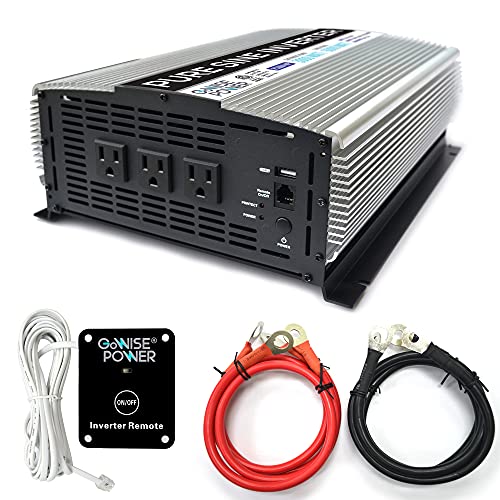
GoWISE Power 3000W Pure Sine Wave Inverter
At 3000W continuous with a 6000W surge rating, GoWISE covers larger loads, like a microwave and a space heater running together. A wired remote control included in the box lets owners switch it on from the living area instead of the battery compartment. Dual 12V DC input terminals accept heavier gauge cable for high current draw.
Pros
- 3000W continuous handles multiple large appliances at once
- Wired remote control included at no extra cost
- Dual input terminals support higher current wiring
Cons
- Higher continuous draw shortens battery bank runtime faster
- Larger chassis takes up more mounting space
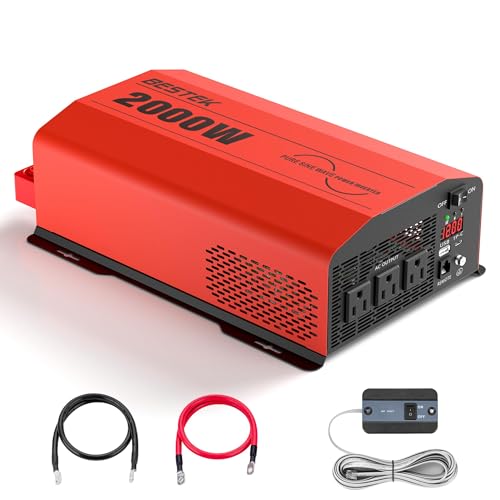
BESTEK 3000W Pure Sine Wave Power Inverter
BESTEK matches the 3000W continuous and 6000W surge output of pricier units at a lower cost, though the remote control is not included. Four AC outlets and two USB ports let several devices run at once from one unit. An LED display shows input voltage and output load without extra wiring.
Pros
- 3000W output at a lower cost than similar-spec rivals
- Four outlets plus two USB ports cover multiple devices
- Built-in LED display shows real-time voltage and load
Cons
- No wired remote control included in the box
- Cooling fans run louder than premium alternatives

AIMS Power 2000 Watt Pure Sine Inverter
AIMS built this 2000W inverter with an adjustable low battery shutoff, a feature that matters most when a solar array is the only charging source. A dedicated remote port lets owners add monitoring without opening the case. Owners running lithium battery banks report the adjustable threshold prevents over-discharge during cloudy stretches.
Pros
- Adjustable low battery shutoff protects solar battery banks
- Remote port supports optional monitoring accessories
- 4000W surge covers well pumps and power tools
Cons
- Larger and heavier than compact travel inverters
- Remote control sold separately from the base unit

Krieger 2000 Watt 12V Power Inverter
Krieger keeps setup simple with a wired remote control included and an ETL listing for straightforward installation before a weekend trip. Its 2000W continuous and 4000W surge rating cover a coffee maker, television and phone chargers without complex wiring. Owners who camp only a few weekends a month favor its lower duty cycle over units built for daily full-time use.
Pros
- Wired remote and ETL listing simplify quick setup
- 2000W continuous covers typical weekend appliance loads
- Compact size suits occasional installation and removal
Cons
- Not built for the duty cycle of daily full-time use
- Fewer outlets than higher-wattage competitors
What matters most
What to look for in an RV solar inverter Pure sine wave output matters most for RVs running laptops, CPAP machines or variable-speed compressors. Modified sine wave power can cause humming, overheating or shutdowns in that equipment. Continuous wattage shows what an inverter runs all day, while surge wattage only covers the split second a motor starts. Every inverter here accepts 12V DC input from a single or paired battery bank. Cooling fans, a wired remote and a low battery shutoff separate a basic unit from one built for daily use.
Sizing an inverter to your battery bank A 2000W inverter draws roughly 170 amps from a 12V battery bank at full load. That shortens runtime fast on a modest solar setup. Battery bank capacity, not solar panel wattage, usually limits how long an inverter runs once the sun goes down. Cable gauge between battery and inverter must match the surge rating, since undersized wire heats up and drops voltage under load. Pairing a higher-wattage inverter like the GoWISE or BESTEK with a small battery bank invites nuisance shutdowns instead of more usable power.
Full-time RVers vs weekend campers Full-time RVers benefit from a hardwired installation like the Xantrex Freedom X 2000, since it ties into the coach’s existing electrical panel. Weekend campers rarely need that complexity and do better with a plug-and-play unit like the Krieger that comes out of storage a few times a month. Daily use wears cooling fans and connectors faster, so a unit rated for continuous duty holds up better than a budget model pushed hard every day. Occasional use forgives a lighter duty cycle that full-time living would expose quickly.
When a modified sine wave inverter is still acceptable Every inverter on this list uses pure sine wave output, but modified sine wave units remain cheaper for basic resistive loads, like incandescent lighting or a simple heater. Motors, chargers and anything with a microprocessor run rougher or hotter on modified sine power. That is why RV owners running electronics have shifted away from it. A modified sine inverter can still work as a backup for tools that tolerate rougher power. For a primary RV inverter powering laptops or medical equipment, pure sine wave remains the safer standard.
Side by side
| # | Model | Continuous power | Best for | Score | Price |
|---|---|---|---|---|---|
| 1 | Renogy 2000W 12V Pure Sine Wave Inverter | 2000W | Best overall | 9.4 | Check price |
| 2 | Victron Energy Phoenix Inverter 12/1200 | 1200W | Best premium and most reliable | 9.2 | Check price |
| 3 | Xantrex Freedom X 2000 Inverter | 2000W | Best for full-time RV electrical systems | 9.0 | Check price |
| 4 | GoWISE Power 3000W Pure Sine Wave Inverter | 3000W | Best high wattage and best value | 8.7 | Check price |
| 5 | BESTEK 3000W Pure Sine Wave Power Inverter | 3000W | Best budget | 8.4 | Check price |
| 6 | AIMS Power 2000 Watt Pure Sine Inverter | 2000W | Best for solar battery bank setups | 8.2 | Check price |
| 7 | Krieger 2000 Watt 12V Power Inverter | 2000W | Best for occasional and weekend RV use | 8.0 | Check price |
Questions worth asking
What size inverter do I need for an RV?
Add up the running wattage of everything used at once, then check that figure against the continuous rating, not the surge rating. A 2000W inverter like the Renogy or Xantrex covers a coffee maker, laptop and television together. Larger loads, like a microwave alongside a space heater, call for 3000W units such as the GoWISE or BESTEK.
Is pure sine wave necessary for RV electronics?
For anything with a motor, compressor or microprocessor, yes. Modified sine wave power can make CPAP machines error out, laptops charge poorly and microwaves hum audibly. Pure sine wave output matches the clean power from a home outlet, which is why every inverter on this list uses it.
Can a 2000 watt inverter run a microwave?
A small 700 to 900 watt microwave runs fine on a 2000W continuous inverter, especially one with a 4000W surge rating like the Renogy or AIMS Power. Larger 1200 watt microwaves push closer to the limit, particularly with something else drawing power at the same time.
How do I connect an inverter to a solar battery bank?
Run heavy gauge cable directly from the battery bank to the inverter’s DC terminals, sized to the surge rating rather than just the continuous rating. Install a fuse or breaker close to the battery for safety. Keep cable runs short, since voltage drop over distance wastes power before it reaches the inverter.
What is the difference between continuous and surge wattage?
Continuous wattage is what an inverter supplies indefinitely without overheating. Surge wattage is a much higher figure delivered for a few seconds, mainly to start a motor or compressor. A 2000W continuous inverter with a 4000W surge rating can start a load that briefly spikes to 3500W, then settles back under 2000W.
Do RV inverters need a remote control?
Not strictly, but a remote saves a trip to the battery compartment every time the inverter switches on or off. The GoWISE, Krieger and Xantrex all include or support a wired remote for that reason. Units like the Victron Phoenix skip a built-in display, favoring a compact sealed housing instead.
How long will a battery bank run an inverter?
Divide the battery bank’s usable amp hours by the current the inverter draws at actual load, not its maximum rating. A 200 amp hour lithium bank running a 500W load through a 2000W inverter lasts several hours before reaching a safe discharge point. Drawing closer to the inverter’s full continuous rating cuts that runtime dramatically.
Can a modified sine wave inverter damage electronics?
It can, particularly with motors, transformers and switch-mode power supplies that run hotter on the choppier waveform. Some devices simply refuse to start or throw errors on modified sine power. Pure sine wave inverters avoid that risk entirely, which is why RV owners running sensitive equipment favor them despite the higher cost.
Which RV inverter is best for a full-time hardwired setup?
The Xantrex Freedom X 2000 is built for that job, wiring directly into an RV’s AC distribution panel instead of plugging in loose. Its GFCI-protected outlet meets code requirements near water hookups, and its 4000W surge rating starts compressor loads without tripping.
Our pick
Most RV owners running everyday electronics off a solar battery bank get the best balance from the Renogy 2000W Pure Sine Wave Inverter, thanks to its surge rating and cooling without the premium price of the Victron Phoenix. Full-time RVers who want a permanent, code-compliant installation should choose the Xantrex Freedom X 2000 instead. Weekend campers who just need simple, occasional power are better served by the Krieger 2000 Watt, which skips features that full-timers pay for and rarely use.
Tony Russo
Tony trained as an automotive technician and spent years in service and parts retail before moving into writing. He focuses on garage tools, car care products and accessories from a hands-on maintenance perspective.


