Which Smart Water Leak Detector Stops Damage Before It Spreads
For whole-home protection with automatic shutoff, the Moen Flo Smart Water Monitor and Shutoff ranks first among these seven. Point sensors cost less, and the Govee WiFi Water Sensor balances price against reliability best. Large properties need extra range, and the YoLink Water Leak Sensor’s hub reaches basements and detached garages standard WiFi misses.
Most water damage claims trace to a slow leak, not a sudden burst pipe. The Moen Flo Smart Water Monitor and Shutoff cuts the water supply automatically once it detects an abnormal flow pattern. Point sensors such as the Govee WiFi Water Sensor cost far less and still catch leaks at specific risk spots.
Some sensors need a dedicated hub or bridge, and wireless range varies enough that a unit rated for one room may not reach a basement. We compared detection method, shutoff capability, hub requirements and battery life using each listing’s published specifications and owner feedback.
What to look for
How do smart water leak detectors work? Most detectors use contact pins or a probe that closes a circuit when water touches it. That contact triggers an alert within seconds. Whole-home valve systems work differently, tracking flow rate and pressure across the plumbing instead of waiting for direct contact. Hidden leaks inside walls trip these systems long before a point sensor ever gets wet.
Do you need a hub, and how much wireless range matters? Some sensors connect straight to WiFi and skip extra hardware entirely. Others need a dedicated hub or bridge, which usually improves range and battery life in exchange for one more device on the network. Zigbee sensors like the Aqara model trade a hub purchase for tighter smart home integration. Detached garages and large basements benefit most from long-range hub systems such as YoLink.
Automatic shutoff vs alert-only sensors: which do you need? An alert-only sensor still needs a person to notice the notification and turn off the water by hand. That gap matters during vacations or overnight, when nobody checks a phone for hours. Whole-home shutoff systems close a valve automatically once they detect a leak pattern, limiting damage even with the house empty. This capability explains most of the price gap between a valve system and a handful of point sensors.
Where should you place water leak sensors in your home? Under sinks, behind toilets, near water heaters and beside washing machines account for most residential leaks. A single whole-home monitor covers every one of these spots from one install point. Point sensors need a unit placed at each risk area individually. Basements and crawl spaces deserve a sensor too, since slow foundation leaks often go unnoticed longest there.
What we recommend

Moen Flo Smart Water Monitor and Shutoff
Installed at the main water line, this device tracks flow patterns across the whole home. It shuts the water supply automatically once it detects a leak signature. Daily pressure tests flag hidden leaks before they surface, and owners cite the automatic shutoff as the top reason to pick it over point sensors alone.
Pros
- Automatic shutoff limits damage without anyone home
- One install point monitors the entire home
- Daily flow tests catch slow leaks before they surface
Cons
- Professional installation adds setup cost and time
- Doesn’t pinpoint the exact leak location
Govee WiFi Water Sensor
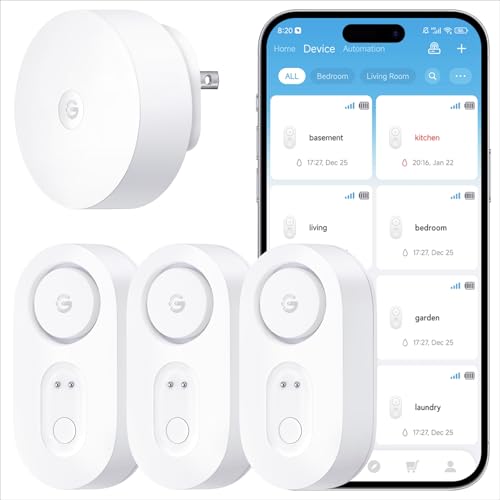
A single probe under a sink or near a water heater triggers a local alarm the moment water touches its pins. WiFi connects directly to the router, skipping any hub or bridge. Several units cost little enough to cover multiple risk spots at once.
Pros
- Connects straight to WiFi with no hub required
- Local 100-decibel alarm backs up the phone alert
- Low enough cost to place several around the home
Cons
- Detects only water that touches the sensor directly
- No automatic shutoff capability

YoLink Water Leak Sensor
A dedicated YoLink hub extends range well beyond typical WiFi sensors. Signals reach basements, garages and detached structures that lose connection to a router. Multiple sensors report to the same hub, useful for covering a sprawling property from several points.
Pros
- Wireless range covers detached garages and basements
- Multi-year battery life reduces maintenance visits
- One hub supports many sensors across a property
Cons
- Requires purchasing a separate hub
- No automatic water shutoff
Wyze Leak Sensor
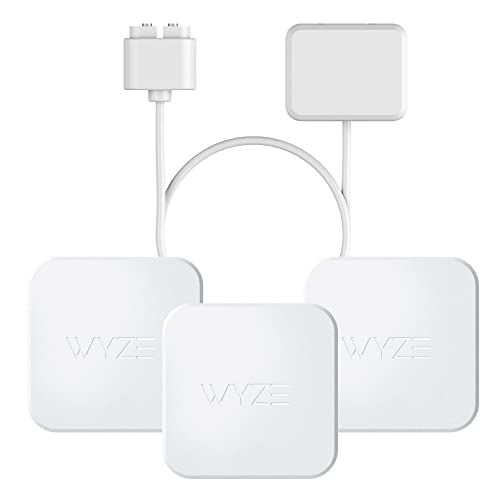
Paired with a Wyze bridge, this sensor detects standing water and pushes an alert to the Wyze app. Its compact size fits behind toilets or under narrow appliance gaps. Existing Wyze camera owners add leak detection to the same app without opening a new account.
Pros
- Lowest price point among sensors in this comparison
- Compact shape fits tight spaces behind fixtures
- Shares an app with existing Wyze cameras
Cons
- Needs a separate bridge device to function
- Shorter range than dedicated long-range sensors

Aqara Water Leak Sensor
Zigbee connectivity through an Aqara hub lets this sensor trigger routines with other smart devices, such as closing a smart valve or flashing lights. HomeKit, Alexa and Google Home all pick it up once paired through the hub. Households already running Aqara or HomeKit gear report the fastest setup in this comparison.
Pros
- Triggers automations with other smart home devices
- Works across HomeKit, Alexa and Google Home
- Roughly two years of battery life between swaps
Cons
- Requires an Aqara hub if you don’t already own one
- No automatic shutoff on its own
Honeywell Lyric WiFi Water Leak and Freeze Detector
Beyond standing water, this sensor tracks ambient temperature and warns before pipes near freezing. Unheated basements and crawl spaces see the most winter pipe bursts. Standalone WiFi connectivity skips the need for any hub.
Pros
- Freeze alert warns before pipes burst in winter
- No hub required for setup
- Roughly two years of battery life
Cons
- No automatic shutoff capability
- Larger footprint than compact point sensors

D-Link Wi-Fi Water Leak Sensor
Direct WiFi connectivity skips any bridge or hub, pairing straight to the home router through a companion app. An external probe on a cord reaches tighter spaces than the sensor body alone. Households without an existing smart home ecosystem get a simple, hub-free setup.
Pros
- No hub or bridge needed for setup
- External probe reaches narrow spaces easily
- Pairs to WiFi in a few app steps
Cons
- No automatic shutoff capability
- Limited smart home ecosystem integration
Compared at a glance
| # | Model | Detection method | Best for | Score | Price |
|---|---|---|---|---|---|
| 1 | Moen Flo Smart Water Monitor and Shutoff | Whole-home flow monitoring | Best overall | 9.4 | Check price |
| 2 | Govee WiFi Water Sensor | Contact sensor pins | Best value | 9.0 | Check price |
| 3 | YoLink Water Leak Sensor | Contact sensor pins | Best for large homes | 8.8 | Check price |
| 4 | Wyze Leak Sensor | Contact sensor pins | Best budget | 8.5 | Check price |
| 5 | Aqara Water Leak Sensor | Contact sensor pins | Best for smart home integration | 8.3 | Check price |
| 6 | Honeywell Lyric WiFi Water Leak and Freeze Detector | Contact sensor pins plus temperature sensor | Best for freeze detection | 8.1 | Check price |
| 7 | D-Link Wi-Fi Water Leak Sensor | External probe on a cord | Best for standalone setup | 8.0 | Check price |
Questions worth asking
Do smart water leak detectors need WiFi?
Many connect directly to home WiFi, while others rely on a Zigbee or proprietary hub that then links to WiFi. Standalone WiFi sensors set up faster but can lose signal sooner than hub-based systems in a large home.
Can a smart water sensor shut off the water automatically?
Only whole-home systems installed at the main line, like the Moen Flo, include an automatic shutoff valve. Standalone point sensors send an alert only and rely on a person to close the water manually.
Where should you place water leak sensors?
Under sinks, behind toilets, near water heaters, by washing machines and in basements cover the most common leak sources. Set sensors flat on the floor where water pools first, not on a shelf.
How long do batteries last in a water leak sensor?
Most standalone sensors run one to two years on included batteries, depending on how often they check in with the hub or app. Zigbee-based sensors generally report longer battery life than direct WiFi sensors.
Is a whole-home water monitor worth it over point sensors?
Whole-home systems track flow and pressure across every pipe, catching leaks inside walls that point sensors never detect, and some shut the water off automatically. That extra coverage and shutoff capability explains most of the price difference.
Do water leak sensors work without a phone app?
Nearly all current models require a companion app for setup and remote alerts, though many also sound a local audible alarm as backup. Losing WiFi or hub connectivity does not usually disable that local alarm.
Can a water leak sensor detect frozen pipes?
Only models with a built-in temperature sensor, like the Honeywell Lyric, warn about freeze risk in addition to standing water. Standard contact sensors detect water only, not ambient temperature.
Do you need a separate hub for every smart water sensor?
It depends on the connectivity type. Direct WiFi sensors need no extra hardware, while Zigbee or proprietary long-range sensors require a dedicated hub that typically supports many sensors at once.
How many leak sensors does an average home need?
Most homes place four to six sensors, covering the water heater, under each sink, the washing machine and the basement floor. Larger or multi-story homes often add a few more at secondary bathrooms.
Our pick
The Moen Flo Smart Water Monitor and Shutoff stands apart for pairing whole-home detection with an automatic valve shutoff. Budget-conscious buyers still get solid protection from point sensors like the Govee WiFi Water Sensor placed at key risk spots. Larger properties should lean on the YoLink system’s extended wireless range instead of pushing a standard WiFi sensor past its limit.
Marcus Chen
Marcus covered consumer electronics for enthusiast tech publications for six years before joining ChoiceCrest. He specializes in translating manufacturer spec sheets into plain-language buying advice, with a focus on audio, computing accessories and smart-home gear.