Which smart temperature sensor suits your rooms?
SwitchBot Meter Pro fits most homes, using a Sensirion element rated to 0.2 degrees Celsius behind a screen readable from a doorway. Govee H5179 reports over Wi-Fi with no hub at all. Aqara covers several rooms cheaply on Zigbee coin cells.
SwitchBot Meter Pro answers the ordinary case. Readings sit on a wide LCD, history stays in the app, and two AAA cells run it for about a year. Alerts while you are out need a SwitchBot hub, which is the one real catch. Govee H5179 skips that step by joining Wi-Fi directly.
Listings rarely make accuracy comparable, and radio choice quietly decides whether a reading reaches your phone from the office. We compared published tolerances, battery format, logging depth and hub requirements. Owner reports on humidity drift and battery drain then shaped the order.
How to pick the right one
What to look for in a smart temperature sensor Accuracy comes first, and most listings publish a tolerance in degrees Celsius. Anything inside 0.5 C covers comfort monitoring. Cellars, humidors and food storage want 0.3 C or tighter. Check whether humidity is measured as well, since damp is what ruins basements and instrument cases. Battery format matters more than buyers expect, because a coin cell in a loft means a ladder twice a year. Confirm how far back the app keeps readings too. One live number tells you almost nothing about a room.
Wi-Fi vs Zigbee vs Bluetooth: which protocol fits your home Wi-Fi sensors report from anywhere and need no extra hardware, yet they drain cells fast and usually want a permanent outlet. Bluetooth units such as the SwitchBot Meter Pro cost less and last longer, though readings stay inside the house unless a hub relays them. Zigbee lands in the middle. Tiny batteries stretch to years, range hops between mains powered devices, and a hub is mandatory. Households already running SmartThings, Hubitat or Home Assistant should default to Zigbee and buy sensors in multiples.
Best sensors for bedrooms, nurseries and comfort tuning Position matters more than brand in a bedroom. Keep the sensor off exterior walls, away from vents and lamps, roughly at sleeping height. Humidity is the number behind night coughs and dry skin, so a combined unit beats a temperature only probe. Ecobee SmartSensor is the shortcut, because it changes what the heating does rather than only reporting. Where the thermostat is another brand, pair a Zigbee or Bluetooth sensor with an automation platform. Same result, more setup evenings.
Freezers, greenhouses, garages and crawl spaces Sealed metal appliances block radio, which is exactly why the Inkbird IBS-TH2 Plus runs a wired probe. Greenhouses and garages swing far wider than living rooms, so read the stated operating range instead of assuming. Alerts are the real feature out here. Nobody opens an app in time to notice a chest freezer failed on Saturday night. Govee H5179 and SensorPush HT.w both earn their place for that reason, since a Bluetooth only sensor cannot reach you at work.
Our top picks

SwitchBot Meter Pro
A Sensirion sensing element drives this one, rated to 0.2 degrees Celsius and 2 percent relative humidity. Numbers sit large on a wide LCD, checkable from a doorway without reaching for a phone. Roughly a month of history stays on the device, though remote alerts need a SwitchBot Hub Mini or Hub 2.
Pros
- Digits stay legible from across a room
- Stored history exports as a CSV file
- Triggers SwitchBot automations once a hub is added
Cons
- Away from home alerts require a separate hub
- Bluetooth range shortens through masonry walls

Govee WiFi Thermometer Hygrometer H5179
Wi-Fi lives inside the unit, so readings reach the Govee app from anywhere with no bridge in between. High and low thresholds fire push alerts, and logged data downloads as CSV for later comparison. Batteries or a USB cable both power it, handy in a garage with one free outlet.
Pros
- Reports to your phone without extra hardware
- Threshold alerts flag a failing freezer early
- USB power suits permanent placements
Cons
- Joins 2.4 GHz networks only
- Battery life falls sharply on frequent reporting

Aqara Temperature and Humidity Sensor
Zigbee keeps this puck tiny and frugal, running about two years on one CR2032 cell. Pairing runs through an Aqara hub, which then exposes readings to Apple Home, Alexa and Google Home. Air pressure arrives as a third measurement, useful for weather style automations.
Pros
- Small enough to hide on a shelf edge
- Reaches Apple Home through an Aqara hub
- Coin cell life suits lofts and crawl spaces
Cons
- No display, so readings live only in an app
- Does nothing at all until a hub is paired
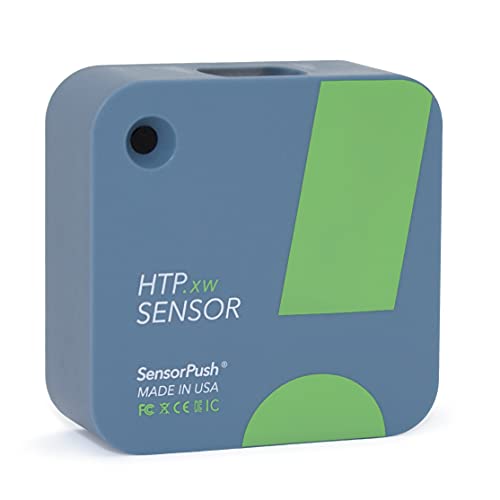
SensorPush HT.w WiFi Temperature Humidity Sensor
Tight published tolerances are why people pick this over a general smart home sensor. Wi-Fi is built into the HT.w version, removing the separate gateway earlier SensorPush models needed. Wine cellars, humidors, reptile rooms and network closets are its usual posts.
Pros
- Published tolerance beats typical home sensors
- Email and push alerts on custom thresholds
- Graphing tools suit long term trend watching
Cons
- Needs an outlet nearby, which limits placement
- App design lags behind Govee and SwitchBot

Ecobee SmartSensor
Temperature and occupancy both feed an Ecobee thermostat, which can average rooms or follow whoever is home. Dropped in a cold back bedroom, it stops the hallway thermostat deciding for the whole house. Outside the Ecobee ecosystem it does nothing.
Pros
- Changes what the heating does, not just what you know
- Occupancy sensing shifts output toward used rooms
- Pairs in a couple of minutes from the thermostat screen
Cons
- Worthless without an Ecobee thermostat
- CR2477 cells are harder to find locally

ThirdReality Zigbee Temperature Humidity Sensor
Cheap Zigbee coverage is the entire point, and it joins SmartThings, Hubitat, Home Assistant and Zigbee capable Echo hubs. A small LCD on the face shows the live reading, which rivals at this level usually drop. Adhesive backing plus a stand cover wall and shelf mounting.
Pros
- Pairs with most third party Zigbee hubs
- Local screen still reads when the hub is down
- AAA cells are stocked in any shop
Cons
- Reports nothing without an existing Zigbee hub
- Humidity drifts more than on premium units

Inkbird IBS-TH2 Plus
An external probe on a cable is the reason to buy this one. Only the probe goes inside the freezer, leaving the radio outside the metal box where Bluetooth still works. Readings collect on the device and sync once your phone comes back in range.
Pros
- Probe reads inside sealed appliances reliably
- Logs continue while your phone is elsewhere
- Rated for deep freeze temperatures other sensors refuse
Cons
- Bluetooth only, so no alerts from work
- Cable has to route through a door gasket
How they compare
| # | Model | Accuracy | Best for | Score | Price |
|---|---|---|---|---|---|
| 1 | SwitchBot Meter Pro | 0.2 C temperature, 2% RH | Best overall | 9.4 | Check price |
| 2 | Govee WiFi Thermometer Hygrometer H5179 | 2.4 GHz Wi-Fi, no hub | Best value | 9.2 | Check price |
| 3 | Aqara Temperature and Humidity Sensor | Zigbee 3.0, Aqara hub required | Best for covering many rooms | 9.0 | Check price |
| 4 | SensorPush HT.w WiFi Temperature Humidity Sensor | 0.3 C temperature, 3% RH | Best for precision monitoring | 8.8 | Check price |
| 5 | Ecobee SmartSensor | Ecobee smart thermostats only | Best for evening out cold rooms | 8.5 | Check price |
| 6 | ThirdReality Zigbee Temperature Humidity Sensor | Zigbee 3.0 | Best budget | 8.3 | Check price |
| 7 | Inkbird IBS-TH2 Plus | Wired external probe included | Best for fridges and freezers | 8.0 | Check price |
Good to know
What is the most accurate smart temperature sensor for home use?
SwitchBot Meter Pro publishes the tightest figure here at 0.2 C, using a Sensirion element. SensorPush HT.w follows at 0.3 C with 3 percent humidity. Either reads far closer than the number shown on a wall thermostat.
Do smart temperature sensors need a hub?
Radio choice decides it. Zigbee models such as Aqara and ThirdReality always need one. Bluetooth units like SwitchBot Meter Pro work locally alone but want a hub for alerts away from home. Wi-Fi sensors including Govee H5179 need nothing extra.
Which smart temperature sensor works with Apple HomeKit?
Aqara Temperature and Humidity Sensor reaches Apple Home once paired to an Aqara hub, the cleanest route in this group. SwitchBot exposes some devices through Hub 2. Govee, Inkbird and Ecobee report through their own apps instead.
Can a temperature sensor monitor a freezer?
Only with a probe or a very short signal path. Inkbird IBS-TH2 Plus places a wired probe inside while the radio stays outside the door. Sealing a Wi-Fi sensor inside a freezer usually kills the signal and flattens the battery.
How long do batteries last in a smart temperature sensor?
Coin cell Zigbee units such as Aqara commonly reach two years, since packets are tiny and infrequent. AAA powered Bluetooth models run around a year. Wi-Fi sensors drain much faster, which is why Govee H5179 and SensorPush HT.w accept USB power.
Is a smart temperature sensor worth it for one room?
For a living room that already feels fine, probably not. Value shows up when a room disagrees with the thermostat, or when something valuable sits in it. Wine, reptiles, instruments, seedlings and frozen food each justify one alone.
SwitchBot Meter Pro vs Govee H5179: which should you buy?
Pick SwitchBot for the readable screen, longer battery life and automation links to other SwitchBot gear. Pick Govee when remote alerts outrank the display and buying a hub is off the table. Both log history and export CSV files.
Where should a temperature sensor be placed for accurate readings?
Avoid exterior walls, supply vents and direct sun. Chest height reflects what people actually feel in a room. Radiators, lamps and electronics all lift readings by a degree or more, so leave clear space around the unit.
Can smart temperature sensors fix a cold room?
Only the ones wired into heating control. Ecobee SmartSensor tells the thermostat to average that room or follow occupancy. Standalone sensors from Govee or Aqara only report the problem unless an automation platform acts on the data.
The verdict
SwitchBot Meter Pro takes the top spot for ordinary homes: accurate to 0.2 C, readable without a phone, and cheap to run on AAA cells. Add a SwitchBot hub only when alerts away from home matter. Anyone watching a freezer, cellar or greenhouse should skip it for the Inkbird IBS-TH2 Plus or SensorPush HT.w, because the probe and the remote alerts are what actually prevent losses.
Marcus Chen
Marcus covered consumer electronics for enthusiast tech publications for six years before joining ChoiceCrest. He specializes in translating manufacturer spec sheets into plain-language buying advice, with a focus on audio, computing accessories and smart-home gear.
You might also need
Smart Home Hubs Compared: Zigbee, Z-Wave and Matter Support

Top Whiteboard Bulk Packs for Offices and Classrooms

Smart Presentation Remotes That Keep You in Control
