Which RV Surge Protector Actually Catches Wiring Faults?
Progressive Industries EMS-PT50X leads for full fault diagnostics in a portable unit. Hughes Autoformers Power Watchdog PWD50-EPO suits owners who want live voltage readings on a phone. Southwire Surge Guard 44280 fits 30-amp rigs needing app monitoring without the higher cost.
Progressive Industries EMS-PT50X checks voltage, frequency and wiring faults before power ever reaches the rig, then displays results on its own screen. Hughes Autoformers Power Watchdog PWD50-EPO sends that same data to a phone over Bluetooth, so a voltage check no longer means walking outside. Southwire Surge Guard 44280 brings app monitoring to 30-amp campers at a friendlier cost. Each unit cuts power automatically the moment a reading turns unsafe.
A basic surge protector only blocks spikes, while an electrical management system, or EMS, checks voltage, polarity and frequency first. Bluetooth models add live monitoring from inside the RV instead of a walk to the pedestal. We compared amperage, protection type, app features and mounting style, then weighed owner reports on false trips and app reliability.
The shortlist, ranked

Progressive Industries EMS-PT50X 50 Amp Portable EMS
This portable EMS checks voltage, frequency, open ground and reverse polarity before letting power through. Automatic shutoff kicks in the moment any reading drifts unsafe. A backlit LCD shows live voltage and amperage draw. Locking hardware secures it to the pedestal against theft.
Pros
- Checks wiring faults, not just voltage spikes
- Shuts off automatically on unsafe readings
- Locking design deters pedestal theft
Cons
- No Bluetooth app monitoring
- Bulkier and heavier than basic surge guards

Hughes Autoformers Power Watchdog PWD50-EPO
Bluetooth sends live voltage, amperage and fault data straight to a phone app. Checking pedestal power no longer requires leaving the rig. The app logs history and pushes alerts when shore power drifts out of range. Automatic shutoff catches the same faults a standalone EMS does.
Pros
- Live voltage readings appear on a phone app
- Push alerts flag power issues remotely
- Matches the fault shutoff of top EMS units
Cons
- Requires a phone within Bluetooth range
- Costs more than non-app EMS models
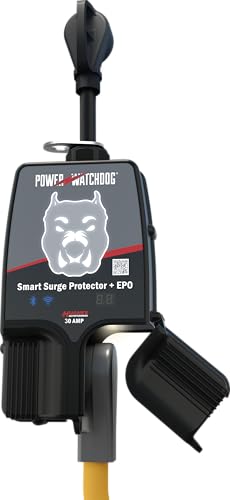
Hughes Autoformers Power Watchdog PWD30-EPO
Smaller travel trailers running 30-amp service get the same Bluetooth app monitoring as the 50-amp model, scaled to a lower current rating. Voltage, fault and history data appear in the same app interface. A separate adapter is needed before it works on a 50-amp pedestal.
Pros
- Sized correctly for 30-amp campers
- Full app monitoring at the lower amperage
- Automatic shutoff on the same fault list
Cons
- Needs an adapter for 50-amp pedestals
- Lower current ceiling limits larger rigs

Southwire Surge Guard 44280 Portable 30 Amp
Southwire adds Bluetooth to its established surge and voltage protection at a friendlier cost than the Power Watchdog line. The app shows real-time status and fault codes. Housing stays weather-resistant, though it feels slightly less rugged than premium EMS rivals.
Pros
- App monitoring at a lower price point
- Established brand with wide dealer support
- Covers the main fault types RVers face
Cons
- Housing feels less rugged than premium rivals
- Fewer fault categories than a full EMS
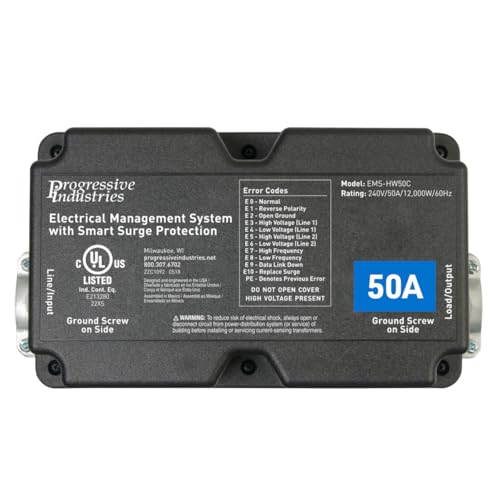
Progressive Industries EMS-HW50C 50 Amp Hardwired EMS
Wiring this unit directly into the RV’s electrical system removes the theft risk of a pedestal-mounted plug-in. A remote display mounts inside the rig, so status shows without stepping outside. Installation calls for an RV technician or real comfort with 120-volt wiring.
Pros
- No pedestal-mounted unit exposed to theft
- Interior display readable without going outside
- Same full fault protection as the portable EMS
Cons
- Professional installation is usually required
- Cannot move between different RVs

Southwire Surge Guard 34931 Portable 50 Amp
LED indicator lights communicate fault codes on the unit itself, covering open ground, reverse polarity and abnormal voltage without an app. Automatic shutoff protects connected appliances the same way pricier units do. Skipping Bluetooth keeps the cost down for budget-focused buyers.
Pros
- Covers the main fault types without an app
- Automatic shutoff protects rig electronics
- Costs less than Bluetooth-enabled models
Cons
- No remote or app monitoring
- LED codes require checking a chart to decode
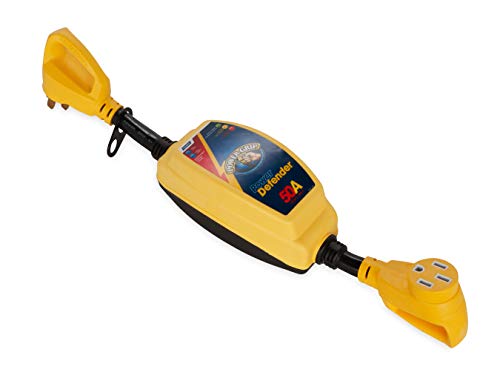
Camco 55305 Power Defender 50 Amp Portable Surge Protector
This unit focuses on surge suppression and basic voltage protection rather than full EMS fault diagnostics. Indicator lights show connection status and basic fault conditions. Owners camping mostly at newer, reliably wired campgrounds get simple, affordable coverage here.
Pros
- Straightforward setup with no app needed
- Costs less than full EMS units
- Indicator lights confirm a safe connection quickly
Cons
- Lacks the detailed fault diagnostics of an EMS
- No Bluetooth or remote monitoring option
How to choose
Surge protector versus electrical management system A basic surge protector blocks voltage spikes but ignores wiring faults like open ground or reverse polarity, both common at older campgrounds. An EMS checks all of that before connecting power, then shuts off automatically once anything drifts unsafe. Full-time RVers gain the most from that added fault coverage.
What Bluetooth and app features actually add An app shows live voltage and fault status from inside the rig, skipping the walk out to a pedestal-mounted screen. History logging helps spot a campground with chronically low voltage over a multi-day stay. Core protection stays identical with or without the app, since connectivity is a convenience layer.
Which amperage does your RV need? Match the protector to your RV’s shore power cord rating, 30 amp for most travel trailers and smaller rigs, 50 amp for larger motorhomes and fifth wheels running more appliances. Running a 30-amp protector on a 50-amp rig through an adapter limits available power instead of protecting all of it.
Portable versus hardwired protection Portable units plug in at the pedestal and travel between campgrounds, though they sit outside where theft becomes a small risk. Hardwired systems mount permanently inside the RV, removing that risk while adding installation cost and losing portability if you switch RVs.
How they compare
| # | Model | Amperage | Best for | Score | Price |
|---|---|---|---|---|---|
| 1 | Progressive Industries EMS-PT50X 50 Amp Portable EMS | 50 amp | Best overall | 9.4 | Check price |
| 2 | Hughes Autoformers Power Watchdog PWD50-EPO | 50 amp | Best app monitoring | 9.2 | Check price |
| 3 | Hughes Autoformers Power Watchdog PWD30-EPO | 30 amp | Best for 30-amp rigs | 9.0 | Check price |
| 4 | Southwire Surge Guard 44280 Portable 30 Amp | 30 amp | Best value with app | 8.7 | Check price |
| 5 | Progressive Industries EMS-HW50C 50 Amp Hardwired EMS | 50 amp | Best for permanent installation | 8.5 | Check price |
| 6 | Southwire Surge Guard 34931 Portable 50 Amp | 50 amp | Best budget with diagnostics | 8.2 | Check price |
| 7 | Camco 55305 Power Defender 50 Amp Portable Surge Protector | 50 amp | Best basic protection | 8.0 | Check price |
Frequently asked questions
What is the difference between a surge protector and an EMS for RVs?
A surge protector only blocks voltage spikes. An EMS also checks for open ground, reverse polarity and frequency issues, cutting power automatically before those faults reach the RV’s wiring.
Do I need a smart RV surge protector with Bluetooth?
It is not required, but it lets you check voltage and fault status from inside the RV instead of walking to the pedestal. Non-Bluetooth EMS units offer the same core protection, just without remote viewing.
Is 30 amp or 50 amp surge protection right for my RV?
Match the protector to your RV’s shore power cord rating, printed on the plug or listed in the owner’s manual. Most travel trailers run on 30 amp, while larger motorhomes and fifth wheels typically need 50 amp.
Can a portable RV surge protector be stolen?
Yes, since it sits outside on the power pedestal between uses. Locking models like the Progressive Industries EMS-PT50X cut that risk, and hardwired systems remove it entirely by mounting inside the RV.
How does a surge protector prevent electrical damage?
It monitors incoming voltage and cuts power automatically once it detects a spike, drop or wiring fault, protecting appliances and wiring before damage occurs.
Do hardwired RV EMS units need professional installation?
Most owners hire an RV technician, since a hardwired unit connects directly into the RV’s 120-volt electrical panel. Portable units need no installation beyond plugging in at the pedestal.
What campgrounds are most likely to have bad wiring?
Older parks and remote campgrounds see more open ground and reversed polarity faults than newer, well-maintained facilities. An EMS matters most for full-time travelers visiting varied locations.
Which smart RV surge protector has the best app?
Owners frequently praise the Hughes Autoformers Power Watchdog series for live voltage readings, fault history and reliable push alerts through its companion app.
RV surge protector vs whole-house surge protector, are they the same?
No. A whole-house unit protects a fixed building’s wiring, while an RV surge protector plugs in at the pedestal and travels with the rig, checking each new campground’s power before connecting.
The bottom line
Choose the Progressive Industries EMS-PT50X when full fault diagnostics matter more than app convenience. Owners who want live monitoring from inside the rig should pick the Hughes Autoformers Power Watchdog PWD50-EPO instead. Budget-focused 30-amp campers get app monitoring without the higher cost by choosing the Southwire Surge Guard 44280.
Tony Russo
Tony trained as an automotive technician and spent years in service and parts retail before moving into writing. He focuses on garage tools, car care products and accessories from a hands-on maintenance perspective.


