Smart Projectors With Built-In Android TV or Google TV
The XGIMI Horizon Pro leads for most living rooms, pairing Android TV 10 with dual Harman Kardon speakers and automatic screen alignment. The Anker Nebula Cosmos Laser 4K delivers true 4K detail, and the Anker Nebula Capsule 3 Laser is the easiest to pack for travel.
Living rooms fit the XGIMI Horizon Pro best: Android TV 10 loads streaming apps directly, automatic screen alignment squares the image in seconds, and dual 16W Harman Kardon speakers replace a soundbar. Its 1080p native panel is the tradeoff, since it downscales true 4K sources.
Brightness, native resolution and onboard platform differ enough between smart projectors that spec sheets alone can mislead. We compared official specs, Amazon listings and owner feedback on setup speed, daylight visibility and speaker output before ranking these seven.
The top picks, ranked

XGIMI Horizon Pro
Android TV 10 runs natively here, so Netflix, Disney+ and Prime Video open without an external stick. Intelligent Screen Adaptation handles autofocus, keystone correction and obstacle avoidance within seconds. Dual 16W Harman Kardon speakers fill a small living room without a separate soundbar.
Pros
- Auto keystone and obstacle avoidance align the screen automatically
- Harman Kardon speakers remove the need for a soundbar
- Android TV 10 includes major streaming apps out of the box
Cons
- 1080p native panel downscales true 4K source material
- Boxier body is less portable than capsule-style projectors
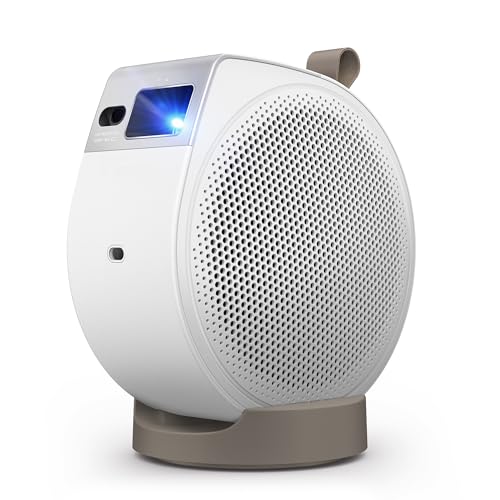
BenQ GV30
A battery-powered, tiltable body lets this projector move from the living room to the backyard without a tripod. Android TV runs directly onboard, skipping a separate streaming stick. At 300 ANSI lumens it performs best after dark, and the built-in battery lasts roughly two hours per charge.
Pros
- Tiltable stand aims the image without extra hardware
- Built-in battery allows cordless outdoor movie nights
- Android TV runs natively without a streaming stick
Cons
- 300 ANSI lumens needs a dark room for a clear picture
- No optical zoom limits how the image can be resized
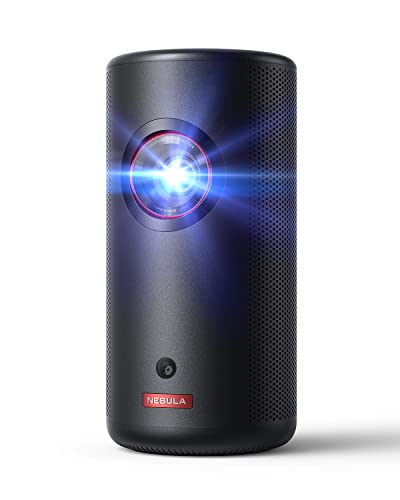
Anker Nebula Capsule 3 Laser
About the size of a soda can, this projector runs Google TV out of the box. Autofocus and auto keystone finish setup on a nightstand or campsite within seconds. A 300 ANSI lumen laser source keeps the image sharp for its size, though the small speaker benefits from a paired Bluetooth unit.
Pros
- Google TV gives full access to YouTube, Netflix and other apps
- Autofocus and auto keystone finish setup within seconds
- Compact enough to pack in a backpack for travel
Cons
- Battery lasts roughly two hours before needing a recharge
- Built-in speaker sounds thin compared to larger projectors

Anker Nebula Cosmos Laser 4K
True 4K UHD resolution sets this projector apart from pixel-shifted rivals at a similar price. An ALPD triple-laser light source is rated for longer service life than an LED bulb. Auto focus, keystone and obstacle avoidance complete setup without manual adjustment, and Android TV 10 handles streaming.
Pros
- True 4K panel resolves finer detail than pixel-shifting rivals
- Laser light source is rated for extended use over LED bulbs
- Auto focus and keystone correction finish setup in seconds
Cons
- Larger chassis needs a dedicated shelf rather than a side table
- Costs more than standard LED smart projectors in this group

Samsung Freestyle 2nd Gen
Tilting a full 180 degrees on its cylinder stand, this projector auto-levels the image on angled surfaces, suiting studio apartments without a media wall. Tizen Smart Hub bundles free Samsung TV Plus channels alongside app streaming. USB-C PD supplies power, since there is no built-in battery.
Pros
- Auto leveling and keystone correction square the image on tilted surfaces
- Tizen Smart Hub adds free live channels alongside streaming apps
- Cylinder body doubles as a smart speaker dock for music
Cons
- Requires USB-C PD power since there is no built-in battery
- Image dims noticeably in rooms with ambient light

XGIMI Elfin
XGIMI trims its gimbal design into a compact body suited to nightstands and bookshelves. Android TV 10 runs onboard, and ISA autofocus plus keystone correction adjust the picture automatically. At 800 ANSI lumens, it is dimmer than the brand’s living-room-oriented models.
Pros
- Gimbal stand angles the lens without a separate mount
- Auto focus and keystone correction adjust the picture automatically
- Compact footprint suits nightstands and small bedrooms
Cons
- 800 ANSI lumens is dimmer than the Horizon Pro for larger rooms
- Single 8W speaker sounds quieter than dual-speaker models

LG CineBeam Q
A 5.2 inch cube swivels on its own stand instead of needing a tripod, fitting a bookshelf or console table. webOS 23 runs onboard with LG Channels free live TV alongside app streaming. Pixel-shifted 4K output looks sharp for its size, though 500 ANSI lumens favors darker rooms.
Pros
- Cube shape and swivel stand fit on a shelf without a tripod
- webOS adds LG Channels free live TV alongside streaming apps
- Pixel-shifted 4K image looks sharp for a compact projector
Cons
- 500 ANSI lumens suits darker rooms over daytime viewing
- No optical zoom means throw distance sets the screen size
How they stack up
| # | Model | Native resolution | Best for | Score | Price |
|---|---|---|---|---|---|
| 1 | XGIMI Horizon Pro | 1080p with 4K input support | Best overall | 9.4 | Check price |
| 2 | BenQ GV30 | 1080p (Full HD) | Best value | 9.1 | Check price |
| 3 | Anker Nebula Capsule 3 Laser | 1080p (Full HD) | Best budget | 8.9 | Check price |
| 4 | Anker Nebula Cosmos Laser 4K | 4K UHD (3840 x 2160) | Best for movie night picture quality | 8.7 | Check price |
| 5 | Samsung Freestyle 2nd Gen | 1080p (Full HD) | Best for small apartments | 8.5 | Check price |
| 6 | XGIMI Elfin | 1080p (Full HD) | Best for bedrooms | 8.2 | Check price |
| 7 | LG CineBeam Q | 4K UHD (pixel-shifted from 0.47-inch DLP) | Best for minimalist living rooms | 8.0 | Check price |
How to choose
What makes a projector smart A smart projector runs a full operating system, such as Android TV, Google TV, Tizen or webOS, directly onboard. Apps like Netflix or YouTube open without a separate streaming stick plugged into HDMI. Account logins and app updates happen on the projector itself. A standard projector needs an external source connected for every app.
Brightness and how much ambient light it tolerates ANSI lumens measure how visible an image stays under ambient light, and the models here range from 300 to 2400 lumens. Anything under 500 lumens works best after dark or behind blackout curtains. Ratings of 2000 lumens and up tolerate some daylight in the room. Screen size and throw distance also matter, since a larger image spreads the same light output thinner.
Portable versus fixed-placement designs Capsule and battery-powered models, like the BenQ GV30 and Anker Nebula Capsule 3 Laser, trade brightness for portability and suit camping trips or moving between rooms. Fixed-placement models, like the XGIMI Horizon Pro and Anker Nebula Cosmos Laser 4K, sit on a shelf and prioritize brightness and speaker output instead. Weigh battery life over raw lumens for a projector that moves often.
Auto setup features worth checking Auto keystone correction, autofocus and obstacle avoidance save time on projectors that get moved or angled often, squaring the image without manual dial adjustments. The Samsung Freestyle and the XGIMI lineup include full auto leveling, while some budget projectors only offer digital keystone that can soften picture quality. Checking for optical rather than digital keystone correction preserves more detail.
Frequently asked questions
What is the difference between a smart projector and a regular projector?
An operating system like Android TV or webOS is built into a smart projector, so streaming apps run without a separate device plugged into HDMI. A regular projector only displays whatever source connects to it, such as a laptop, streaming stick or game console.
Is a smart projector as good as a smart TV?
Brightness and native resolution usually run lower on a smart projector than on a comparably priced smart TV, since projectors depend on ambient darkness for contrast. In exchange, the image can stretch past 100 inches, far beyond what a similarly priced TV offers.
Which smart projector works best for outdoor movie nights?
Battery-powered models like the BenQ GV30 or Anker Nebula Capsule 3 Laser work well outdoors since neither needs a nearby outlet. Both run under three hours per charge, so a portable power bank helps extend a longer screening.
Can smart projectors play Netflix and other streaming apps directly?
Yes. Projectors running Android TV, Google TV, Tizen or webOS include app stores where Netflix, Disney+, Prime Video and similar apps install directly. Licensed apps like Netflix sometimes require a certified version of the platform, which the XGIMI, Anker, Samsung and LG models here include.
Is a 4K smart projector worth it over 1080p?
True 4K panels, like the Anker Nebula Cosmos Laser 4K, resolve more fine detail on screens over 100 inches but cost more than 1080p models. Below that size or on a tighter budget, a 1080p projector like the XGIMI Horizon Pro is hard to visually tell apart from 4K.
Do smart projectors need a separate speaker?
Larger built-in speakers, such as the XGIMI Horizon Pro’s dual 16W Harman Kardon units, handle small to medium rooms without extra audio gear. Compact projectors like the Anker Nebula Capsule 3 Laser carry thinner sound and benefit from a paired Bluetooth speaker.
Which smart projector suits a bedroom best?
The XGIMI Elfin fits bedrooms well thanks to its compact gimbal body and nightstand-friendly footprint, though its 800 ANSI lumens performs better with curtains closed. The Samsung Freestyle is another compact option when ceiling or angled projection is needed.
How much throw distance does a smart projector need?
Most models here need roughly 8 to 10 feet of throw distance for a 100 inch image, though exact figures vary by lens design. Projectors without optical zoom, like the LG CineBeam Q and BenQ GV30, rely entirely on distance from the wall to set screen size.
The verdict
The XGIMI Horizon Pro remains the strongest all-around pick, pairing Android TV 10 with auto setup and speakers strong enough to skip a soundbar. Buyers who prioritize true 4K detail over portability should choose the Anker Nebula Cosmos Laser 4K instead. Anyone who needs a projector that travels should look at the Anker Nebula Capsule 3 Laser or BenQ GV30.
Marcus Chen
Marcus covered consumer electronics for enthusiast tech publications for six years before joining ChoiceCrest. He specializes in translating manufacturer spec sheets into plain-language buying advice, with a focus on audio, computing accessories and smart-home gear.