Which Smart AC Controller Fits Your Air Conditioner?
Sensibo Air Pro fits most homes, combining broad infrared code coverage with humidity and air quality sensing. Cielo Breez Plus adds a touchscreen for households that dislike phone only control. SwitchBot Hub 2 asks the least and still brings Matter to older infrared air conditioners.
Sensibo Air Pro suits almost any mini split, window or portable AC that has no thermostat wiring. Broad remote code coverage, humidity tracking and Climate React rules carry the automation. Mounting takes minutes and nothing touches the air conditioner itself. One limit shapes the decision: a single puck drives a single indoor unit, so a three head system needs three.
Compatibility, not features, is where these devices fail. Older Daikin, Fujitsu and Hitachi handsets fall outside some code databases, and several controllers skip HomeKit. We compared published remote libraries, onboard sensor types, geofencing behavior, Matter status and owner reports about dropped connections. Every pick here runs on 2.4 GHz Wi-Fi, which trips up mesh routers that hide the legacy band.
What we recommend

Sensibo Air Pro
Learning mode captures codes straight from a mini split, window or portable AC handset. Onboard sensors read temperature, humidity and indoor air quality, and Climate React starts the AC once any of those cross a threshold. HomeKit, Alexa, Google and SmartThings all connect natively, which few rivals manage.
Pros
- Air quality sensing sits in the same puck
- Native HomeKit and SmartThings, no bridge needed
- Rules can trigger on humidity, not only temperature
Cons
- One controller drives one indoor unit
- Air quality readings stay inside the app

Cielo Breez Plus
A backlit touchscreen on the front lets a guest change the setpoint with no app and no login. Room temperature and humidity feed weekly schedules, while runtime logs show how many hours the AC actually ran. HomeKit is absent, so iPhone households lean on Alexa or Google voice instead.
Pros
- Physical screen works for kids and visitors
- Runtime logs expose overcooling habits
- Weekly schedules allow several blocks per day
Cons
- No native HomeKit support
- USB outlet must sit within cable reach

SwitchBot Hub 2
One puck acts as an infrared blaster and a Matter bridge, so the AC, TV and ceiling fan answer through the same app. Temperature and humidity come from a sensor built into the power cable, which keeps the reading away from the warm body. Two buttons on the face fire scenes when no phone is nearby.
Pros
- Retires several infrared remotes at once
- Matter bridging reaches Apple Home
- Face buttons run scenes with no phone
Cons
- AC specific features are thinner than dedicated controllers
- Cable sensor must hang clear of warm electronics

tado Smart AC Control V3+
Location rules are the headline: cooling stops once the last household phone leaves the area. Open window detection pauses the AC when a balcony door stays open for several minutes. Part of that automation sits behind the Auto Assist subscription, worth checking before you commit to the brand.
Pros
- HomeKit connects without a bridge
- Open window detection cuts wasted runtime
- Geofencing follows several phones at once
Cons
- Auto Assist subscription gates key automations
- Pairing takes longer than rivals

Ambi Climate Mini
Feedback replaces fixed setpoints here: tap too warm or too cold, and the unit adjusts while weighing humidity alongside temperature. Coastal and monsoon rooms gain most, since 78 degrees in sticky air feels nothing like 78 degrees dry. No screen sits on the body, so every setting lives in the app.
Pros
- Comfort mode reduces constant manual tweaking
- Small footprint fits a narrow shelf
- Humidity weighting suits sticky climates
Cons
- No display or physical buttons at all
- Learning needs several days of feedback to settle

Mysa Smart Thermostat for Mini-Split Heat Pumps
Wall mounting makes this read like a standard thermostat, yet commands still travel by infrared to the head unit. Setpoint and room temperature show on the face, and the bracket hides the USB-C run. Heat pump owners schedule heating and cooling in one interface rather than juggling two apps.
Pros
- Reads as a built in thermostat on the wall
- Covers heat mode as well as cooling
- Supports Matter and HomeKit together
Cons
- Needs a tidy cable route to a USB outlet
- Overbuilt for a single window air conditioner
BroadLink RM4 Pro
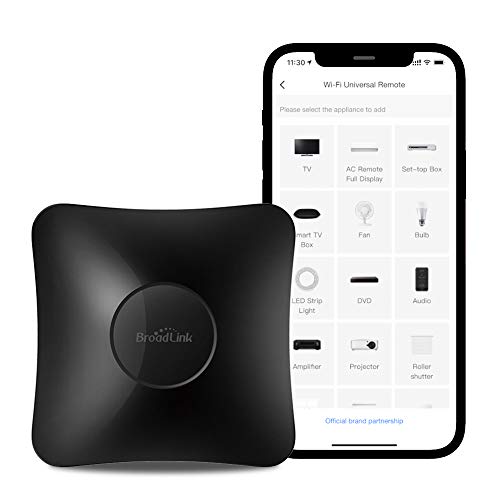
Two radios sit inside: infrared for the air conditioner, 433 MHz for roller blinds and older fans. Nothing senses temperature out of the box, though BroadLink sells a cable probe that adds temperature and humidity. Setup leans on a code database and learning mode rather than a polished AC dashboard.
Pros
- Reaches RF blinds and fans other hubs ignore
- Learns codes from the original handset
- Small enough to hide behind a TV
Cons
- No temperature sensor in the box
- App is clumsier than purpose built AC apps
What matters most
What a smart AC controller actually does These devices copy an air conditioner remote and replay its infrared signal on command. That one trick unlocks schedules, voice control and away mode on units that shipped without Wi-Fi. Most add temperature and humidity sensing, letting the controller hold a room near a target instead of blasting cold air at one fixed setting. Nothing gets wired into the air conditioner, so a renter can unplug the whole setup at move out. Portable and window units qualify just as much as a wall mounted mini split head.
Check remote compatibility before anything else Code coverage decides whether the rest of the feature list matters. Each controller ships with a database of remote codes, and coverage shifts by brand and region. Older Daikin, Fujitsu and Hitachi handsets cause the most failures, along with multi function remotes that carry their own display. Sensibo, Cielo and BroadLink all include learning mode, recording signals directly from your handset. Find out whether your remote sends its full state on every press, because stateless handsets drift out of sync with the app.
Sensors, geofencing and how deep the schedules go Sensor quality separates a plain timer from a climate controller. Humidity matters most on the coast, where 78 degrees in damp air feels far worse than the number suggests. Sensibo Air Pro and Ambi Climate Mini both act on humidity rather than temperature alone. Irregular hours favor geofencing, and tado stops cooling once every phone has left. Fixed shift workers usually get more from plain weekly blocks, which Cielo Breez Plus handles well on its own screen.
Picks for renters, mini splits and multi room homes One window unit in a rented apartment points to SwitchBot Hub 2, because it retires the TV and fan remotes at the same time. Mini split owners who want a thermostat on the wall get more from Mysa, which schedules heat mode too. Three or four indoor heads means three or four controllers, so count the units before picking a brand and an app. Mixed gear changes the answer again: BroadLink RM4 Pro is the only pick here that also reaches 433 MHz blinds. Skip the category entirely if your AC already has a working native app with real scheduling.
How they compare
| # | Model | Sensors | Best for | Score | Price |
|---|---|---|---|---|---|
| 1 | Sensibo Air Pro | Temperature, humidity, air quality | Best overall | 9.4 | Check price |
| 2 | Cielo Breez Plus | Onboard backlit touchscreen | Best value | 9.2 | Check price |
| 3 | SwitchBot Hub 2 | Infrared blaster plus Matter hub | Best budget | 9.0 | Check price |
| 4 | tado Smart AC Control V3+ | Temperature and humidity | Best for geofencing | 8.8 | Check price |
| 5 | Ambi Climate Mini | Temperature and humidity | Best for humid rooms | 8.6 | Check price |
| 6 | Mysa Smart Thermostat for Mini-Split Heat Pumps | Wall mounted thermostat | Best for mini split heat pumps | 8.3 | Check price |
| 7 | BroadLink RM4 Pro | Infrared plus 433 MHz RF | Best for mixed infrared and RF gear | 8.0 | Check price |
Good to know
What is a smart AC controller?
It is a small Wi-Fi device that copies your air conditioner remote and replays those infrared codes on a schedule. Voice control, geofencing and away mode then run through an app. No wiring or installation touches the air conditioner.
Will a smart AC controller work with my air conditioner?
Compatibility depends on one thing: your AC must have come with an infrared remote, ideally one with a display. Window units controlled only by a panel of buttons cannot be reached. Check the maker’s brand list before ordering.
Which smart AC controllers support Apple HomeKit?
Sensibo Air Pro, tado Smart AC Control V3+ and Mysa all speak HomeKit directly. SwitchBot Hub 2 reaches Apple Home through Matter instead. Cielo Breez Plus and BroadLink RM4 Pro offer no native HomeKit path.
Can one controller run two air conditioners?
No. Infrared is line of sight, so each controller points at a single indoor unit. Two bedroom heads need two controllers, though both live under one app account.
Sensibo vs Cielo: which one should you buy?
Sensibo Air Pro wins on sensors and ecosystem reach, including HomeKit and air quality data. Cielo Breez Plus wins in a household that wants a real screen on the wall. Weekly schedules and remote access work well on both.
Do smart AC controllers need a subscription?
Core scheduling and remote control stay free across every pick here. Tado puts geofencing and open window detection behind Auto Assist. Sensibo sells an optional plan for extended features, while the basics keep working without it.
Is a smart AC controller worth it for a window unit?
Yes, if you cool a bedroom on a routine or want the unit idle while the house is empty. Owners report the biggest saving from away mode rather than voice control. A budget hub covers that without paying for air quality sensing.
How far can the controller sit from the air conditioner?
Line of sight is the constraint, and most makers suggest roughly 20 to 25 feet. Curtains, glass cabinet doors and furniture all block the beam. Mount the controller on a facing wall at a height close to the indoor unit.
Do these controllers work with a mini split heat pump in winter?
Heat mode works whenever the controller can send the same codes your remote sends. Mysa schedules heating and cooling in one place, which suits year round heat pump use. Sensibo and tado also pass heat commands through, though the interface centers on cooling.
What happens to schedules if the Wi-Fi goes down?
Cloud based schedules pause, since the command has to reach the controller over the network. Your original remote still works, and Cielo Breez Plus keeps its touchscreen usable at the wall. Reconnection is automatic once the router returns.
Final word
Choose Sensibo Air Pro when one device has to cover scheduling, humidity driven automation and every major smart home platform. Cielo Breez Plus is the better answer for a household that wants a screen on the wall instead of another app on a phone. Pick SwitchBot Hub 2 when the air conditioner is only one of several infrared devices you want to retire.
Marcus Chen
Marcus covered consumer electronics for enthusiast tech publications for six years before joining ChoiceCrest. He specializes in translating manufacturer spec sheets into plain-language buying advice, with a focus on audio, computing accessories and smart-home gear.