Indoor Ski Trainers That Build Real Off-Season Fitness
Concept2 SkiErg with PM5 Performance Monitor delivers cardio conditioning closest to skiing’s double-poling motion, Indo Board Original Balance Board Training Package builds edge-to-edge control, and First Place Sports Slide Board trains the lateral strength skiers use pushing off each edge. Pick based on whether cardio, balance or lateral power matters most for your training.
Concept2 SkiErg with PM5 Performance Monitor suits skiers chasing measurable cardio gains, since its pulling motion mirrors the double-poling stroke used in cross-country and classic skiing. A PM5 monitor tracks pace, watts and stroke rate, feedback no balance board can match. Mount hardware sells separately, and the pulling stroke needs real ceiling clearance, so cramped basements should look elsewhere.
Indoor ski training splits into cardio ergometers and balance or lateral stability boards, categories too different to rank on one scale. We compared resistance mechanisms, deck and roller construction, footprint and recurring owner feedback on stability and durability. Each pick below targets a specific off-season goal rather than claiming one overall winner.
The top picks, ranked
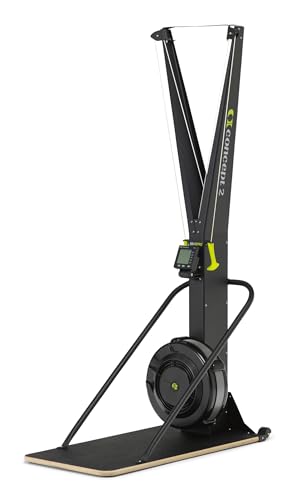
Concept2 SkiErg with PM5 Performance Monitor
A flywheel paired with an adjustable air damper builds drag as the flywheel spins faster, so resistance scales with pull strength. The PM5 monitor logs pace, watts, calories and distance, then syncs to the ErgData app over Bluetooth or ANT+. Handles pull down and outward in a motion that closely tracks the double-poling technique cross-country and classic skiers use.
Pros
- Pulling motion closely replicates double-poling technique
- PM5 monitor tracks pace, watts and stroke rate for structured training
- Damper setting matches resistance to real ski pole effort
Cons
- Wall or floor mount hardware sells separately from the machine
- Needs more floor-to-ceiling clearance than most home gym equipment

Indo Board Original Balance Board Training Package
This package bundles a grip-taped wood deck, roughly 30 by 14 inches, with a plastic roller cylinder and a softer cushion for easing into rolling balance work. Rocking side to side on the roller mimics the edge-to-edge weight shifts skiers make carving turns. Beginners start on the cushion, then graduate to the roller once balance improves.
Pros
- Two-piece set scales difficulty from cushion to roller
- Deck size fits varied stances for ski-specific drills
- Grip tape holds footing secure during lateral rocking
Cons
- Roller motion takes practice before it feels controlled
- No built-in resistance or workout tracking

First Place Sports Slide Board
A low-friction laminate surface, bordered by adjustable end bumpers, lets athletes push off one edge and glide toward the other. Slide booties included fit over athletic shoes to cut friction during each lateral push. That push-glide motion trains hip and adductor muscles that overlap heavily with ski edging and carving.
Pros
- Adjustable bumper width shortens stride for beginners
- Slide booties come included, no separate socks needed
- Lateral push motion directly trains ski edging muscles
Cons
- Unrolled length demands significant floor space
- Surface needs occasional cleaning to keep glide consistent

Vew-Do Zone Balance Board
A 7-ply maple deck pairs with an end-stop roller that limits travel before catching a bumper. Falls land softer with that end-stop design than they would on a free-rolling cylinder, useful for building confidence before advancing further. Riders moving up from stationary wobble boards benefit from the wider deck stance.
Pros
- End-stop roller cuts down on runaway board falls
- Maple deck holds up under repeated flexing
- Wider stance eases the jump from wobble boards to rollers
Cons
- Bulkier than compact wobble boards for storage
- Lower progression ceiling than free-roller boards for advanced riders

BOSU Home Balance Trainer
An inflatable rubber dome sits on a rigid platform base, usable dome-up for softer instability or platform-up for a firmer surface. Standing on the dome recruits ankle and hip stabilizers similar to skiing over uneven snow. Flip it over, and the flat side anchors push-up or squat drills for off-season leg strength.
Pros
- Two-sided design packs two difficulty levels into one piece of equipment
- Dome surface trains ankle and hip stabilizers used off-piste
- Doubles as a strength platform, not just a balance tool
Cons
- Needs a hand pump to inflate and maintain dome firmness
- Dome surface wears faster than rigid boards under daily use

Revbalance 360 Board
A rotational disc base lets the deck tilt and spin freely rather than roll along a fixed track like a cylinder board. That combination trains rotational core control alongside the lateral edging motion skiers use linking turns. Its lower step-up height and contained base suit extended sessions, even standing-desk balance work between workouts.
Pros
- Rotational base trains turning motion, not just side-to-side tilt
- Lower profile than roller boards reduces fall height
- Contained base needs less floor clearance than slide boards
Cons
- Rotational motion takes longer to learn than simple tilt boards
- Offers less aggressive resistance than dedicated roller boards for advanced riders

Yes4All Wobble Balance Board
A round wood deck sits on a fixed hemispherical base, tilting in any direction instead of rolling along a track. Its compact diameter suits single-leg balance drills and ankle stability work that carries over to ski stance control. Non-slip surface texture keeps footing secure during fast tilt corrections.
Pros
- Compact size stores easier than roller or slide boards
- Fixed hemisphere base forgives first-time balance training
- Non-slip deck surface holds footing during quick corrections
Cons
- Limited tilt range compared to free-rolling boards
- Doesn’t replicate skiing’s linear edge-to-edge motion as closely as rollers
How they compare
| # | Model | Resistance type | Best for | Score | Price |
|---|---|---|---|---|---|
| 1 | Concept2 SkiErg with PM5 Performance Monitor | Air flywheel, adjustable damper | Best overall | 9.4 | Check price |
| 2 | Indo Board Original Balance Board Training Package | ~30 x 14 in wood deck | Best for ski-specific edge and balance technique | 9.1 | Check price |
| 3 | First Place Sports Slide Board | 6 ft or 8 ft options | Best for lateral conditioning | 8.8 | Check price |
| 4 | Vew-Do Zone Balance Board | 7-ply maple | Best for intermediate balance progression | 8.6 | Check price |
| 5 | BOSU Home Balance Trainer | ~25 in (65 cm) dome | Best for full-body stability training | 8.4 | Check price |
| 6 | Revbalance 360 Board | Rotational disc, 360-degree movement | Best for low-impact rotational balance work | 8.2 | Check price |
| 7 | Yes4All Wobble Balance Board | Round, hemispherical base | Best budget | 8.0 | Check price |
How to pick the right one
How indoor ski trainers differ Indoor ski gear splits into two broad groups, cardio ergometers and balance or lateral stability boards. Ergometers like the SkiErg use a flywheel or air damper to recreate the pulling and pushing effort of skiing. Balance and slide boards instead target edge control, weight transfer and the lateral strength carving demands. Comparing both groups on one spec sheet misses how differently they train the body.
Choosing gear by training goal Cardio endurance and aerobic base building point most skiers toward a SkiErg, since it outputs measurable watts and pace data. Balance, edge pressure and carving mechanics respond better to a roller or wobble board that isolates lateral stability. Lateral conditioning, the hip and adductor strength used pushing off each ski edge, suits a slide board more than any static balance platform. Matching gear to the actual skill gap beats buying equipment that trains the wrong muscle pattern.
Balance board progression, from wobble to free roller Fixed hemispherical wobble boards suit beginners best, since their limited tilt range forgives early mistakes better than a free-rolling cylinder. Intermediate riders often step up to an end-stop roller board, which still rolls but catches itself before running away. Rotational boards add a turning element closer to linking ski turns than simple side-to-side tilt. Advanced riders eventually move to free rollers without end stops for the least forgiving, most ski-like challenge.
Floor space and ceiling clearance to check first SkiErg machines need real ceiling clearance for the pulling stroke, so basements with low ceilings or apartments with 8-foot ceilings may not fit one comfortably. Slide boards unroll to 6 or 8 feet, which rules them out for smaller rooms unless floor space clears before each session. Inflatable domes like the BOSU need periodic reinflation and lose some firmness over months of use. Compact wobble boards remain the most practical choice for apartment dwellers short on storage.
Frequently asked questions
What is the best indoor equipment for ski cardio training?
Concept2 SkiErg with PM5 Performance Monitor comes closest to skiing’s aerobic demand, since its pulling motion mirrors double-poling technique and its monitor tracks pace and watts.
Can a SkiErg replace actual skiing for fitness?
It replicates the cardio and upper-body pulling effort of double-poling closely, but it skips the edge control, turning and lower-body balance work downhill skiing requires.
Balance board vs slide board, which is better for ski training?
Balance boards train edge-to-edge stability and core control, while slide boards target the lateral push-off strength used in carving, so many skiers use both for different muscle groups.
What is the best balance board for beginners learning ski stance?
Yes4All Wobble Balance Board suits beginners best, since its fixed hemispherical base offers a more forgiving, limited tilt range than free-rolling cylinder boards.
How much floor space does a slide board need?
First Place Sports Slide Board unrolls to 6 or 8 feet depending on the model, so a clear stretch of floor that length is needed during use.
Does a wobble board actually help with skiing?
Wobble boards build ankle and single-leg stability that carries over to holding ski stance on uneven terrain, though they don’t replicate linear edge-to-edge motion as closely as roller boards.
SkiErg vs rowing machine, which trains skiing better?
The SkiErg’s pulling motion mirrors ski pole double-poling more closely than a rowing machine’s seated leg-drive stroke, making it the more ski-specific cardio choice.
What is the best compact indoor ski trainer for small apartments?
Yes4All Wobble Balance Board and Revbalance 360 Board both use contained bases that need far less floor space than a SkiErg or slide board.
How long does it take to learn a roller balance board?
Riders coming from a wobble board typically need a few weeks of short sessions before an end-stop roller like the Vew-Do Zone feels controlled.
The verdict
Concept2 SkiErg with PM5 Performance Monitor remains the strongest all-around pick for skiers chasing measurable cardio conditioning built around real ski technique. Skiers focused purely on balance and edge control in a tight apartment should pick the Yes4All Wobble Balance Board instead, since its compact hemispherical base needs far less floor space and ceiling clearance.
Derek Holt
Derek has a background coaching recreational and amateur athletes and has worked the sales floor at specialty fitness retailers. He focuses on equipment durability, ergonomics and realistic use cases rather than marketing claims.