SD Cards for Cameras: Speed Class vs Capacity
SanDisk Extreme PRO SDXC UHS-I suits most cameras, with V30 certification and roughly 90 MB/s writes for 4K and burst shooting. Lexar Professional 1667x adds UHS-II speed for a modest step up. ProGrade Digital SDXC UHS-II V90 fits cameras recording 6K or long high bitrate takes.
SanDisk Extreme PRO SDXC UHS-I is our overall pick, since V30 certification covers 4K video and fast burst shooting in most camera bodies. Lexar Professional 1667x is the step up for cameras with UHS-II contacts. Video shooters recording 6K or long takes should look at a ProGrade Digital SDXC UHS-II V90 instead.
Card packaging mixes read speed, x ratings and class logos on one label, which confuses more than it explains. Sustained write speed is what actually stops a recording, and that number hides behind the V rating rather than the big headline figure. We compared video speed classes, stated write speeds, bus type, capacity options and operating temperature ranges, then weighed owner feedback on buffer clearing and card longevity.
The top picks, ranked
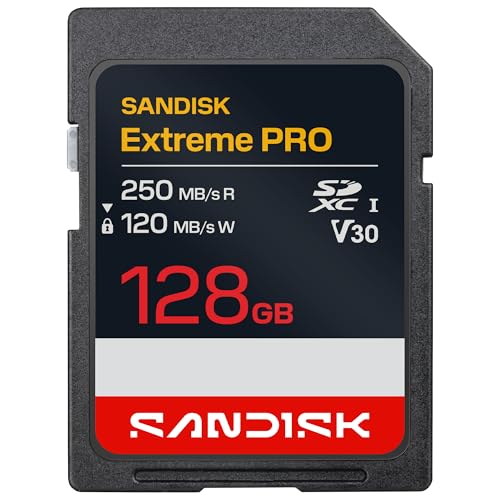
SanDisk Extreme PRO SDXC UHS-I 128GB
SanDisk lists up to 200 MB/s reads and 90 MB/s writes on this card. V30 and U3 certification cover sustained 4K recording in most mirrorless bodies. A shockproof, waterproof and temperature proof rating suits outdoor field work.
Pros
- Handles 4K recording in nearly every current camera
- Runs at full speed in UHS-I only card slots
- Rated for temperature extremes, shock and moisture
Cons
- UHS-I bus limits write speed near 90 MB/s
- Not certified for high bitrate 6K modes

Lexar Professional 1667x SDXC UHS-II
A second contact row unlocks the UHS-II bus on this card. Lexar quotes reads near 250 MB/s and writes near 120 MB/s. V60 certification guarantees 60 MB/s sustained, enough for most 4K and several 6K codecs.
Pros
- UHS-II speed for close to UHS-I pricing
- V60 rating covers most high bitrate 4K codecs
- Backward compatible with UHS-I camera slots
Cons
- Needs a UHS-II reader for full transfer speed
- Drops to UHS-I speed in older camera bodies
SanDisk Extreme SDXC UHS-I
This model sits one tier below the Extreme PRO in write speed. SanDisk lists reads near 180 MB/s and writes near 60 MB/s. V30 certification still covers 4K, so buffer clearing is the main difference in daily use.
Pros
- V30 certification at the lowest price point here
- Enough headroom for 4K in consumer and hybrid cameras
- Shares the PRO’s rugged environmental ratings
Cons
- Buffer clears slower after long burst sequences
- Write speed leaves little margin above the V30 floor

Sony TOUGH SF-M Series SDXC UHS-II
Sony molds this card as a single piece, removing the write protect switch and rib edges that typically crack. Bend strength rates 18 times the SD standard, with a 5 meter drop rating. V60 certification and writes near 150 MB/s keep it fast as well as tough.
Pros
- No write protect switch left to snap off
- IP68 rating resists dust and water
- Write speed runs high for a V60 card
Cons
- Costs more than standard UHS-II competitors
- Rib free shape fits some card readers tightly

ProGrade Digital SDXC UHS-II V90
V90 certification guarantees 90 MB/s sustained writes, the floor that high bitrate 6K and ALL-I codecs demand. ProGrade lists reads to 300 MB/s and writes to 250 MB/s on the UHS-II bus. Each card carries a serial number and an individual test record.
Pros
- V90 sustained rate suits demanding video codecs
- Serialized cards ship with individual test records
- Clears large raw buffers almost instantly
Cons
- Highest cost per gigabyte among these seven cards
- Extra speed goes unused without a UHS-II slot

Angelbird AV PRO SD MK2 V60
Angelbird engineers this card around sustained heat rather than peak numbers, aiming for hours in a hot camera body. V60 certification and a 90 MB/s minimum write speed cover extended 4K takes. Operating range spans minus 25 to 85 degrees Celsius.
Pros
- Built to withstand hours of continuous recording
- Wide operating temperature range for field use
- Write speed stays consistent rather than peaking then dropping
Cons
- Read speed trails the fastest V90 cards here
- Retail availability lags behind SanDisk and Lexar

PNY Elite-X SDXC UHS-I
PNY rates this card at up to 100 MB/s read, with U3 and V30 certification for 4K in most hybrid cameras. Its role fits a bag pocket, ready for the day a main card gets left behind. Capacities reach 512GB, so a spare need not mean less storage.
Pros
- Lowest cost V30 card to keep as a spare
- Available in capacities up to 512GB
- Magnet proof and temperature proof rated
Cons
- Write speed trails every other card in this list
- Not suited as a primary card for burst shooting
How to pick the right one
What do the numbers on an SD card actually mean? Ignore the large read speed printed on the front. Look instead at the V rating, since it guarantees a minimum sustained write speed. V30 means 30 MB/s, V60 means 60, and V90 means 90. U3 is an older label that matches V30 in practice. UHS-I and UHS-II describe the bus type, and UHS-II cards add a second contact row that roughly triples the speed ceiling. SDXC simply marks capacity above 32GB, which requires exFAT formatting in most cameras.
Which SD card speed class does your camera actually need? Match the card to the highest bitrate mode you record, not the mode you might use someday. Standard 4K at around 100 Mbps needs only V30, a floor every card here clears. High bitrate 4K, 6K and ALL-I codecs push past what V30 guarantees, so V60 becomes the safer minimum. Cameras recording 8K or heavy intraframe footage call for a V90 card such as the ProGrade Digital SDXC UHS-II V90. Buying speed beyond what your camera can use adds cost without adding performance.
Best SD cards for burst photography and buffer clearing Sports and wildlife shooting stress a card differently than video does. What matters is how fast the buffer empties between bursts, which tracks peak write speed rather than the sustained V figure. UHS-II cards such as the Lexar Professional 1667x SDXC UHS-II and Sony TOUGH SF-M Series clear a raw buffer far faster, but only in bodies with UHS-II contacts. Inside a UHS-I only camera, the SanDisk Extreme PRO sits near the practical ceiling.
How to choose SD card capacity and keep cards healthy Several medium cards beat one large card, since a single failure then costs part of a shoot instead of all of it. For most photographers, 128GB strikes a reasonable balance between file count and risk. Format in the camera rather than on a computer, since that writes the exact file structure the body expects. Offload and verify footage before formatting, and retire any card that shows write errors. Store spare cards in a hard case, away from the bottom of a bag.
Compared at a glance
| # | Model | Bus | Best for | Score | Price |
|---|---|---|---|---|---|
| 1 | SanDisk Extreme PRO SDXC UHS-I 128GB | UHS-I | Best overall | 9.4 | Check price |
| 2 | Lexar Professional 1667x SDXC UHS-II | UHS-II | Best value UHS-II | 9.2 | Check price |
| 3 | SanDisk Extreme SDXC UHS-I | UHS-I | Best budget | 9.0 | Check price |
| 4 | Sony TOUGH SF-M Series SDXC UHS-II | UHS-II | Best durability | 8.8 | Check price |
| 5 | ProGrade Digital SDXC UHS-II V90 | UHS-II | Best for 6K and 8K video | 8.6 | Check price |
| 6 | Angelbird AV PRO SD MK2 V60 | UHS-II | Best for long recordings | 8.3 | Check price |
| 7 | PNY Elite-X SDXC UHS-I | UHS-I | Best spare card | 8.0 | Check price |
Good to know
What SD card speed do I need for 4K video?
V30 covers standard 4K at around 100 Mbps, which fits the SanDisk Extreme, SanDisk Extreme PRO and PNY Elite-X. High bitrate 4K and ALL-I codecs need V60 or faster, such as the Lexar Professional 1667x SDXC UHS-II.
What is the difference between UHS-I and UHS-II SD cards?
UHS-II cards add a second contact row and a faster bus, roughly tripling peak transfer speed over UHS-I. They still work in UHS-I cameras, but only at UHS-I speeds. Both the camera and the card reader need UHS-II support before the extra speed shows up.
Is a V90 SD card worth buying over V60?
Only if your camera records 8K, 6K or high bitrate ALL-I footage, or you shoot very long raw bursts. For most other use, a V60 card such as the Sony TOUGH SF-M Series delivers the same practical result.
Which SD card capacity should you buy for a camera?
128GB suits most photographers, holding thousands of raw files or roughly an hour of high bitrate 4K footage. Carrying two or three medium cards spreads risk better than relying on one 1TB card for a whole trip.
Do SD cards wear out over time?
Yes, flash memory has a finite number of write cycles, though most cards outlast the cameras they serve. Replace any card that produces write errors, refuses to format, or shows corrupted files instead of reformatting and hoping.
Should you format an SD card in the camera or on a computer?
Format in the camera every time. That process creates the exact folder structure and file system the body expects. Computer formatting can leave a card that mounts fine but behaves unpredictably during long recordings.
What is the most durable SD card for outdoor shooting?
Sony’s TOUGH SF-M Series is molded as one piece with no write protect switch, and it carries an IP68 rating plus a 5 meter drop rating. SanDisk Extreme cards add temperature proof and X-ray proof ratings too.
Why does my camera drop frames even with a fast SD card?
Peak read speed printed on the label is not the same as sustained write speed. A card advertised at 200 MB/s read may only guarantee 30 MB/s of sustained writes. Check the V rating against your recording bitrate, and confirm the card slot supports that bus.
Best SD card for burst shooting sports and wildlife?
UHS-II cards with a high peak write speed clear a raw buffer fastest, since burst shooting depends more on peak speed than sustained V rating. The Lexar Professional 1667x SDXC UHS-II and Sony TOUGH SF-M Series both fit that role in bodies with UHS-II contacts.
Can you use a UHS-II SD card in a UHS-I camera?
Yes, UHS-II cards are backward compatible and will work in a UHS-I slot. Speed drops to the UHS-I ceiling near 90 to 104 MB/s, so the extra UHS-II hardware goes unused until you upgrade the camera.
The bottom line
SanDisk Extreme PRO SDXC UHS-I fits most photographers, since V30 plus roughly 90 MB/s writes covers 4K and burst shooting in nearly every body. Cameras with UHS-II slots gain real speed from the Lexar Professional 1667x SDXC UHS-II for a modest step up. Reach for the ProGrade Digital SDXC UHS-II V90 only when a camera records 6K or 8K, where sustained write speed decides whether a take survives.
Marcus Chen
Marcus covered consumer electronics for enthusiast tech publications for six years before joining ChoiceCrest. He specializes in translating manufacturer spec sheets into plain-language buying advice, with a focus on audio, computing accessories and smart-home gear.