Stop Weak RV Water Pressure With the Right 12V Pump
SEAFLO’s 42-Series leads on raw output at 5.5 GPM and 60 PSI, plus run-dry protection for occasional dry starts. Shurflo’s 4008-101-A65 Revolution balances flow and price for single-bathroom rigs. Aquatec’s 5850 Series matches that same flow rate but runs noticeably quieter through thin cabin walls.
Most RV water pumps land in a narrow band, 1 to 5.5 gallons per minute at 30 to 60 PSI. That range decides whether two fixtures run at once without a pressure drop. We compared flow rate, pressure switch design, noise level, and amp draw across seven 12-volt pumps built for RV fresh water systems.
Listed GPM figures assume ideal conditions, not a pump straining against a clogged strainer or a half-full tank. We leaned on manufacturer specifications and patterns in owner feedback about noise and switch cycling to sort real differences from marketing claims.
The shortlist, ranked

SEAFLO 42-Series 12V 5.5 GPM Diaphragm Pump
SEAFLO’s 42-Series pushes 5.5 gallons per minute at up to 60 PSI, enough for two fixtures running together. Its diaphragm design tolerates running dry without burning out the motor. Mounting brackets and a strainer ship in the box.
Pros
- Handles simultaneous shower and sink use
- Self-primes from up to 6 feet
- Rubber mounting feet cut vibration noise
Cons
- Draws close to 10 amps at full output
- Inlet strainer needs periodic cleaning

Shurflo 4008-101-A65 Revolution Water Pump
Shurflo’s Revolution series delivers 3.0 GPM at 55 PSI, a middle ground for single-bathroom trailers. Its built-in pressure switch cycles less often than older Shurflo models, according to owner reports. A filter and mounting hardware ship with the pump.
Pros
- Cycles quieter than the older 4008-101-E65
- Compact housing fits tight compartments
- Replacement parts stay widely stocked
Cons
- Flow drops when two fixtures open together
- Plastic fittings can crack if overtightened
Aquatec 5850 Series RV Water Pump
Aquatec’s 5850 pump matches the 42-Series on output, 5.5 GPM at 60 PSI, but adds a soft-mount design that isolates motor vibration from cabinet walls. Owners report noticeably less hum through thin RV floors. Replacement diaphragm kits cost more than SEAFLO parts.
Pros
- Cycles noticeably quieter than standard diaphragm pumps
- High flow suits larger fresh water tanks
- Accepts standard 1/2 inch NPT fittings
Cons
- Diaphragm kits cost more than SEAFLO equivalents
- Larger footprint than compact mini pumps
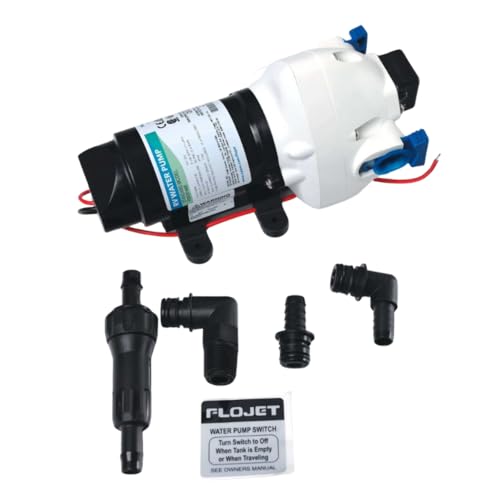
Flojet 03526-144A Triplex Water Pump
Flojet’s 03526-144A uses a triplex piston design rather than a diaphragm, rated at 4.5 GPM and 45 PSI. Three offset pistons deliver smoother, more consistent flow with less pulsing at the faucet. Fifth-wheels with multiple bathrooms suit this pump well.
Pros
- Delivers smoother output than diaphragm pumps at the tap
- Handles multiple fixtures with less pressure drop
- Piston assembly stays field-serviceable
Cons
- Runs lower max pressure than the SEAFLO 42-Series
- Costs more upfront than diaphragm alternatives

Whale GP1332 Universal Freshwater Pump
Whale built the GP1332 for caravans and small camper vans, rating it at 12 liters per minute, about 3.2 GPM, at 30 PSI. Its narrow body suits vertical or horizontal mounting in tight spaces. Current draw stays lower than higher-pressure models.
Pros
- Slim body mounts inside narrow cabinets
- Lower current draw extends boondocking runtime
- Suits single-fixture use well
Cons
- Delivers lower pressure than the 5.5 GPM diaphragm models here
- Replacement seals can be harder to source in the US

Remco Aquajet 4.0 GPM Water Pressure Pump
Remco’s Aquajet series pairs a 4.0 GPM, 55 PSI pump with a demand-sensing pressure switch tuned to cycle less than older mechanical switches. That cuts on-off chatter common at low flow, like a slow-running faucet. Remco also sells rebuild kits for long-term upkeep.
Pros
- Reduces pressure-switch chatter at low flow
- Rebuild kits extend pump life
- Holds consistent pressure across fixtures
Cons
- Stays less widely stocked than SEAFLO or Shurflo
- Costs more than comparable diaphragm pumps

SEAFLO 21-Series Mini Diaphragm Pump
The 21-Series scales down to 1.0 GPM and 30 PSI, sized for teardrop trailers and pop-up campers. Its housing measures under 6 inches, fitting shallow storage bays. Lower flow means a slower fill on an outdoor shower.
Pros
- Fits compartments too small for full-size pumps
- Low current draw suits smaller battery banks
- Costs little to replace if it fails
Cons
- Lacks enough flow for two fixtures at once
- Shows shorter service life, per some owner reports
What matters most
What GPM and PSI Mean for an RV Water Pump GPM measures how much water moves each minute; PSI measures the pressure pushing it out. A single kitchen faucet typically needs about 1 GPM. Running a shower and a sink together can require 3 to 4 GPM without a pressure drop. Most RV pumps top out between 30 and 60 PSI, matched to fixtures rated for similar pressure. Higher PSI does not fix low GPM when two fixtures open at once.
Which Pump Size Fits Your RV? A teardrop trailer or pop-up with one faucet rarely needs more than 1 to 2 GPM, where the SEAFLO 21-Series or Whale GP1332 fit well. A single-bathroom travel trailer usually lands in the 3 to 4 GPM range. Fifth-wheels and rigs with two bathrooms benefit from 4.5 to 5.5 GPM pumps, like the Flojet triplex or SEAFLO 42-Series, so a shower and a sink can run together without a pressure dip.
Diaphragm vs Triplex Pumps: What’s the Difference Diaphragm pumps use a flexible membrane that flexes with each stroke, creating the pulsing feel common in RV plumbing. Triplex pumps use three pistons offset in timing, smoothing output and cutting that pulse. SEAFLO, Shurflo, and Aquatec models here use diaphragm designs. Flojet’s 03526-144A is the triplex option, priced higher than the rest. Diaphragm pumps stay generally easier and cheaper to rebuild at home.
Why RV Water Pumps Chatter, and How to Stop It Pressure-switch chatter happens when a pump cycles on and off rapidly at low flow, like a slow-dripping faucet. Demand-sensing switches, used on the Remco Aquajet, widen the cycling range to cut that chatter. Air in the line from a low tank or a loose fitting causes a similar rattling sound. Vibration-isolated mounts, like Aquatec’s, cut noise traveling through cabinet walls even when the switch behaves normally.
The lineup, side by side
| # | Model | Flow rate | Best for | Score | Price |
|---|---|---|---|---|---|
| 1 | SEAFLO 42-Series 12V 5.5 GPM Diaphragm Pump | 5.5 GPM | Best overall | 9.4 | Check price |
| 2 | Shurflo 4008-101-A65 Revolution Water Pump | 3.0 GPM | Best value | 9.0 | Check price |
| 3 | Aquatec 5850 Series RV Water Pump | 5.5 GPM | Best for quiet operation | 8.8 | Check price |
| 4 | Flojet 03526-144A Triplex Water Pump | 4.5 GPM | Best for large rigs and high flow | 8.6 | Check price |
| 5 | Whale GP1332 Universal Freshwater Pump | 3.2 GPM (12 LPM) | Best for small campers and caravans | 8.4 | Check price |
| 6 | Remco Aquajet 4.0 GPM Water Pressure Pump | 4.0 GPM | Best for consistent pressure | 8.2 | Check price |
| 7 | SEAFLO 21-Series Mini Diaphragm Pump | 1.0 GPM | Best budget | 8.0 | Check price |
Good to know
How many GPM does an RV water pump need?
Most single-bathroom RVs run fine on 3 to 4 GPM. Larger rigs with two bathrooms or an outdoor shower benefit from 5 to 5.5 GPM pumps like the SEAFLO 42-Series.
What PSI should an RV water pump run at?
Between 40 and 60 PSI covers most RV fixtures. Pressure above that range can stress older plastic fittings and shower heads over time.
Can an RV water pump run dry?
Some models, including the SEAFLO 42-Series, include run-dry protection that prevents motor damage. Others need water in the tank before startup, per the manufacturer’s instructions.
Diaphragm vs triplex RV water pump: which is better?
Diaphragm pumps cost less and rebuild more easily. Triplex pumps, like the Flojet 03526-144A, deliver smoother flow with less pulsing at the faucet.
Why does an RV water pump keep cycling on and off?
Rapid cycling usually points to a partly open faucet, a loose fitting letting in air, or a worn pressure switch. Demand-sensing switches cut this compared with older mechanical switches.
Is a quiet RV water pump worth the extra cost?
Vibration-isolated mounts, like Aquatec’s 5850 Series, cut noise traveling through thin RV floors and walls. That matters most in smaller rigs where the pump sits near a sleeping area.
What size water pump fits a small camper or teardrop trailer?
Compact pumps rated near 1 to 3 GPM, like the SEAFLO 21-Series or Whale GP1332, fit the shallow storage bays common in small trailers.
How do you replace an RV water pump?
Most 12-volt pumps bolt onto a bracket with two water lines and two wire leads. Matching inlet and outlet fitting size to the old pump avoids extra adapters.
Which RV water pump handles two bathrooms at once?
Pumps rated 4.5 to 5.5 GPM, like the Flojet 03526-144A or SEAFLO 42-Series, keep pressure steady when two fixtures run together.
Our take
SEAFLO’s 42-Series covers the widest range of RVs with 5.5 GPM output and run-dry protection. Shurflo’s Revolution pump makes a practical middle choice for single-bathroom trailers. Buyers chasing quiet operation or smooth triplex flow should look at the Aquatec 5850 or Flojet 03526-144A instead.
Tony Russo
Tony trained as an automotive technician and spent years in service and parts retail before moving into writing. He focuses on garage tools, car care products and accessories from a hands-on maintenance perspective.