How Leveling Blocks Keep Your RV Steady on Uneven Ground
Andersen Camper Leveler 3604 is the overall pick, leveling a trailer in one forward pull with no stacking involved. Camco FasTen 44510 blocks remain the most versatile locking system, and Lynx Levelers 00015 handle the highest stacks for badly sloped sites.
Andersen Camper Leveler 3604 gets a travel trailer level in one motion for side to side correction, while Camco FasTen 44510 blocks stay the most flexible option and Lynx Levelers 00015 handle the worst slopes a campsite can throw at you.
Leveling gear confuses buyers because ramp style levelers, interlocking blocks and stacking pads each solve different problems, and load ratings vary wildly between products that look nearly identical. We compared published load capacities and lift heights against what owners report about cracking under heavy rigs to rank the seven below.
What we recommend
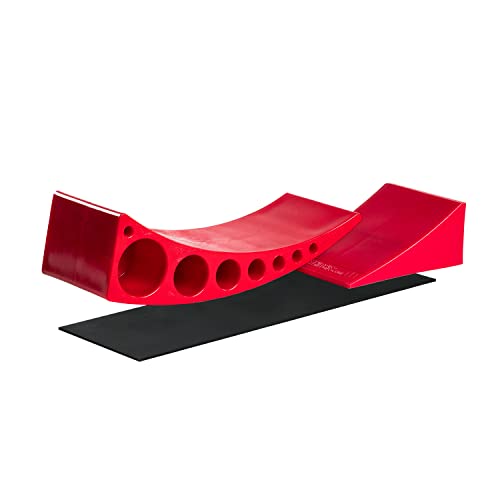
Andersen Hitches Camper Leveler 3604
A curved ramp and matching chock let you drive up to any height within range and stop, with no stacking or guesswork involved. Setup takes well under a minute once you know your rig. Owners report it as the single biggest time saver in the arrival routine for single axle and tandem trailers.
Pros
- Levels to any height within range without stacking
- Very fast setup compared with block towers
- Doubles as a wheel chock once positioned
Cons
- Only works on tyres, not on jacks or stabilisers
- Grip mats are essential on hard pavement

Camco FasTen 44510 Leveling Blocks
Ten interlocking blocks snap together in any orientation, building a pad under tyres, jacks or stabilisers as the site demands. A locking design stops the tower from shifting apart under load. Owners report these solve so many different problems that they become the most used item in the storage bay.
Pros
- Works under tyres, jacks and stabiliser feet
- Interlocking design resists shifting under load
- Compact and easy to store in a bay
Cons
- Needs stacking and repositioning to get level
- Can crack under very heavy fifth wheel pin weights

Tri-Lynx 00015 Lynx Levelers
A honeycomb pattern locks in every direction and stacks higher than most competing blocks without turning unstable. Ten blocks give plenty of height for badly sloped sites. Owners report reaching for these whenever a site needs more than a couple of inches of correction on one side.
Pros
- Stacks tall while staying stable
- Honeycomb locks in every direction
- Also works as jack pads and stabiliser bases
Cons
- Bulky to store compared with flat pads
- Sharp edges are unkind to bare feet and hands

Beech Lane Camper Leveler
A curved ramp system sits in the same family as the Andersen, with a slightly wider base suited to heavier tandem axle trailers. Rubber grip mats and a carrying bag come included as standard. Owners report the wider footprint reduces sinking on soft gravel sites.
Pros
- Wider base spreads load on soft ground
- Carry bag and grip mats included
- No stacking or block towers required
Cons
- Bulkier to store than flat block sets
- Tyres must sit fully on the ramp to be safe

Valterra A10-0918 Stackers Leveling Blocks
Ten blocks nest tightly together, so the full set takes up markedly less bay space than honeycomb designs. Stacking under tyres and jack feet stays secure. Owners report the nesting shape as the main reason to pick these over interlocking alternatives.
Pros
- Nests down to a small storage footprint
- Light enough to carry one handed
- Stable under both tyres and jacks
Cons
- Lower load ceiling than heavy duty blocks
- Less grip on wet concrete than ribbed designs

Camco 44573 Curved Leveler
A single piece curved ramp targets single axle trailers and smaller travel trailers, offering up to four inches of lift with no stacking. Weight stays lowest among the ramp style options here. Owners report it works well on lighter rigs but is not the right tool for a large fifth wheel.
Pros
- Very light and easy to position
- No stacking needed for typical corrections
- Compact enough for small storage bays
Cons
- Load rating rules out heavy fifth wheels
- Single axle focus limits versatility
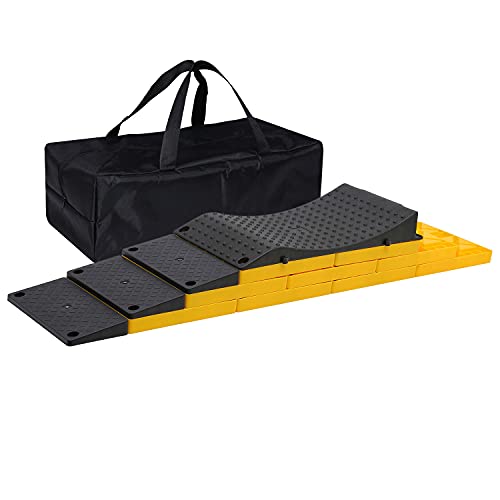
Homeon Wheels RV Leveling Blocks
A ten block interlocking set with a carry bag targets owners wanting a spare set for the second axle or for jack pads without a large outlay. Locking follows the usual grid pattern. Owners report these as adequate for lighter trailers and useful as backup blocks.
Pros
- Sensible as a second set for jack pads
- Carry bag included
- Interlock reliably in a standard grid
Cons
- Lower load tolerance than premium blocks
- Plastic flexes more under heavy static weight
How to pick the right one
Ramp levelers or stacking blocks: which do you need? Curved ramp levelers let you drive up and stop at whatever height corrects the slope, removing the stack, reverse, check, repeat cycle entirely. Stacking blocks take longer but work under stabiliser jacks, tongue jacks and landing gear as well as tyres, something ramps cannot do. Most experienced owners eventually carry both, ramps for side to side leveling and blocks for everything underneath the rig.
Why does load rating matter so much? Quoted ratings vary from a few thousand pounds per pad to forty thousand pounds for a set. That gap matters most under a fifth wheel landing gear or a heavy tongue jack, where load concentrates on a small footprint. Cracked blocks almost always trace back to a point load on a pad rated for a spread tyre load. Check your rig’s gross weight and its axle and pin weights before choosing.
Which order should you level in? Correct the side to side slope first while tyres can still roll, then chock the wheels, then use the tongue or landing gear jack for front to back. Reversing that order means unchocking and rolling a rig already partly supported on jacks, which is both slower and less safe.
Do you need pads under your jacks too? Stabiliser and landing gear feet sink into gravel, dirt and hot asphalt, undoing your leveling overnight and sometimes marking paved sites. A wide pad or a stack of interlocking blocks under each foot spreads the load and keeps everything in place. This is also why many owners carry more blocks than the leveling job itself requires.
Side by side
| # | Model | Load rating | Best for | Score | Price |
|---|---|---|---|---|---|
| 1 | Andersen Hitches Camper Leveler 3604 | 30,000 lb per pair | Best overall | 9.4 | Check price |
| 2 | Camco FasTen 44510 Leveling Blocks | 40,000 lb | Best value | 9.2 | Check price |
| 3 | Tri-Lynx 00015 Lynx Levelers | 40,000 lb | Best for steep sites | 9.0 | Check price |
| 4 | Beech Lane Camper Leveler | 35,000 lb per pair | Best for tandem axle trailers | 8.8 | Check price |
| 5 | Valterra A10-0918 Stackers Leveling Blocks | Rated for typical RV axle loads | Best for tight storage | 8.6 | Check price |
| 6 | Camco 44573 Curved Leveler | 3,500 lb per leveler | Best for single axle trailers | 8.3 | Check price |
| 7 | Homeon Wheels RV Leveling Blocks | 10 blocks with carrying bag | Best budget | 8.0 | Check price |
Common questions
How level does an RV actually need to be?
Close is good enough for sleeping and for doors and drawers behaving. Absorption refrigerators are the strict case, and most manufacturers specify within about three degrees side to side and six degrees front to back. Residential compressor fridges, increasingly common now, tolerate far more.
Can you use wood blocks instead?
Plenty of owners do, and treated lumber cut into pads works fine under jacks. Splitting under repeated point loads, water absorption and added weight are the drawbacks, along with no interlock so towers walk apart. Purpose made blocks are lighter, stack predictably and store more cleanly.
Do curved levelers work on tandem axles?
Yes, but both tyres on the side being lifted must end up supported, which is why the ramps run long enough to carry two wheels on most tandem trailers. Check a specific product’s stated compatibility, since smaller single axle ramps are not built for this.
Why do leveling blocks slide on pavement?
Smooth concrete and asphalt offer very little grip to a plastic ramp, especially when wet. Rubber grip mats under the leveler solve this, and most ramp kits now include them. Staggering the layers rather than building a perfect column also helps with stacking blocks.
Should you put blocks under stabiliser jacks?
Yes, on anything other than solid pavement. Stabiliser feet have small contact areas and sink into gravel, grass and soft ground over the course of a stay. A block or pad under each foot keeps the rig stable and avoids releveling after a rainy night.
How much lift do most campsites need?
Most sites need two inches or less of correction, and many need nothing at all. Sites requiring four inches or more are uncommon but do exist, which is why carrying a ten block set alongside ramps is worthwhile even if the full stack rarely gets used.
Do you still need wheel chocks with a ramp leveler?
Ramp kits include a matching chock that locks the tyre in position on the ramp, handling the levelled side. Conventional chocks are still needed on the wheels touching the ground, since nothing else stops the trailer rolling.
Will leveling blocks damage tyres?
Not if the tyre sits fully supported across its tread. Problems come from parking with part of the tread hanging off a block’s edge, putting a sustained pressure line into the sidewall shoulder. Confirm the full contact patch sits on the block or ramp before unhitching.
The verdict
Andersen Camper Leveler 3604 changes the arrival routine more than any other item here, making it the first buy for most travel trailers. Pair it with a set of Camco FasTen 44510 blocks for jack pads and awkward sites, and step up to Lynx Levelers 00015 when regular campgrounds bring serious slopes.
Tony Russo
Tony trained as an automotive technician and spent years in service and parts retail before moving into writing. He focuses on garage tools, car care products and accessories from a hands-on maintenance perspective.


