RV Backup Cameras: Which Signal Type Fits Your Rig
Furrion’s Vision S FOS43TASE leads for overall performance among current RV backup cameras. Rear View Safety’s RVS-770613 suits owners who want a hardwired signal, and AUTO-VOX’s Solar Wireless SA1 fits rigs where running cable is not practical. We compared monitor size, camera count and night vision range across seven systems.
Reversing a 30-foot motorhome without a clear rear view invites scraped bumpers and worse. A dedicated backup camera closes that blind spot with a dash monitor and a weatherproof rear camera. Digital wireless models skip the cable run through the frame, and wired systems avoid interference near power lines and other RVs.
Towing rigs, motorhomes and truck campers all mount cameras differently, which makes picking one tricky. Signal type, monitor resolution, night vision range and camera expansion listed in each product’s specifications guided these picks. Owner feedback on installation and daytime glare shaped the final ranking.
The best picks, ranked

Furrion Vision S FOS43TASE
Furrion pairs a 4.3-inch monitor with a digital wireless signal rated for interference-free reception at typical RV lengths. An IP66 rating protects the rear camera from rain and road spray, and infrared night vision switches on automatically in low light. Matching side and rear cameras let owners expand the system later.
Pros
- Digital signal resists interference from nearby wireless devices
- IP66 housing withstands rain and road spray
- Expands to additional Furrion cameras later
Cons
- 4.3-inch screen shows less detail than larger monitors
- Pairing range shortens on longer fifth wheels
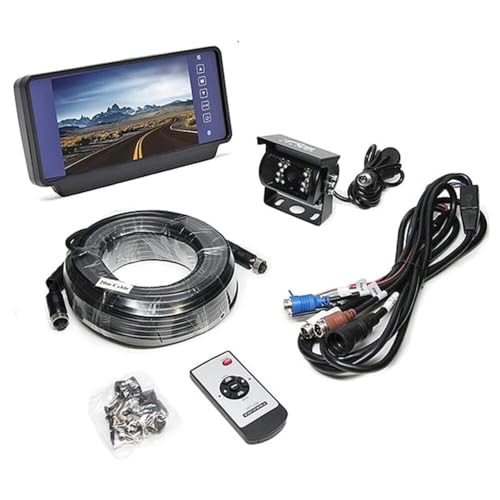
Rear View Safety RVS-770613
A shielded RCA cable runs from a license-plate-mounted camera to this kit’s 7-inch wired monitor. Hardwired signals avoid the dropouts that can affect wireless units near power lines or other transmitters. Built-in LED night vision and a 120-degree lens round out the camera.
Pros
- Wired connection stays stable near other RF devices
- Large 7-inch screen shows more of the lane behind
- License plate mount fits most trailers without drilling
Cons
- Running cable through the frame adds installation time
- Cable length limits how far the camera can sit from the monitor

AUTO-VOX Solar Wireless SA1
A solar panel trickle-charges this camera’s internal battery, removing the need for any cable run or power tap. Digital wireless links the camera to a 5-inch monitor mounted at the front of the cab. IP68 sealing lets the housing survive full submersion in road spray.
Pros
- Solar charging removes the need for a wired power tap
- Magnetic mount allows quick removal for storage
- IP68 housing handles heavy rain and mud
Cons
- Cloudy stretches can drain the battery faster than the panel refills it
- Monitor lacks a split-screen input for a second camera
Amtifo AM-T12
This Amtifo kit splits its 5-inch monitor between two camera feeds at once, useful for watching a rear camera and a side-mounted blind spot camera together. Digital wireless transmission connects both cameras without running cable along the chassis. Infrared LEDs extend visibility to roughly 33 feet at night.
Pros
- Split screen shows two camera angles simultaneously
- Digital pairing avoids the ghosting seen on older analog kits
- IP69K cameras tolerate pressure washing
Cons
- Small split-screen view makes fine detail harder to read
- Supports only two camera inputs, fewer than dedicated 4-camera kits

Haloview MC7601
Haloview rates the MC7601’s digital wireless signal effective up to roughly 800 feet, aimed at long motorhomes and towed trailers. Its 7-inch monitor accepts up to four camera inputs for owners who add side or interior views later. Night vision LEDs on the included camera cover typical parking-lot lighting gaps.
Pros
- Longer rated wireless range than most competing kits
- Expands to four cameras for full-perimeter coverage
- Large 7-inch screen aids visibility in daylight
Cons
- Actual range drops with metal siding or nearby obstructions
- Larger monitor takes up more dash space than compact units

LeeKooLuu LK1
LeeKooLuu keeps costs down with a wired 7-inch monitor paired to a single rear camera, skipping wireless pairing entirely. An IP68-rated housing and seven infrared LEDs keep the camera working after dark and in wet weather. A clip-on sunshade cuts glare on the monitor during daytime driving.
Pros
- Lower cost than most wireless multi-camera systems
- Wired signal needs no channel pairing before use
- Included sunshade reduces daytime monitor glare
Cons
- Single-camera design offers no side or interior views
- Cable routing gets more involved on longer trailers
Yada Digital Wireless BT53872
Yada sizes the BT53872 for smaller travel trailers and truck campers rather than long fifth wheels. A compact 4.3-inch monitor pairs with a license-plate-mounted camera that switches to night vision under low light. Its windshield-mount bracket lets the monitor move between vehicles.
Pros
- Compact monitor suits smaller dashboards and cabs
- Digital wireless setup skips running cable through the trailer
- Bracket lets the monitor transfer between tow vehicles
Cons
- Wireless range is shorter than dedicated long-range systems
- Single camera input limits multi-angle coverage
The lineup, side by side
| # | Model | Monitor Size | Best for | Score | Price |
|---|---|---|---|---|---|
| 1 | Furrion Vision S FOS43TASE | 4.3 inches | Best Overall | 9.4 | Check price |
| 2 | Rear View Safety RVS-770613 | 7 inches | Best Wired System | 9.1 | Check price |
| 3 | AUTO-VOX Solar Wireless SA1 | 5 inches | Best Solar-Powered Wireless | 8.9 | Check price |
| 4 | Amtifo AM-T12 | 5 inches | Best Multi-Camera System | 8.7 | Check price |
| 5 | Haloview MC7601 | 7 inches | Best Long-Range Wireless | 8.5 | Check price |
| 6 | LeeKooLuu LK1 | 7 inches | Best Budget | 8.3 | Check price |
| 7 | Yada Digital Wireless BT53872 | 4.3 inches | Best for Small Trailers | 8.0 | Check price |
How to pick the right one
What to Look for in an RV Backup Camera System Every RV backup camera pairs a rear-mounted camera with a cab monitor, though the details vary widely between models. Signal type sets the baseline: digital wireless resists interference better than older analog wireless, while a wired connection avoids dropouts entirely. Monitor size ranges from compact 4.3-inch screens to 7-inch displays that show more detail at highway speed. Night vision range and waterproof rating matter most for camera placement, since the unit sits exposed to rain, dust and road spray year-round.
Wired or Wireless: Which Signal Fits Your Rig Wired kits route a cable from the rear camera to the dash monitor, keeping the signal stable near cell towers, other RVs and power lines. Wireless digital systems skip that cable run, a real advantage on fifth wheels and long travel trailers where fishing wire through the frame is impractical. Range matters more with wireless: a 40-foot motorhome needs a longer rated distance than a 20-foot camper. Solar-powered wireless cameras add a third option, trading a small charging tradeoff for zero wiring at all.
Multi-Camera Setups for Trailers and Large Motorhomes A single rear camera covers backing up but misses blind spots along the sides of a long trailer. Split-screen systems like the Amtifo AM-T12 show two feeds at once, useful for a rear view paired with a side-mounted camera during lane changes. Expandable monitors that accept four camera inputs suit toy haulers and large motorhomes towing a second vehicle. Owners who only reverse into straightforward pull-through sites rarely need more than one camera.
Installation Difficulty and Common Trouble Spots License-plate-mounted cameras install fastest, since they bolt onto existing hardware without drilling. Wired systems take longer, especially on rigs where the cable has to pass through a slide-out or storage bay. Wireless units pair quickly but can lose signal near metal siding or when parked beside another RV running a similar frequency. Rental and borrowed RVs benefit from magnetic or solar-powered mounts that install without permanent modification and come off just as easily.
Frequently asked questions
What is the best RV backup camera for a fifth wheel?
Digital wireless systems with a longer rated range, such as Haloview’s MC7601, tend to suit fifth wheels better than short-range analog kits, since the camera sits far from the cab monitor.
How far can a wireless RV backup camera transmit a signal?
Rated range varies by model, from roughly 100 feet on compact systems to around 800 feet on long-range digital units like the Haloview MC7601, though metal siding and obstructions shorten real-world distance.
Do RV backup cameras work at night?
Most current models include infrared LEDs or automatic night vision that activates in low light, letting the camera show a usable image well after sunset.
Is a wired or wireless RV backup camera better?
Wired systems hold a steadier signal near other RF devices, while wireless digital kits save installation time on trailers where running cable is impractical. The better choice depends on the rig.
Can I add a backup camera to an older RV without running new wires?
Solar-powered wireless cameras, like the AUTO-VOX SA1, charge from a small panel and pair wirelessly to the monitor, so no wiring or drilling is needed.
How many cameras can an RV backup camera system support?
Basic kits support one rear camera, split-screen models handle two feeds at once, and expandable monitors such as the Haloview MC7601 accept up to four camera inputs.
Is a solar-powered wireless backup camera worth it for an RV?
It suits owners who want zero wiring and don’t mind occasional charging gaps in extended cloudy weather, since the panel trickle-charges an internal battery rather than running off the RV’s electrical system.
What monitor size works best for an RV backup camera?
A 4.3-inch monitor fits smaller dashboards on trucks and vans, while a 7-inch screen shows more detail at highway speed and suits larger motorhome dashboards better.
RV backup camera vs tow mirror cameras: which gives a better view while reversing?
A dedicated backup camera shows the direct area behind the bumper, while tow mirrors mainly cover the sides. Many owners run both for full coverage during reversing and lane changes.
Final word
Furrion’s Vision S system offers the most balanced mix of digital reliability and expandability for most rigs. Owners running long fifth wheels benefit more from Haloview’s extended range, while those avoiding any wiring should look at AUTO-VOX’s solar-powered option. Match camera count and signal type to how the rig actually backs into a site.
Tony Russo
Tony trained as an automotive technician and spent years in service and parts retail before moving into writing. He focuses on garage tools, car care products and accessories from a hands-on maintenance perspective.


