Running Armbands That Stay Put Mile After Mile
TRIBE’s running armband suits most people, thanks to a strap range that spans slim and muscular arms plus a sweat resistant pouch. Quad Lock’s Run Kit locks the phone mechanically and kills bounce. Runners carrying gels, a card and a race ID should take the Armpocket Racer instead.
Start with the TRIBE armband if you want one band for daily training. Its neoprene strap covers slim and larger arms, and the pouch resists sweat while leaving the touchscreen usable. Bulky protective cases are the sticking point, since the pouch is cut for a bare handset. Quad Lock’s Run Kit and the Armpocket Racer answer the two complaints that follow, bounce and storage.
Fit failures, not build quality, drive most one star reviews here. A band that slides down mid run was usually bought for the wrong bicep measurement or the wrong phone thickness. We compared strap adjustment ranges, maximum phone dimensions, case compatibility, extra pockets, reflective detailing and touchscreen response through the cover, then weighed what owners report after months of sweat.
The top picks, ranked

TRIBE Running Phone Holder Armband
Soft neoprene and a hook and loop closure cover a wide span of arm sizes, and an extender is sold separately for larger biceps. Sweat resistance is the design brief rather than waterproofing, so drizzle is fine and a downpour is not. Reflective trim and a key slot handle the basics runners actually use.
Pros
- Strap range covers slim arms and larger biceps with the extender
- Reflective trim adds visibility on evening runs
- Taps and passcode entry work through the cover
Cons
- Thick protective cases will not fit inside the pouch
- Sweat resistant only, so heavy rain reaches the phone
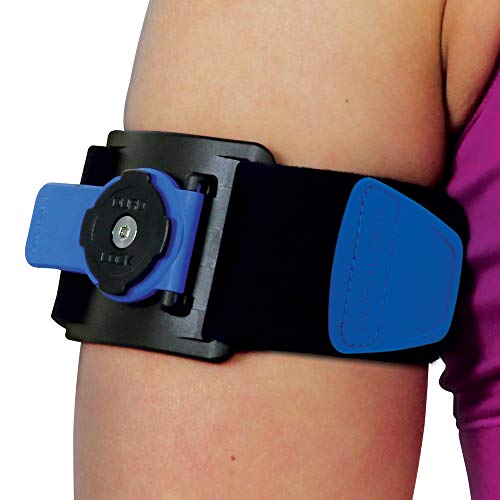
Quad Lock Run Kit
Instead of a pouch, the phone twists onto a dual stage mount and locks, which removes internal movement almost entirely. A matching Quad Lock case is required, so the system costs more to enter. Nothing sits between finger and glass, meaning the screen behaves exactly as it does in your hand.
Pros
- Locked mount eliminates the bounce pouches suffer from
- Direct screen contact with no film in the way
- Same case snaps onto Quad Lock bike and car mounts
Cons
- Buying into the Quad Lock case system is mandatory
- Rain hits the phone directly with no cover fitted

VUP Running Armband
Rotate the holder a full turn to flip between portrait and landscape without unstrapping anything. A clamp grips the handset edges rather than enclosing it, which leaves room for oversized phones. Owners report the clamp bites better on a bare phone than on a glossy case.
Pros
- Rotation allows a landscape switch mid run
- Open clamp accepts bigger phones than sewn pouches
- Holder detaches and moves onto a handlebar
Cons
- Open design leaves the phone unprotected in rain
- Grip weakens on very glossy phone cases

i2 Gear Running Armband
No rotation and no mounting system, just a light pouch with a long adjustable strap and a key pocket. Its screen cover is thin enough for accurate taps, passcode entry included. Runners who want a phone carried and nothing else solved will find little missing.
Pros
- Smallest outlay for a band that does the core job
- Thin cover keeps touch accuracy high
- Long strap reaches around a calf as well as an arm
Cons
- Thinner materials wear faster than neoprene
- No reflective detailing for low light
Armpocket Racer
An expandable pocket swallows energy gels, a race ID and a car key alongside the phone, which mirrors what half marathon runners actually carry. Moisture wicking fabric sits against the skin instead of slick neoprene. Fully loaded it becomes the bulkiest band here, so short runs feel over equipped.
Pros
- Carries nutrition and ID without adding a waist belt
- Wicking liner feels cooler than neoprene on long efforts
- Size options reach very slim and very large arms
Cons
- Bulkiest option once packed for race day
- More capacity than a short weekday run needs

Bone Collection Run Tie Connect
Silicone ties hold the phone flat against a slim band, cutting weight to a fraction of a padded pouch. Air reaches the back of the handset, so it runs cooler than an enclosed design on hot days. Storage is zero, which is the trade for barely feeling it.
Pros
- Weight is barely noticeable next to padded bands
- Open back keeps the phone cooler in summer heat
- Silicone avoids the itch some runners get from neoprene
Cons
- Nowhere to stash keys, cards or gels
- Phone sits fully exposed to rain and grit
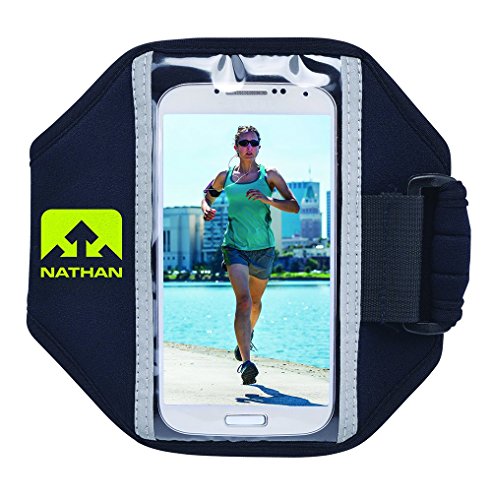
Nathan Sports Super 5K Armband
Reflective material is built into the outer face, which is what counts on unlit roads where headlights are the only light. Its pouch takes a mid size phone plus a key, and the closure holds position on tapered arms. Storage stays deliberately small to keep the profile close to the arm.
Pros
- Most visible band here once headlights hit it
- Low profile stays flat against the arm
- Closure resists sliding on tapered arms
Cons
- Little room beyond a phone and a key
- Larger handsets sit tight in the pouch
How to choose
What to check before you buy Three measurements settle most of this. Wrap a tape around your bicep mid run height, then match that number to the strap range rather than a size label. Check phone thickness with the case on, since depth defeats pouches more often than screen size does. Decide last what else travels with you, because a key slot, a card pocket and a gel pocket are three different designs. Reflectivity and rain protection follow from when and where you run.
What actually stops an armband bouncing Bounce has two sources. Straps that stretch under sweat lose tension inside a mile, and a phone shifting within its pouch adds a slower secondary wobble. Wide straps spread load and creep less than narrow elastic. Mechanical holders remove the internal movement completely, which is why the Quad Lock Run Kit feels steadier than any fabric pouch. Positioning helps too: just above the elbow slips less on arms that taper sharply.
Phone size and case compatibility Listings quote a screen size, yet thickness is the real limit. A 6.1 inch phone inside a rugged case can measure deeper than a bare 6.7 inch handset. Clamp holders such as the VUP cope with that better than sewn pouches, because they grip edges instead of wrapping the body. Quad Lock sidesteps the question by supplying its own case. Refuse to remove a bulky case before running and you should rule out fabric pouches immediately rather than returning one later.
Best running armband for night runs and long distance Unlit roads shift the priority to the outer face. Nathan’s reflective panels catch headlights from a useful distance, while TRIBE adds a narrower strip. Reflectivity on the underside or strap does nothing once the band is on your arm. Distance changes the brief again, since gels, a card and a key never fit a phone sized pocket. Armpocket’s expandable design covers that without a waist belt, and runners doing both should accept the bulk rather than splitting kit across two carriers.
Compared at a glance
| # | Model | Strap | Best for | Score | Price |
|---|---|---|---|---|---|
| 1 | TRIBE Running Phone Holder Armband | Adjustable neoprene, extender available | Best overall | 9.4 | Check price |
| 2 | Quad Lock Run Kit | Dual stage twist lock | Best for a locked mount | 9.2 | Check price |
| 3 | VUP Running Armband | 360 degree rotating clamp | Best value | 9.0 | Check price |
| 4 | i2 Gear Running Armband | Adjustable across a long range | Best budget | 8.8 | Check price |
| 5 | Armpocket Racer | Expandable pocket for gels, cards and keys | Best for race day storage | 8.5 | Check price |
| 6 | Bone Collection Run Tie Connect | Silicone tie straps, no enclosure | Best minimal design | 8.3 | Check price |
| 7 | Nathan Sports Super 5K Armband | Reflective outer panels | Best for low light visibility | 8.0 | Check price |
Questions worth asking
How do you stop a running armband from sliding down?
Measure your bicep and match it to the strap range instead of trusting a size label. Moving the band just above the elbow also helps on arms that taper.
Which running armband fits large phones?
VUP’s clamp takes oversized handsets, since it grips the edges rather than enclosing them. Quad Lock fits any phone covered by its case range.
Can you use a touchscreen through an armband cover?
On most pouches here, yes, passcode entry included. Face recognition is less reliable through a cover, so set a code before your first run.
Is an armband or a running belt better?
Armbands keep the screen visible for pace checks. Belts carry more and bounce less over distance, which is why many marathon runners use both together.
Are running armbands waterproof?
Almost none are. Fabric pouches handle sweat and light rain, while open designs such as Quad Lock and the Bone Run Tie leave the phone fully exposed.
What should you look for in an armband for night running?
Reflective panels on the outer face, as on the Nathan Super 5K. Anything reflective on the strap or underside is wasted once the band is worn.
Quad Lock vs a fabric armband: which is worth it?
Quad Lock needs its own case and costs more to start, but it removes bounce and gives direct screen access. Fabric pouches win on rain resistance and simple storage.
Do you need an armband with a case pocket for gels?
Only past about 10 km, where nutrition starts to matter. The Armpocket Racer expands for gels and a race ID, while smaller bands stop at a key and a card.
How do you wash a running armband?
Rinse by hand in cool water, keep detergent off hook and loop closures, then air dry away from heat. Machine washing distorts the pouch and weakens the strap.
The bottom line
Pick the TRIBE armband as the default, because its strap range fits most arms and the sweat resistant pouch handles everyday training. Anyone who has already returned a band for bouncing should switch to the Quad Lock Run Kit and accept the case requirement as the price of a locked mount. Half marathon and trail runners carrying gels, ID and keys want the Armpocket Racer, which replaces a separate belt outright.
Derek Holt
Derek has a background coaching recreational and amateur athletes and has worked the sales floor at specialty fitness retailers. He focuses on equipment durability, ergonomics and realistic use cases rather than marketing claims.


