Which Rugged Smartphone Can Actually Survive a Job Site?
The Samsung Galaxy XCover6 Pro suits most buyers who want rugged durability without leaving mainstream Android software. The CAT S62 Pro adds a built in thermal camera for trade work, while the Unihertz Tank trades a slimmer profile for a battery that lasts several days between charges.
The Samsung Galaxy XCover6 Pro fits most shoppers who want a rugged phone that still runs familiar, well supported Android software. It costs more than budget rugged brands, so anyone who mainly needs a huge battery or a thermal camera has better matches further down this list.
Rugged phone marketing throws around drop ratings and IP numbers loosely, so the real differences show up in battery capacity, update support and job specific extras like thermal sensors. We compared published durability certifications, battery size, camera hardware and carrier compatibility before ranking these seven.
Our top picks

Samsung Galaxy XCover6 Pro
Samsung carries the XCover6 Pro on the same One UI software track as its mainstream Galaxy phones, so updates arrive on a similar schedule. A removable battery is a rare feature on a modern phone, letting field workers swap a spare rather than wait on a charger. Carrier certification covers most major US networks.
Pros
- Removable battery, rare on modern phones
- Runs the same software track as Samsung’s mainstream phones
- Certified on major US carriers
Cons
- Camera trails flagship Galaxy models
- Costs more than budget rugged brands

CAT S62 Pro
CAT fits the S62 Pro with a built in FLIR thermal sensor, letting an electrician or HVAC technician spot a hot connection or a missing wall insulation gap on the spot. The housing is rated for both dust submersion and a high pressure wash down, not just a rain shower. A compact body keeps it manageable in a tool belt pocket.
Pros
- Built in thermal camera for inspecting leaks and wiring
- Rated for both dust submersion and high pressure wash down
- Compact size compared to large battery rugged phones
Cons
- Smaller screen than most newer rugged phones
- Thermal resolution lower than a dedicated FLIR tool

Doogee V30
Doogee adds an infrared sensor to the V30 that captures usable images in near total darkness, a genuine step beyond a standard low light camera mode. The display runs at a high outdoor brightness level that stays legible under direct sun. A large battery doubles as a reverse charging power source for other devices in the field.
Pros
- Infrared camera adds genuine low light capability
- Screen stays readable in direct sunlight
- Large battery doubles as a power bank for other devices
Cons
- Camera photo quality behind mainstream brands in normal light
- Software updates slower than Samsung or Nokia

Unihertz Tank
Unihertz centers the Tank around a 9800 mAh cell, large enough to cover several days of mixed use between charges for most owners. The same battery doubles as an emergency power source for a tablet or another phone through OTG output. Despite the cell size, the body stays more compact than many large battery rivals.
Pros
- Battery regularly lasts multiple days of mixed use
- Doubles as an emergency power bank for other gear
- Compact body despite the large cell
Cons
- Heavier in the pocket than slimmer rugged phones
- Fast charging slower given the battery size
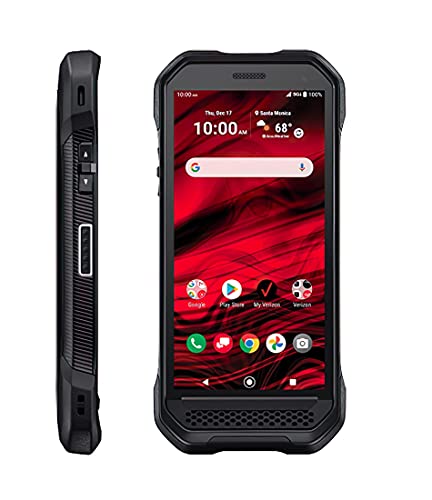
Kyocera DuraForce Ultra 5G
Kyocera designs the DuraForce Ultra 5G specifically around US carrier certification rather than selling an unlocked global phone first. A glove touch mode keeps the screen responsive for outdoor trade work in cold weather. A dedicated push to talk button suits dispatch teams coordinating over a radio style app.
Pros
- Built specifically for US carrier certification
- Glove touch mode works for outdoor trade use
- Push to talk button suits dispatch and field teams
Cons
- Smaller screen feels dated next to other picks
- Limited to carrier specific unlocked versions

Nokia XR21
HMD Global builds the Nokia XR21 with a longer promised update window than most rugged brands outside Samsung. The interface stays close to stock Android rather than a heavily customized skin. Drop testing covers falls onto concrete from 1.8 meters, which is in line with the category’s toughest claims.
Pros
- Longer promised update window than most rugged brands
- Clean near stock Android interface
- Drop tested to 1.8 meters onto concrete
Cons
- Camera performance is average for the price
- Fewer specialty features like thermal or night vision

Oukitel WP19
Oukitel undercuts name brand rugged phones on price while still packing a 9800 mAh battery into the WP19. A triple rear camera adds a dedicated macro lens for close up detail shots. A loud external speaker is meant to cut through job site noise better than a standard phone speaker.
Pros
- Large battery at a lower cost than name brand rivals
- Triple camera adds a dedicated macro lens
- Loud external speaker for job site noise
Cons
- Android skin carries more preinstalled software
- Resale value lower than Samsung or Nokia
Side by side
| # | Model | Durability rating | Best for | Score | Price |
|---|---|---|---|---|---|
| 1 | Samsung Galaxy XCover6 Pro | MIL STD 810H and IP68 | Best overall | 9.3 | Check price |
| 2 | CAT S62 Pro | MIL STD 810H and IP68, IP69K | Best for trade work | 9.0 | Check price |
| 3 | Doogee V30 | IP68, IP69K and MIL STD 810H | Best for night vision and outdoor brightness | 8.7 | Check price |
| 4 | Unihertz Tank | 9800 mAh | Best battery life | 8.8 | Check price |
| 5 | Kyocera DuraForce Ultra 5G | MIL STD 810H and IP68 | Best for carrier reliability | 8.6 | Check price |
| 6 | Nokia XR21 | MIL STD 810H and IP68, IP69K | Best for long term software support | 8.9 | Check price |
| 7 | Oukitel WP19 | 9800 mAh | Best budget big battery | 8.5 | Check price |
How to choose
What makes a smartphone rugged Durability claims rest on two separate standards: an IP rating for dust and water, and a MIL STD 810H style test for drops and temperature swings. A phone can pass one without the other, so check both numbers rather than assuming a high IP rating alone means drop proof. Reinforced corners and a thicker housing add bulk in exchange for that protection.
Battery life and software support Rugged phones vary widely in how long they get software updates, with Samsung and Nokia generally promising a longer window than smaller rugged brands. Battery capacity swings even more, from a standard size cell up to the Unihertz Tank’s 9800 mAh pack built for multi day use. Decide which matters more for your work day before comparing anything else.
Specialized features for trade work A thermal camera, like the one built into the CAT S62 Pro, lets a technician spot a hot wire or a cold spot behind drywall without separate equipment. Infrared night vision on the Doogee V30 serves a narrower audience that genuinely shoots in near total darkness. A push to talk button, as found on the Kyocera DuraForce Ultra 5G, suits dispatch heavy jobs more than solo field work.
Choosing a rugged phone for carrier coverage US carrier certified models like the Kyocera DuraForce Ultra 5G are built and tested specifically for networks such as Verizon and AT&T. Unlocked global brands including Doogee and Oukitel work on GSM networks but skip that formal carrier certification process. Anyone buying through a carrier plan should confirm certification first rather than assuming any unlocked rugged phone qualifies.
Good to know
Are rugged smartphones waterproof?
Most rugged phones carry an IP68 or higher rating, which means resistance to submersion for a set time at a set depth rather than true unlimited waterproofing. Check the exact rating before exposing a phone to deep or prolonged water contact.
What is the difference between IP68 and IP69K ratings?
IP68 covers dust resistance and submersion in still water. IP69K adds resistance to high pressure, high temperature water jets, which matters for anyone who hoses down equipment regularly.
Do rugged smartphones work with Verizon and AT&T?
Some models, like the Kyocera DuraForce Ultra 5G, are built and certified specifically for those carriers. Unlocked global brands may work on the same networks but without formal carrier certification.
How long does the battery last on a rugged phone?
It depends heavily on the model. Standard rugged phones run similar to mainstream phones, while large battery models like the Unihertz Tank or Oukitel WP19 can stretch across multiple days of mixed use.
Are Doogee rugged smartphones unlocked out of the box?
Yes, Doogee sells its rugged lineup, including the V30, as unlocked phones meant to work on GSM networks without a carrier specific lock.
Does Nokia still make rugged smartphones?
HMD Global continues the Nokia brand’s rugged line with models like the XR21, which pairs MIL STD 810H durability with a near stock Android software experience.
Can a rugged phone survive a drop onto concrete?
Models tested to MIL STD 810H standards, including the Nokia XR21, are rated for drops from around 1.8 meters onto a hard surface, though results vary by angle and surface.
Do rugged smartphones get regular software updates?
Update support varies by brand. Samsung and Nokia generally offer a longer promised update window than smaller rugged manufacturers.
What is a thermal camera phone used for?
A built in thermal sensor, like the one on the CAT S62 Pro, helps spot temperature differences such as a hot electrical connection, a water leak behind a wall, or missing insulation.
Final word
The Samsung Galaxy XCover6 Pro is the best starting point for most buyers who want rugged durability paired with familiar, well supported Android software. Trade workers who need a built in thermal sensor for inspections should choose the CAT S62 Pro instead. Anyone whose main concern is simply running all day without a charger will get more out of the Unihertz Tank’s oversized battery.
Marcus Chen
Marcus covered consumer electronics for enthusiast tech publications for six years before joining ChoiceCrest. He specializes in translating manufacturer spec sheets into plain-language buying advice, with a focus on audio, computing accessories and smart-home gear.


