Camping lanterns that recharge instead of eating batteries
Goal Zero Lighthouse 600 suits car camping best, with 600 lumens, a hand crank and a USB output for phones. BioLite AlpenGlow 500 renders warmer, truer colour for cooking and reading. Backpackers should carry the MPOWERD Luci Outdoor 2.0 Pro, near 5 ounces and charged by sun.
Goal Zero Lighthouse 600 covers most trips where the car parks nearby. Output reaches 600 lumens across 360 degrees, and the built in crank adds light once the 5200mAh cell runs flat. At about 1.1 pounds it has no place in a thru-hike pack.
Box runtime figures come from the lowest brightness setting, which hides the number you care about. We compared rated lumens at high, battery capacity in milliamp hours, charge input, weight and USB output across seven current lanterns. Owner reports on overnight runtime and water resistance settled the order.
Before you buy
What the lumen and battery numbers really mean Lumens describe the highest setting only. Around 150 lumens suits a tent interior, while 500 to 600 lights a picnic table for four. Battery capacity in milliamp hours predicts runtime better than box hours, since those come from minimum output. USB-C input means one cable for lantern and phone. Ratings from IPX4 upward shrug off a night of rain, and unrated plastic housings do not.
How to keep a lantern charged off grid Three methods cover almost every trip. A large cell, like the 6400mAh unit in the BioLite AlpenGlow 500, simply lasts a long weekend. Solar refills daily on open ground but stalls under canopy or thick cloud. Cranking, available on the Goal Zero Lighthouse 600, is the only option at midnight in rain. Pair one bright lantern with a separate power bank for week-long trips, because lighting and phone charging drain the same cell.
Best rechargeable lantern for backpacking Weight decides this branch outright. MPOWERD Luci Outdoor 2.0 Pro at about 5 ounces and Black Diamond Moji R+ at 5.3 ounces are the only credible trail picks. Both give close-range diffuse light, which is what a tent actually needs. Leave the Coleman OneSource and Goal Zero units in the car, since each passes a pound. Hikers already carrying a headlamp can skip a lantern and hang the headlamp against a water bottle for diffusion.
For family camping and power cuts at home Group camping rewards brightness and fast battery swaps. Coleman OneSource reaches 1000 lumens and takes a removable pack, so a spare ends any runtime worry. During a home outage, lanterns with a USB port double as phone chargers, which covers the Goal Zero, BioLite, Luci and LE picks. Store one at full charge in a cupboard and top it up every few months, because lithium cells self discharge in storage.
The top picks, ranked
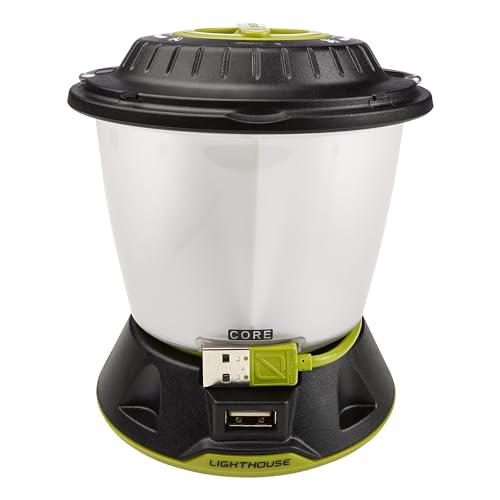
Goal Zero Lighthouse 600 Lantern
Two light panels switch independently, so half output lights one side of a picnic table and stretches the battery. Cranking for a minute buys roughly ten minutes of low light, insurance no other pick here offers. A USB port sends charge back out to a phone at camp.
Pros
- Hand crank works with a dead battery
- USB output tops up a phone
- Left and right panels switch separately
Cons
- 1.1 pounds is too heavy to backpack
- Cranking yields little charge per minute

BioLite AlpenGlow 500 Lantern
ChromaReal LEDs skip the blue-white cast most camp lanterns throw, which helps when reading or chopping vegetables. Shaking the body cycles colour modes, including a slow candle flicker for a tent. Its 6400mAh cell is the largest here and keeps capacity spare for a phone.
Pros
- Warm output with accurate colour rendering
- USB-C charging in and power out
- Largest battery capacity in this group
Cons
- 1.2 pounds rules out trail use
- Shake gestures take practice
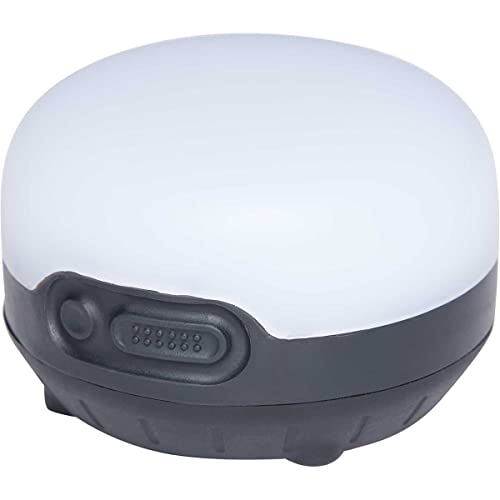
Black Diamond Moji R+ Lantern
Hanging from a tent ceiling loop is this lantern’s job, and 5.3 ounces makes that effortless. Double hooks plus a folding handle give several positions inside a small dome. Brightness stops at 150 lumens, right for a tent interior and short of a group cooking area.
Pros
- 5.3 ounces fits a jacket pocket
- Two hooks and a folding handle for hanging
- Coloured modes for low-glare night use
Cons
- 150 lumens cannot light a group camp
- No USB output for charging phones

Coleman OneSource Rechargeable LED Lantern
Swapping the OneSource pack takes seconds, so darkness never waits on a charge cycle. That same pack runs other OneSource tools, which favours families already in the system. Brightness climbs to 1000 lumens, the highest figure here, enough for a full campsite table.
Pros
- 1000 lumens, brightest in this roundup
- Spare packs swap in instead of recharging
- Pack shares with other Coleman OneSource gear
Cons
- About 2 pounds, car camping only
- Spare packs are a separate purchase

MPOWERD Luci Outdoor 2.0 Pro Solar Lantern
Inflatable construction packs this down near an inch tall, so it straps to a pack lid and charges as you walk. About 14 hours of direct sun fills it, and the USB port covers bad weather or trickles emergency charge to a phone. Light spreads softly through the diffuser instead of throwing distance.
Pros
- Recharges from sunlight with no cable
- Deflates nearly flat inside a pack
- Waterproof body floats if dropped
Cons
- Cloud and tree canopy slow solar charging
- Diffuse glow throws no distance

Energizer 360 Rechargeable LED Camping Lantern
Plain 360 degree output and a hanging hook cover camping, outages and garage work. Two buttons run everything, handy when passing it to a child at dusk. Water resistant housing and a fold-down handle survive a toss into the boot, though the beam stays cool white.
Pros
- Two-button controls, nothing to learn
- Doubles as a household outage light
- Fold-down handle hangs from a tent loop
Cons
- Cool-toned light looks clinical
- No USB output for phones

LE Rechargeable LED Camping Lantern
Pulling the body open switches it on, which kids manage without instructions. Roughly 300 lumens lights a vestibule or a child’s sleeping corner. Plastic housing feels plainer than the Goal Zero or BioLite units, so keep this as a spare rather than the main lantern.
Pros
- Lowest outlay for lighting several tents
- Extending the body powers it on
- USB output for an emergency phone charge
Cons
- Plastic body feels less durable
- Runtime claims assume the lowest setting
How they compare
| # | Model | Max output | Best for | Score | Price |
|---|---|---|---|---|---|
| 1 | Goal Zero Lighthouse 600 Lantern | 600 lumens | Best overall | 9.4 | Check price |
| 2 | BioLite AlpenGlow 500 Lantern | 500 lumens | Best light quality | 9.2 | Check price |
| 3 | Black Diamond Moji R+ Lantern | 150 lumens | Best for tents | 9.0 | Check price |
| 4 | Coleman OneSource Rechargeable LED Lantern | 1000 lumens | Best for family camping | 8.7 | Check price |
| 5 | MPOWERD Luci Outdoor 2.0 Pro Solar Lantern | 150 lumens | Best for backpacking | 8.5 | Check price |
| 6 | Energizer 360 Rechargeable LED Camping Lantern | 500 lumens | Best value | 8.3 | Check price |
| 7 | LE Rechargeable LED Camping Lantern | About 300 lumens | Best budget pick | 8.0 | Check price |
Questions worth asking
How many lumens do I need for a camping lantern?
Between 100 and 200 lumens feels comfortable inside a tent. A picnic table or cooking area wants 400 to 600 lumens. Anything past 800 lumens matters only when lighting a whole group campsite.
How long do rechargeable camping lanterns last on one charge?
Brightness setting decides it. Most run a few hours at maximum and many times longer at the lowest level, which is the figure printed on the box. Compare battery capacity instead of advertised hours.
Can a camping lantern charge my phone?
Four picks here can. Goal Zero Lighthouse 600, BioLite AlpenGlow 500, MPOWERD Luci Outdoor 2.0 Pro and the LE lantern all carry a USB output. Expect a partial charge, since light and phone share one cell.
Are solar camping lanterns worth it?
On open, sunny trips with no power bank, yes. Filling a panel takes many hours of direct sun, so forest canopy and overcast days undercut the idea. Pick a model like the Luci Outdoor 2.0 Pro that accepts USB as backup.
Which camping lantern is best for a tent?
Black Diamond Moji R+ is the tent specialist at 5.3 ounces, with two hooks, a folding handle and a 150 lumen ceiling that will not dazzle anyone in a small dome.
Rechargeable vs disposable battery lanterns: which is better?
Regular campers come out ahead with rechargeable units, since running costs drop and no cells go in the bin. Disposable AA models still win on multi-week trips away from power, where you carry spares instead of a charger.
Are rechargeable camping lanterns waterproof?
Most are water resistant rather than fully waterproof. Moji R+ carries an IPX4 rating, and the Luci Outdoor 2.0 Pro is waterproof and floats. Check the rating before leaving one out through a storm.
Can I use a camping lantern indoors during a power cut?
Yes, and nothing burns, which makes them safer than candles or fuel lanterns. Warm-toned units such as the BioLite AlpenGlow 500 feel easier indoors than cool white models.
What is the best rechargeable lantern for backpacking?
MPOWERD Luci Outdoor 2.0 Pro wins on packed size, deflating to roughly an inch tall at about 5 ounces. Choose the Moji R+ if you want instant brightness without waiting on daylight.
Does warm or cool light work better at camp?
Warm light around candle tones keeps night vision intact and attracts fewer insects than cool white. Cool white shows detail better for repairs and cooking, which is why the Energizer 360 still earns its place.
Our take
Goal Zero Lighthouse 600 is the pick for most campers, because the crank guarantees light after the 5200mAh cell dies and the USB port covers a phone. Anyone who cares how food and faces look under the lamp should take the BioLite AlpenGlow 500 instead. Backpackers should ignore both and strap the 5 ounce MPOWERD Luci Outdoor 2.0 Pro to a pack lid, where it charges all day for free.
Derek Holt
Derek has a background coaching recreational and amateur athletes and has worked the sales floor at specialty fitness retailers. He focuses on equipment durability, ergonomics and realistic use cases rather than marketing claims.


