Camping Lanterns That Keep Working in Freezing Rain
Goal Zero Lighthouse 600 leads for multi night trips, since a hand crank and USB output keep both the light and a phone alive. BioLite AlpenGlow 500 renders camp food and faces most naturally. For rain and sub freezing nights, Streamlight Siege AA seals better on swappable AA cells.
Goal Zero Lighthouse 600 suits campers who stay out for several nights running. Its internal pack, fold out crank and USB port keep a light going and a phone charged. Weight is the catch, which rules it out of any pack carried uphill. Gram counting backpackers should take the Black Diamond Moji instead.
Cold attacks a lantern twice over. Lithium cells give up usable capacity below freezing, and each warm to cold swing pulls damp air past weak gaskets onto the driver board. We compared lumen output, stated low mode runtime, battery chemistry, ingress rating and hanging hardware. Owner feedback from shoulder season and winter trips settled the close calls.
The best picks, ranked
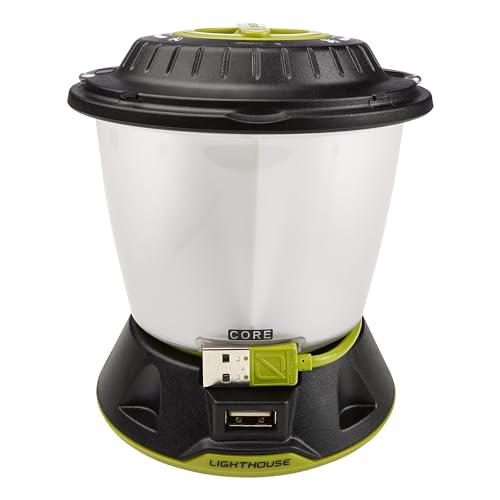
Goal Zero Lighthouse 600
Each half of the globe dims independently, so one side of the tent stays dark while somebody reads. According to the listing, a minute of cranking returns roughly ten minutes of low light. A USB port feeds a phone from the same internal pack. Fold out legs stand it on a picnic table, and a collapsible hook takes a ridgeline.
Pros
- Crank makes light when no charging source exists
- USB output tops up a phone without a separate bank
- Running one side only stretches a night of runtime
Cons
- Too heavy for anything carried on your back
- Solar input crawls under overcast sky

BioLite AlpenGlow 500
Colour tuning is what separates this from a plain white panel. Warm settings flatter food and faces where cool white leaves everything grey. Shaking the body cycles colour and candle flicker modes, which keeps children entertained for an hour. USB C charging shares a cable with modern phones and headlamps.
Pros
- Warm output cuts glare during late tent reading
- One cable covers lantern, phone and headlamp
- Dimmed low, a single charge covers several evenings
Cons
- Cells are sealed in, so no field swap
- Colour and flicker modes empty the pack faster than white

Black Diamond Moji Lantern
Packed size decides what goes in a backpack, and this drops into a lid pocket beside a spare buff. Twin hooks clip straight to tent ceiling loops without a carabiner. Frosted plastic spreads output so nobody catches a hotspot in the eye. Dimming runs low enough for reading inside a sleeping bag.
Pros
- AAA cells turn up in any village shop
- Light enough that nobody argues about who carries it
- Even glow avoids hard shadows in a two person tent
Cons
- Too dim to light a group cooking area
- Alkaline capacity drops sharply near freezing

Streamlight Siege AA Lantern
Duty gear standards show in the IPX7 housing and impact resistant polycarbonate body. Pull the globe off and a bare emitter remains, useful when you are peering into an engine bay. Red mode keeps night vision intact on a walk to the toilet block. Swapping AA cells turns a dead lantern into a working one in about a minute.
Pros
- Gasketed housing handles rain and condensation cycles
- Red night mode avoids blinding tent mates
- AA cells sit on the shelf of every filling station
Cons
- Peak output sits below the rechargeable models here
- Buying cells all season creates ongoing waste

Coleman Quad LED Lantern
One body splits into four removable panels, so four people can leave the table with their own light. Clipping a panel back onto the base recharges it. D cells in the base carry the main load, which puts this in car camping territory only. Owners report the handle survives being swung around a site by children.
Pros
- Panels answer the one lantern, four people problem
- Base recharges every panel between nights
- Handle and shell hold up to rough family handling
Cons
- Bulk rules out anything but vehicle camping
- Replacing D cells adds up across a season

UST 30-Day Duro LED Lantern
Runtime is the headline here, quoted at up to thirty days on the lowest setting from D cells. That fits a static basecamp tent or a storm supply tub in the garage. A dial sets brightness anywhere in its range instead of stepping through three fixed levels. Output lights a table well but will not reach across a field.
Pros
- Low mode outlasts every rechargeable on this list
- Dial control lands on the exact level you want
- Sensible light to keep in a home power cut kit
Cons
- D cells add serious weight to any pack
- Maximum output trails the Goal Zero and BioLite

LE Rechargeable LED Camping Lantern
Buy this when you need a second or third lantern and do not want to think about it. A rechargeable pack, several brightness steps and a hanging hook cover ordinary campsite duty. Charging works off a car adapter or a power bank on the drive in. Build is plainer than the Streamlight, so park it under the awning once rain sets in.
Pros
- Affordable enough to leave one in every vehicle
- Recharges from a car adapter or power bank
- Light for its size, easy to hang off a tarp pole
Cons
- Sealing falls well short of the IPX7 models here
- Pack capacity fades after a couple of heavy seasons
What to look for
How many lumens a camping lantern actually needs Campsite jobs need far less light than box numbers suggest. Cooking, eating and card games sit comfortably at 100 to 200 lumens. Above that, brightness mostly burns runtime and wrecks everyone’s night vision. Diffusion beats peak output for tent use, because a frosted globe fills a space evenly while a bare emitter throws hard shadows. Read the low mode runtime first, since that is the setting you will live on.
Why lanterns fail in cold and wet weather Freezing air cuts the usable capacity of lithium and alkaline cells alike. A lantern quoted at twelve hours indoors will fall short of that at minus five. Sealing causes the second failure: each warm to cold cycle draws damp air through a weak gasket, then condensation fogs the lens and creeps onto the driver board. True insulation is rare on lanterns, so treat an IPX7 rating and a gasketed globe as the real cold weather feature. Sleeping with a rechargeable model inside your bag recovers most of the lost runtime.
Rechargeable vs battery powered camping lanterns Rechargeables make sense near a vehicle, a mains socket or a solar panel, and a few double as power banks. Replaceable AA and D cells win on remote trips, in deep cold and in emergency kits, because a fresh set restores full output in seconds with no charging window. Weight tips the other way: D cells are heavy, and spare packs are not. Many winter campers carry one of each, running the rechargeable at camp and keeping cells sealed in a dry bag as backup.
Best lantern for backpacking, car camping and basecamp Backpackers should weigh grams before anything else, which points at the Black Diamond Moji plus a headlamp. Families at a drive in site get more from the Coleman Quad, since four panels stop the single lantern following one person to the toilet block. Cooks who care how food looks should take the BioLite AlpenGlow 500. Static basecamps and storm kits favour the UST 30-Day Duro, where weeks on low beat raw brightness. One lantern rarely covers all three roles, and buying that compromise leaves you heavy on trail and dim at camp.
Compared at a glance
| # | Model | Output | Best for | Score | Price |
|---|---|---|---|---|---|
| 1 | Goal Zero Lighthouse 600 | Up to 600 lumens | Best overall | 9.4 | Check price |
| 2 | BioLite AlpenGlow 500 | Up to 500 lumens | Best light quality | 9.2 | Check price |
| 3 | Black Diamond Moji Lantern | Around 100 lumens | Best for backpacking | 9.0 | Check price |
| 4 | Streamlight Siege AA Lantern | IPX7 waterproof, impact resistant body | Best weather sealing | 8.8 | Check price |
| 5 | Coleman Quad LED Lantern | Four detachable rechargeable panels | Best for families | 8.6 | Check price |
| 6 | UST 30-Day Duro LED Lantern | Up to 30 days on the lowest setting | Best runtime | 8.3 | Check price |
| 7 | LE Rechargeable LED Camping Lantern | Rechargeable internal battery, USB charging | Best value | 8.0 | Check price |
Frequently asked questions
What is the best camping lantern for cold weather?
Streamlight Siege AA copes best with cold and wet, thanks to swappable AA cells and an IPX7 housing that resists condensation. Rechargeable models still work if you keep them inside your sleeping bag overnight.
What does an insulated camping lantern really mean?
Very few lanterns carry actual insulation. In practice the phrase describes a sealed, gasketed housing and cells that tolerate cold, so look at the ingress rating and battery chemistry rather than the word itself.
How many lumens does a camping lantern need?
Roughly 100 to 200 lumens covers cooking, eating and reading. Higher output helps when pitching a tent in the dark or lighting a group shelter, but it drains cells several times faster.
Rechargeable vs battery camping lanterns: which is better?
Rechargeables suit car camping, short trips and anyone near a socket. Replaceable cells are more dependable on long remote trips and in freezing conditions, where pack capacity falls without warning.
Can you leave a camping lantern out in the rain?
Only when the rating allows it. An IPX7 model such as the Streamlight Siege tolerates brief immersion. Budget lanterns are usually splash resistant at best and belong under an awning.
Which camping lantern is best for a family tent?
Coleman Quad LED Lantern, because its four detachable panels give each person a light of their own. A single lantern always ends up in the wrong corner once several people start moving.
Do camping lanterns work as emergency lights at home?
Yes, and the UST 30-Day Duro fits that role with weeks of runtime on low. Models with USB output, like the Goal Zero Lighthouse 600, also keep a phone alive through an outage.
Why does my lantern die faster in winter?
Cold cuts the capacity both lithium packs and alkaline cells can deliver. Storing the lantern inside a jacket or sleeping bag until you need it recovers most of that lost runtime.
Is a lantern better than a headlamp for camping?
They solve different problems. A headlamp aims light wherever you look, while a lantern fills a whole space. Most campers carry both and switch to the lantern once camp is pitched.
How do you hang a lantern inside a tent?
Use the ceiling loop most tents sew into the apex, and clip the lantern’s hook or shock cord to it. Hanging it high and dimming it down spreads light better than standing it on the floor.
Our take
Goal Zero Lighthouse 600 is the buy for anyone camping more than one night at a time, since the crank and USB output make it a light and a small power source in one body. Families at a drive in site should spend on the Coleman Quad instead, and anyone counting grams on trail should skip both for the Black Diamond Moji. When shoulder season rain soaks everything you own, the IPX7 rated Streamlight Siege AA is the safer bet than any sealed rechargeable.
Derek Holt
Derek has a background coaching recreational and amateur athletes and has worked the sales floor at specialty fitness retailers. He focuses on equipment durability, ergonomics and realistic use cases rather than marketing claims.

