Golf vs Hunting Rangefinders: Picking the Right One
The Bushnell Tour V6 Shift leads for golfers who need slope switching and a vibrating pin lock. The Leupold RX-2800 TBR/W handles long-range hunting out to 2800 yards on reflective targets. The TecTecTec VPRO500 gives casual golfers a low-cost way in.
Golfers chasing a consistent yardage tend to land on the Bushnell Tour V6 Shift, since its slope switch and vibrating PinSeeker confirm the flag instead of the trees behind it. Hunters shooting farther need the wind-adjusted ballistic math built into the Leupold RX-2800 TBR/W instead.
A golf rangefinder and a hunting rangefinder solve different problems, locking a flag against slope versus calculating bullet drop across wind and angle. A single spec sheet does not capture that difference, so we compared range, compensation features and locking technology separately for each sport.
What to look for
What to look for in a rangefinder Golf and hunting rangefinders prioritize different things entirely. Golf models focus on flag-locking feedback, vibration or pulse, plus slope compensation for elevation. Hunting models focus on maximum reflective range and ballistic math that factors in angle, wind and bullet drop. Magnification sits around 6x to 7x across both categories, which affects how easily a small target stands out.
Best for golf, casual rounds to tournaments A slope switch, found on the Bushnell Tour V6 Shift and Precision Pro NX9, lets a golfer use elevation-adjusted yardage in practice and flip to raw distance for tournament rules. Vibration or pulse confirmation cuts the odds of ranging a tree instead of the flag. Budget picks like the TecTecTec VPRO500 skip those extras but still cover standard course distances.
Best for hunting at extended range Long-range hunting favors the Leupold RX-2800 TBR/W or Sig Sauer Kilo2200BDX, both of which calculate a ballistic solution rather than raw yardage alone. Reflective range figures, often 2000 yards or more, describe hard flat surfaces rather than game, so the deer-sized rating gives a more realistic field expectation. Angle compensation matters most from an elevated tree stand or across a canyon.
Best for pairing with a scope Sig Sauer’s BDX system pairs a rangefinder with a compatible riflescope over Bluetooth, projecting a holdover dot directly into the reticle. That removes the need to dial or hold over manually once a target is ranged. Hunters without a matching scope still get standalone rangefinder function, just without the automated display.
Our top picks

Bushnell Tour V6 Shift Golf Rangefinder
A physical slope switch toggles between tournament-legal distance and slope-adjusted yardage for practice rounds. PinSeeker with JOLT technology vibrates the instant the laser locks onto the flag, separating it from background trees. Bushnell rates the unit to roughly 450 yards under ideal conditions.
Pros
- Slope switch keeps it legal for tournament play
- JOLT vibration confirms flag lock without second-guessing
- Compact body fits a golf bag pocket easily
Cons
- Slope mode needs manual switching before tournaments
- Costs more than basic golf rangefinders

Leupold RX-2800 TBR/W Hunting Rangefinder
True Ballistic Range with Wind factors in angle and wind, not just raw distance, to produce a shooting solution. Leupold rates it to over 1400 yards on deer-sized game and roughly 2800 yards on reflective targets. A DNA precision engine speeds up locking on smaller, moving targets at range.
Pros
- Wind-adjusted ballistic solution goes beyond raw yardage
- Long reflective range suits open-country hunting
- DNA engine locks faster on small or moving game
Cons
- Setting up ballistic profiles has a learning curve
- Bulkier and heavier than compact golf models

TecTecTec VPRO500 Golf Rangefinder
This unit covers standard golf distances with a claimed range up to 540 yards, plenty for approach shots on most courses. Pinsense mode separates the flag from background clutter, though it skips the vibration confirmation found on pricier models. A single-button interface keeps operation simple for casual rounds.
Pros
- Low entry price for a first golf rangefinder
- One-button operation stays simple on the course
- Range covers recreational course distances easily
Cons
- No slope compensation for elevation changes
- No vibration or audio confirmation of lock

Precision Pro NX9 Slope Golf Rangefinder
Pulse vibration technology confirms the flag lock the same way pricier rivals do, at a lower cost. Slope adjusts for elevation during practice and switches off for tournament compliance. Precision Pro rates the effective flag range at around 400 yards.
Pros
- Vibration confirmation at a mid-range price point
- Slope switch covers both practice and tournament rounds
- Lightweight body suits an all-day carry
Cons
- Shorter maximum range than premium golf models
- Optics dim faster during low-light dawn rounds
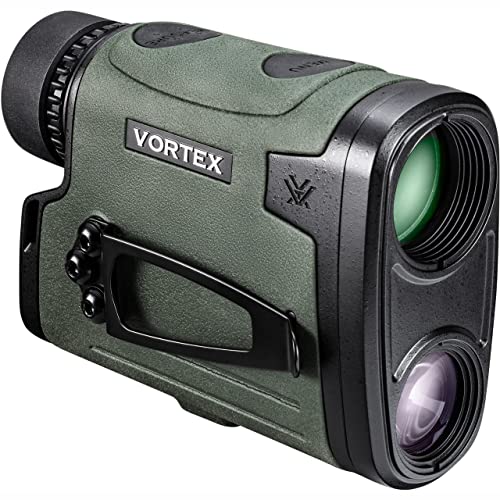
Vortex Diamondback HD 2000 Rangefinder
An HD optical system sharpens clarity and contrast over base Diamondback models, helping separate game from brush. Vortex rates it to 2000 yards on reflective targets and roughly 1400 yards on deer-sized game. It skips the built-in ballistic calculator found on pricier hunting units, keeping the interface simple.
Pros
- HD optics improve clarity when game sits in brush
- Strong reflective range for the price point
- Simple interface skips a complex ballistic menu
Cons
- No built-in ballistic or wind compensation
- Measures line of sight distance only, not angle-adjusted

Sig Sauer Kilo2200BDX Rangefinder
The BDX system pairs this rangefinder over Bluetooth with compatible Sig Sauer riflescopes, sending a holdover dot into the reticle. Sig rates the reflective range at roughly 2200 yards. Hunters without a BDX scope still get a standalone laser rangefinder with basic angle compensation.
Pros
- BDX pairing sends holdover data straight into a scope
- Reflective range suits open terrain hunting
- Works standalone without a BDX-compatible scope
Cons
- Full ballistic benefit needs a separate BDX scope purchase
- Bluetooth pairing adds a setup step in the field

Nikon COOLSHOT PROII STABILIZED Rangefinder
Built-in image stabilization cuts the hand shake that blurs the view at higher magnification, a first Nikon markets for its class. Range reaches roughly 800 yards, and ID technology factors in incline or decline on hilly courses. A slope switch keeps it usable for both practice and tournament rounds.
Pros
- Image stabilization steadies the view at 6x zoom
- Longer maximum range than most golf-specific models
- Slope switch supports tournament compliance
Cons
- Larger body than compact golf rangefinders
- Stabilization feature increases battery draw
How they stack up
| # | Model | Max range to flag | Best for | Score | Price |
|---|---|---|---|---|---|
| 1 | Bushnell Tour V6 Shift Golf Rangefinder | Approx 450 yards | Best overall | 9.4 | Check price |
| 2 | Leupold RX-2800 TBR/W Hunting Rangefinder | Approx 2800 yards | Best for long-range hunting | 9.1 | Check price |
| 3 | TecTecTec VPRO500 Golf Rangefinder | Approx 540 yards | Best budget | 8.8 | Check price |
| 4 | Precision Pro NX9 Slope Golf Rangefinder | Approx 400 yards | Best value for golf | 8.6 | Check price |
| 5 | Vortex Diamondback HD 2000 Rangefinder | Approx 2000 yards | Best value for hunting | 8.4 | Check price |
| 6 | Sig Sauer Kilo2200BDX Rangefinder | Approx 2200 yards | Best for ballistic data pairing | 8.2 | Check price |
| 7 | Nikon COOLSHOT PROII STABILIZED Rangefinder | Approx 800 yards | Best for stabilized golf accuracy | 8.0 | Check price |
Questions worth asking
What is the difference between a golf and a hunting rangefinder?
Golf rangefinders prioritize flag-locking accuracy and slope compensation for course elevation. Hunting rangefinders emphasize longer reflective range and ballistic math for angle and wind.
Is slope compensation legal in golf tournaments?
Most tournament rules require slope compensation switched off or absent, which is why the Bushnell Tour V6 Shift and Precision Pro NX9 include a physical slope switch.
How far can a hunting rangefinder actually range game?
Reflective range figures, often 2000 to 2800 yards, apply to flat reflective targets. Deer-sized game typically ranges at roughly half that distance or less.
Does a rangefinder need image stabilization?
Stabilization mainly helps at higher magnification, where hand shake blurs the view, which is why the Nikon COOLSHOT PROII STABILIZED markets it as a standout feature rather than a given.
What does BDX mean on a Sig Sauer rangefinder?
BDX is Sig Sauer’s Bluetooth ecosystem, pairing a rangefinder with a compatible riflescope to show a calculated holdover point in the reticle.
Can one rangefinder work for both golf and hunting?
Some hunters use a golf rangefinder for short-range scouting, but hunting-specific models offer longer range and ballistic features golf units lack.
What magnification is best for a rangefinder?
Most golf and hunting rangefinders use 6x to 7x, which balances a wide field of view against enough zoom to identify a distant flag or target.
Do budget rangefinders sacrifice accuracy?
Budget models like the TecTecTec VPRO500 generally measure distance accurately but skip slope compensation, vibration confirmation or a ballistic calculator.
Which rangefinder is best for bow hunting?
Bow hunters typically favor a shorter, angle-compensated model like the Vortex Diamondback HD 2000, since bow range rarely exceeds a few hundred yards.
How accurate is a golf rangefinder to the flag?
Most golf rangefinders read within a yard once locked onto the flag, though vibration or pulse confirmation, found on the Bushnell Tour V6 Shift and Precision Pro NX9, reduces the chance of a false lock on background objects.
Final word
Golfers playing both casual and tournament rounds get the most flexibility from the Bushnell Tour V6 Shift, thanks to its switchable slope mode and vibration lock. Long-range hunters should choose the Leupold RX-2800 TBR/W instead, since a wind-adjusted ballistic solution matters more than distance alone. Anyone building a Sig Sauer BDX rifle setup gets real added value from the Kilo2200BDX, but only when paired with a compatible scope.
Sierra Daniels
Sierra's background is in landscape design and nursery retail. She focuses on lawn and garden equipment, outdoor furniture and gear durability, weighing published specs against how materials actually hold up outside.

