Radar Detectors Ranked by Real Range and False Alerts
The Uniden R8 is the best overall radar detector, combining long detection range with GPS-based false alert filtering for highway driving. The Valentine One Gen2 suits drivers who want directional arrows, and the Cobra RAD 480i covers budget detection with app connectivity.
The Uniden R8 is the best overall radar detector, because its dual-antenna design extends detection range in both directions while its GPS database filters out repeat false alerts from fixed sources like automatic doors. It costs more than simpler detectors, so anyone on a tighter budget can still get solid highway detection from the Cobra RAD 480i instead.
We compared detection range, false alert filtering through GPS lockouts, laser detection coverage, and app or display features using manufacturer specifications and feedback from long-distance drivers.
The top picks, ranked

Uniden R8
A dual-antenna design extends detection range both ahead and behind the vehicle, catching signals that a single-antenna detector might miss until much closer. A built-in GPS database automatically filters out repeat false alerts from fixed sources like red light cameras and automatic doors.
Pros
- Dual antennas extend range in both directions of travel
- GPS lockout database reduces repeat false alerts over time
- Color display with directional arrows aids quick reaction
Cons
- Price sits above most radar detectors in this comparison
- Mounting and initial GPS lockout setup take some time

Escort MAX 400
A companion smartphone app simplifies setup and shows real-time alerts shared from other Escort users nearby, adding crowd-sourced data on top of the detector’s own sensors. Voice alerts announce threat type and direction without requiring a glance at the display.
Pros
- Crowd-sourced app alerts add warnings beyond the detector’s own range
- Voice alerts reduce the need to look at the display while driving
- Simple setup suits drivers new to radar detectors
Cons
- Full app functionality requires a connected smartphone running
- Detection range trails the Uniden R8’s dual-antenna design

Valentine One Gen2
Arrows on the display indicate whether a detected signal comes from ahead, behind or both at once, helping a driver judge whether a threat is closing in or already passed. Bluetooth connectivity pairs with a companion app for additional alert filtering options.
Pros
- Directional arrows clarify whether a threat is ahead or behind
- Dual antennas catch signals from both directions of travel
- Long-standing reputation for accurate signal strength readings
Cons
- Interface feels less modern than newer app-first competitors
- Premium pricing matches its premium feature set
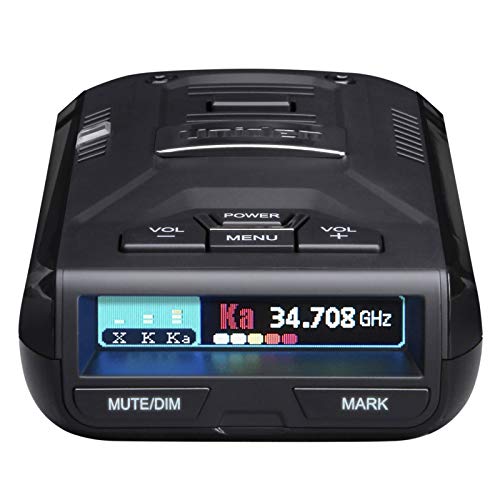
Uniden DFR9
Uniden’s mid-tier model keeps much of the flagship R8’s detection range while dropping some of the pricier extras, landing at a noticeably lower cost. A built-in GPS database still filters common false alert sources automatically.
Pros
- Strong detection range for a mid-tier priced detector
- GPS filtering included despite the lower price than the R8
- Simple display icons keep alerts easy to read quickly
Cons
- Single forward antenna gives less rear detection than dual-antenna models
- Fewer app integration options than Escort’s connected lineup

Cobra RAD 480i
A lower price point still includes app connectivity for crowd-sourced alerts, extending its practical range beyond what the hardware alone would catch. Basic radar and laser detection cover typical highway driving without premium extras.
Pros
- Lowest price among app-connected detectors in this comparison
- Crowd-sourced alerts add coverage beyond the detector’s own range
- Compact size mounts easily on most windshields
Cons
- Detection range trails premium detectors at this price tier
- Fewer manual filtering options than the Uniden R8 or Escort MAX 400

Escort Redline 360c
Laser sensors cover all four directions around the vehicle, catching laser-based enforcement that single-direction sensors on cheaper detectors can miss. Extreme detection range on radar signals gives drivers more advance warning on open highways.
Pros
- 360-degree laser detection catches threats from every direction
- Extended radar range gives more advance warning time
- Compatible with Escort’s crowd-sourced alert network
Cons
- Among the priciest detectors in this comparison
- Advanced features take time to fully configure and understand

Whistler CR93
A no-frills design covers standard radar and laser bands without GPS filtering or app connectivity, suiting drivers who want basic awareness without a learning curve. A compact body mounts quickly on any windshield.
Pros
- Lowest cost entry point into radar detection in this comparison
- Simple design requires no app or account setup
- Quick, straightforward windshield mounting
Cons
- No GPS filtering means more repeat false alerts over time
- Detection range trails every other detector in this comparison
Compared at a glance
| # | Model | Antenna Design | Best for | Score | Price |
|---|---|---|---|---|---|
| 1 | Uniden R8 | Dual, front and rear | Best Overall | 9.4 | Check price |
| 2 | Escort MAX 400 | Radar and laser | Best for Ease of Use | 9.0 | Check price |
| 3 | Valentine One Gen2 | Dual, front and rear | Best for Directional Arrows | 9.1 | Check price |
| 4 | Uniden DFR9 | Radar and laser | Best Value | 8.6 | Check price |
| 5 | Cobra RAD 480i | Radar and laser | Best Budget | 8.1 | Check price |
| 6 | Escort Redline 360c | Radar and 360-degree laser | Best for Laser Detection Range | 9.2 | Check price |
| 7 | Whistler CR93 | Radar and laser | Best Budget Simple Pick | 7.9 | Check price |
How to pick the right one
What to Look For in a Radar Detector Detection range matters most on open highways, while GPS-based false alert filtering matters most for daily city or suburban driving past automatic doors and fixed cameras. Laser detection coverage, especially 360-degree coverage like the Escort Redline 360c offers, catches enforcement methods that basic radar-only sensors miss entirely. Balancing these factors against price narrows the field faster than chasing the single highest range number.
GPS Filtering and Reducing Repeat False Alerts A detector’s GPS database learns the locations of fixed false alert sources, like automatic doors or traffic sensors, and silences repeat alerts at those same spots over time. Detectors without this feature, like the Whistler CR93, alert at the same false triggers every single drive past them. Daily commuters benefit from GPS filtering far more than someone who drives the same stretch of highway only occasionally.
App-Connected Detectors and Crowd-Sourced Alerts Detectors paired with apps like Escort Live or Cobra’s iRadar receive alerts from other connected drivers on the same road, extending effective warning distance beyond what the detector’s own antenna could catch alone. That crowd-sourced data depends on enough nearby drivers also running the same app, so rural roads see less benefit than busy commuter routes. Drivers who want this feature should check app activity in their specific driving area before relying on it heavily.
Directional Arrows and Judging Threat Location Detectors with front and rear arrows, like the Uniden R8 and Valentine One Gen2, help a driver judge whether a detected signal is approaching from ahead or already passed from behind. That distinction matters more on multi-lane highways with frequent oncoming and overtaking traffic. Single-antenna detectors skip this feature, giving less context about where exactly a signal originated.
Frequently asked questions
Are radar detectors legal to use while driving?
Laws vary by location. Most states allow radar detectors in personal vehicles, though some restrict or ban them, so checking local regulations before relying on one matters.
What is the difference between radar and laser detection?
Radar detectors sense radio frequency signals used by traditional speed enforcement, while laser detection catches a separate, shorter-range beam-based method some enforcement uses instead.
Does GPS filtering stop all false alerts?
It reduces repeat alerts from known fixed sources like automatic doors, but it cannot eliminate every false alert, since new or temporary sources still trigger a response.
How much detection range do I actually need?
Highway drivers benefit most from longer range, like the Uniden R8 offers, while city drivers dealing mainly with fixed sources benefit more from strong GPS filtering than raw range.
Do app-connected radar detectors need constant internet access?
They need a connected smartphone running the companion app to receive crowd-sourced alerts, though the detector’s own hardware sensors still work independently without it.
What do directional arrows on a radar detector display mean?
They show whether a detected signal is coming from ahead, from behind, or both, helping a driver judge whether a threat is approaching or already passed.
Is a budget radar detector like the Whistler CR93 still useful?
Yes, for basic awareness of radar and laser signals, though it lacks the GPS filtering and extended range that reduce false alerts on pricier models.
Can one radar detector cover both city and highway driving well?
Detectors with both strong GPS filtering and long range, like the Uniden R8 or Escort Redline 360c, handle both environments better than detectors built around just one strength.
Final word
The Uniden R8 stands out overall for pairing long dual-antenna range with GPS filtering that cuts down repeat false alerts. Drivers who want clear directional context on detected signals should choose the Valentine One Gen2 instead, for its front and rear arrow display. Budget-focused drivers still get dependable app-connected detection from the Cobra RAD 480i.
Marcus Chen
Marcus covered consumer electronics for enthusiast tech publications for six years before joining ChoiceCrest. He specializes in translating manufacturer spec sheets into plain-language buying advice, with a focus on audio, computing accessories and smart-home gear.


