How to Choose a Quarantine Tank That Protects Your Fish
Among 7 tanks compared, the Aqueon Standard Glass Aquarium 10 Gallon ranks first for its stable ten gallon volume and bare glass build that sterilises easily. The Tetra 10 Gallon LED Aquarium Kit bundles everything a first quarantine setup needs, while the Marineland Portrait Glass LED Aquarium suits a single fish or nano shipment.
A quarantine tank works best when it stays deliberately plain: bare glass, a sponge filter, a heater and nothing else. Ten gallon options such as the Aqueon Standard Glass Aquarium hold steady parameters without becoming hard to clean. Smaller and larger builds each solve a different sizing problem, from a single betta to a group of new arrivals.
Display tank features work against quarantine, since built in carbon filters and porous decor absorb medication meant for a sick fish. We compared water volume, filtration type, build simplicity and footprint across 7 current listings, then weighed what fishkeepers report about cleaning and stability between uses.
The top picks, ranked

Aqueon Standard Glass Aquarium 10 Gallon
Ten gallons keeps parameters stable while keeping water changes to a single bucket. Silicone sealed glass panels have no built in equipment, so nothing is there to absorb medication or trap bacteria. Owners report it wipes down and sterilises quickly between fish, which speeds up turnaround for a busy quarantine rotation.
Pros
- Stable ten gallon volume for dosing and testing
- No built in equipment to absorb medication
- Sterilises quickly between occupants
Cons
- Filter, heater and lid sold separately
- Full tank is heavy to move

Tetra 10 Gallon LED Aquarium Kit
This kit bundles a tank, hood, LED light and filter, cutting the shopping list for a first quarantine setup. Its supplied filter runs on carbon cartridges, so the cartridge needs pulling before any medication goes in. Pairing it with a spare sponge filter keeps biological filtration running once carbon comes out.
Pros
- Tank, hood, light and filter arrive in one box
- Hood keeps jumpers contained
- Low profile LED avoids stressing sick fish
Cons
- Carbon cartridge must be removed during treatment
- Heater is not included
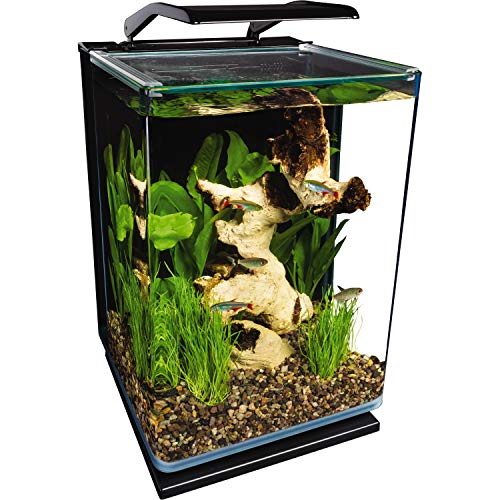
Marineland Portrait Glass LED Aquarium 5 Gallon
Curved glass and a rear filtration compartment make this a natural fit for a single betta or a small nano shipment. Five gallons swings faster than ten, so daily testing matters more here. Its narrow footprint fits a shelf, which helps when floor space for a second tank does not exist.
Pros
- Compact footprint fits shelves and desks
- Hidden rear filtration stays quiet
- Adjustable LED suits day and night viewing
Cons
- Small volume moves faster and needs closer monitoring
- Rear compartment is awkward to scrub clean

Fluval Spec V Aquarium Kit
An aluminium frame and a three stage filter chamber give this tank more media control than most nano setups. Sponge and biological media can run alone during treatment, with carbon left out of the chamber. Many owners keep it running as a display tank between quarantine cycles rather than storing it empty.
Pros
- Aluminium frame feels sturdier than typical nano tanks
- Filter chamber media is easy to swap out
- Adjustable flow suits a stressed or recovering fish
Cons
- Bright stock LED may need dimming for sick fish
- Five gallon volume limits it to small species

SeaClear Acrylic Aquarium 20 Gallon
Acrylic construction cuts the weight compared with glass of the same size, which matters when a tank gets drained and stored between uses. Twenty gallons gives a larger fish or a small group real swimming room. Cleaning calls for a soft pad instead of a blade, since acrylic scratches more easily than glass.
Pros
- Lighter than glass for repeated moving and storage
- Twenty gallon volume suits larger or grouped fish
- Resists shattering better than glass
Cons
- Scratches if cleaned with the wrong pad
- Priced above an equivalent glass tank

Koller Products Panaview 5 Gallon Aquarium Kit
Plastic panels, an internal filter and colour changing LED lighting make this the lowest cost way to keep a hospital tank ready. Occasional quarantine use suits it well, though frequent draining and refilling will cloud the plastic over time. Treat it as a backup tool rather than a permanent tank.
Pros
- Lowest cost option for an on demand hospital tank
- Light weight makes storage between uses simple
- Filter and hood are included
Cons
- Plastic panels cloud and scratch with repeated use
- Internal filter holds limited media

hygger Horizon 8 Gallon Aquarium
Curved front glass gives a clear view of a new fish, which is most of the point of quarantine. An LED light and a small filter ship with it, though the filter is worth swapping for a sponge unit during treatment. Eight gallons sits between the nano tanks and a full ten gallon, useful when neither size fits.
Pros
- Curved front glass aids close observation
- Eight gallon volume splits the difference between sizes
- Light brightness adjusts for a recovering fish
Cons
- Curved glass distorts the view at the edges
- Stock filter struggles with a full bioload
Before you buy
How big should a quarantine tank be? Ten gallons is the volume most fishkeepers reach for first, since it holds parameters steady without turning water changes into a chore. A single betta or a handful of nano fish do fine in five gallons, though smaller water volumes swing temperature and chemistry faster. Larger or grouped fish need the extra room a twenty gallon tank provides, at the cost of more water and more medication per dose. Match the tank to the fish, not the other way around.
Why does a quarantine tank stay bare? Substrate and decorations absorb medication and give pathogens somewhere to hide, which works against the entire purpose of the setup. A bare bottom with a length of pipe or a plastic plant offers cover without the cleanup problem. Waste and symptoms also show up faster against bare glass, so problems get caught sooner. Anything left in the tank should be something you are willing to disinfect or throw away.
What filtration works during quarantine treatment? Activated carbon pulls medication straight out of the water, so a standard cartridge filter fights against treatment. An air driven sponge filter handles biological filtration and gentle flow instead, without stripping anything from the water. Seeding a spare sponge filter in the main tank keeps it colonised and ready the moment quarantine starts. Cartridge filters that ship with a kit still work fine once the carbon insert comes out.
How do you sterilise a tank between fish? Skipping this step lets one fish’s problem carry over to the next occupant. Draining, scrubbing and disinfecting the tank and hardware, then rinsing and air drying, is the routine most keepers follow. Nets, siphons and buckets used for quarantine should stay separate from the equipment used on a main display. Shared gear is one of the easiest ways for a pathogen to cross between tanks.
The lineup, side by side
| # | Model | Volume | Best for | Score | Price |
|---|---|---|---|---|---|
| 1 | Aqueon Standard Glass Aquarium 10 Gallon | 10 gallons | Best overall | 9.4 | Check price |
| 2 | Tetra 10 Gallon LED Aquarium Kit | 10 gallons | Best complete kit | 9.2 | Check price |
| 3 | Marineland Portrait Glass LED Aquarium 5 Gallon | 5 gallons | Best for single fish | 9.0 | Check price |
| 4 | Fluval Spec V Aquarium Kit | 5 gallons | Best filtration | 8.8 | Check price |
| 5 | SeaClear Acrylic Aquarium 20 Gallon | 20 gallons | Best for larger fish | 8.6 | Check price |
| 6 | Koller Products Panaview 5 Gallon Aquarium Kit | 5 gallons | Best budget | 8.3 | Check price |
| 7 | hygger Horizon 8 Gallon Aquarium | 8 gallons | Best viewing | 8.0 | Check price |
Good to know
How long should new fish stay in quarantine?
Two to four weeks covers most parasites and infections, according to common fishkeeping guidance. Extend the period if any symptom appears, and restart the clock after treatment rather than counting from the day the fish arrived.
What size quarantine tank do most fishkeepers use?
Ten gallons fits most community fish and stays easy to manage. A single small fish gets by in five gallons, while a group or larger species benefits from twenty gallons of room.
Do quarantine tanks need a filter?
Yes, and an air driven sponge filter is the usual choice. It provides biological filtration and oxygen without pulling medication out of the water the way a carbon cartridge does.
Should a quarantine tank have gravel or substrate?
No. Bare glass is simpler to clean, makes waste and symptoms easier to spot, and avoids substrate soaking up medication between fish.
Can a quarantine tank double as a display tank?
Many owners run one setup both ways, provided it gets stripped and sterilised before each quarantine cycle. Attractive builds like the Fluval Spec V suit either role.
How do you cycle a quarantine tank fast?
Keep a spare sponge filter running inside your main aquarium so it stays colonised with bacteria. Moving it into the quarantine tank gives you established filtration immediately instead of waiting weeks to cycle from scratch.
Is a heater necessary in a quarantine tank?
Almost always, since steady temperature lowers stress and many treatments assume a specific range. Heaters rarely come bundled with tanks or kits, so budget for one separately.
How do you clean a quarantine tank between fish?
Drain it fully, scrub the glass and any hardware, then disinfect with a solution rated safe for aquarium use. Rinse thoroughly, let everything air dry, and keep nets and siphons dedicated to quarantine only.
What is the difference between a quarantine tank and a hospital tank?
The terms overlap in practice, though some keepers reserve hospital tank for treating an already sick fish and quarantine tank for observing new arrivals. Either way the setup, bare, simple and separate, stays the same.
Can I quarantine multiple fish together?
Fish from the same shipment or source can usually share a tank, provided there is enough volume for the group. Fish from different sources are better kept separate, since one might carry something the other has not been exposed to.
Final word
The Aqueon Standard Glass Aquarium 10 Gallon remains the default pick, since a correctly sized bare glass box is what quarantine actually calls for. Choose the Tetra 10 Gallon LED Aquarium Kit for an all in one setup, or the Marineland Portrait Glass LED Aquarium when only shelf space is available.
Olivia Hartley
Olivia spent several years working at an animal shelter and a pet-supply retailer before joining the editorial team. She researches pet gear with an emphasis on safety, comfort and the fine print that owners often miss.

