What Size Tank Does a Betta Fish Really Need?
Fluval’s Spec V wins overall, since an adjustable output nozzle tames the current bettas struggle against. The Fluval Flex 9 Gallon adds volume plus a remote controlled LED for a display setup. For a wide swimming footprint, the hygger 8 Gallon Horizon spreads its water across a long base.
Flow and volume decide whether a betta thrives or sulks in a corner. Fluval’s Spec V pairs five gallons with an output nozzle you can aim and throttle, which is why it leads here. The Fluval Flex 9 Gallon suits anyone wanting a centrepiece, while the hygger 8 Gallon Horizon buys chemical stability through sheer water volume.
Small tank kits are where most betta problems begin, because the bundled pump was designed for tetras rather than long finned fish. Warm, stable, slow moving water is the target instead. We compared published capacities, filter design and whether output can be reduced, LED brightness for growing anubias or java fern, heater clearance inside the tank, and how easily each lid comes off for a water change. Owner reports about baffling filters and keeping temperatures steady informed the ranking.
What to look for
What size tank does a betta actually need? Five gallons is the figure most experienced keepers settle on as a minimum. Volume is really about chemistry: more water dilutes ammonia and nitrate, so a missed change matters less. Larger tanks also hold temperature steadily through a cold night, which small ones cannot. Bettas patrol horizontally, so a long base beats a tall column of the same volume. Anything under three gallons turns routine care into a daily job.
How do you soften filter flow for a betta? Long fins act like sails, and a strong return leaves a betta pinned against the glass or hiding behind decor. Start with a filter whose output can be aimed or throttled, as the Fluval Spec V allows. Where output is fixed, wedge a piece of clean filter sponge over the outlet or point the flow at the back glass to break it up. A pre-filter sponge on the intake also stops fins being pulled in. Watch the fish for a day: resting mid water rather than wedged in a corner means the current is right.
Do betta tanks need a heater and a thermometer? Bettas come from warm, shallow water in Southeast Asia and stay tropical in captivity. Most homes drop below their comfortable range overnight, even in summer. Fit a small adjustable heater sized to the tank volume, then verify with a separate thermometer rather than trusting the dial. Sudden swings stress a fish faster than a steady temperature at the cooler end of the range. Check that the tank has clearance behind ornaments for the heater to sit fully submerged.
Which tanks suit live plants, desks and small rooms? Planted setups need usable light and depth for roots. Tall designs such as the Marineland Portrait favour stem plants, while a long base like the hygger Horizon leaves room for carpeting species and driftwood. On a desk, weight and reach matter more: the Koller Panaview lifts easily, and the Tetra ColorFusion tucks into a corner. Anubias and java fern attach to wood and need no substrate at all, which makes maintenance simpler in any of them. Silk plants remain a safe fallback, unlike stiff plastic that tears fins.
The best picks, ranked

Fluval Spec V
Five gallons of etched glass sit behind an aluminum trim, with a rear chamber hiding mechanical, chemical and biological media. Output arrives through a directional nozzle that can be aimed at the back glass to break up current. Bright LED lighting supports anubias, java fern and cryptocoryne without a separate fixture.
Pros
- Nozzle aims flow away from the swimming area
- Rear chamber hides equipment from view
- LED grows low light plants without upgrades
Cons
- Factory flow still needs turning down for a betta
- Heater must be bought separately

Fluval Flex 9 Gallon
A curved front panel magnifies the aquascape, and the multi stage filter tucks into a rear compartment out of sight. Colour and brightness adjust from a remote, so you can run a dim dusk setting before lights out. Nine gallons dilute waste well, which forgives the occasional missed water change.
Pros
- Largest volume here keeps parameters steady
- Remote dims the light for evening viewing
- Rear chamber leaves the display uncluttered
Cons
- Return flow needs restricting for long fins
- Curved glass distorts the view from sharp angles

hygger 8 Gallon Horizon
Eight gallons spread across a long base give a betta room to patrol end to end rather than circle. Included power filtration and an adjustable LED cover the essentials for a planted setup. Extra volume buffers temperature swings in rooms that cool overnight.
Pros
- Long footprint suits horizontal swimming
- Volume slows temperature and nitrate swings
- LED brightness steps down for shy fish
Cons
- Power filter output needs a sponge baffle
- Occupies more counter depth than nano tanks
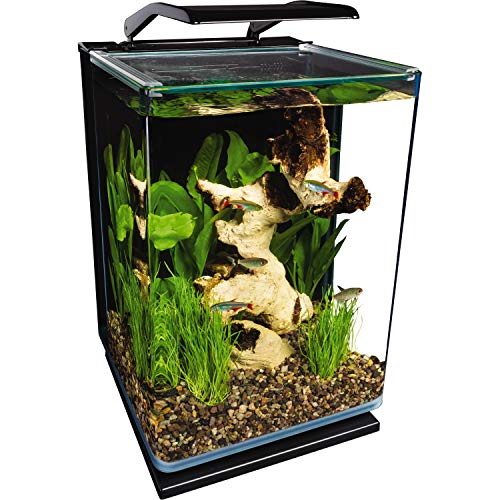
Marineland Portrait
Height rather than width defines this five gallon tank, giving room for taller stem plants and driftwood. A hidden three stage filter runs at the back, and the daylight LED switches to a blue moonlight mode. Narrow base depth limits how much foreground you can plant.
Pros
- Vertical space fits tall stem plants
- Small counter footprint for its volume
- Moonlight setting suits evening viewing
Cons
- Narrow base restricts foreground planting
- Filter needs baffling before adding a betta
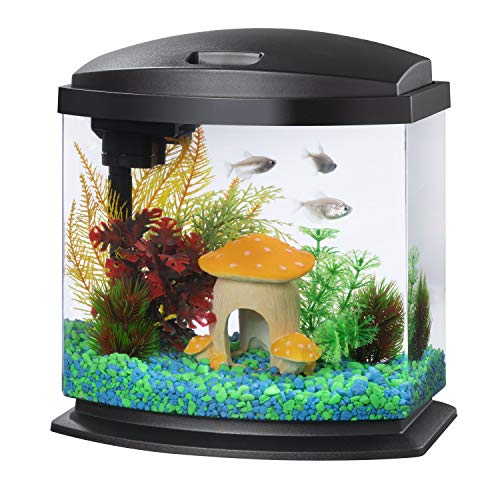
Aqueon LED MiniBow
Everything needed to start arrives in one box: hood, LED, cartridge filter and a bowed front panel. Five gallons is the commonly recommended minimum for a single betta, so this clears the bar without extras. Acrylic keeps the weight low but scratches under a magnet cleaner with grit trapped underneath.
Pros
- Complete kit needs nothing else but a heater
- Light enough for a shelf that cannot take glass
- Bow front widens the viewing angle
Cons
- Cartridge filter runs strong for a betta
- Acrylic scratches more readily than glass

Tetra ColorFusion
Three gallons, a Whisper internal filter and a colour shifting LED make this an easy introduction to fishkeeping. Volume sits below the five gallon figure most keepers recommend, so water changes need to happen weekly rather than fortnightly. Temperature also drifts faster in a small body of water, making a heater and thermometer essential.
Pros
- Low cost entry into a filtered, lit tank
- Internal filter frees the back of the tank
- Fits a desk or bedside table easily
Cons
- Three gallons demands stricter maintenance
- Internal filter output needs softening

Koller Products Panaview
Impact resistant plastic keeps this five gallon tank light enough to lift onto a high shelf single handed. A rounded panoramic front and a multi colour LED give it desk appeal. Plastic walls cloud and scratch over the years, so this is a starter tank rather than a decade long fixture.
Pros
- Very light to lift and reposition
- Panoramic front widens the view
- Complete kit with filter and lighting
Cons
- Plastic scratches and clouds faster than glass
- Filter output needs a sponge to slow it
The lineup, side by side
| # | Model | Capacity | Best for | Score | Price |
|---|---|---|---|---|---|
| 1 | Fluval Spec V | 5 gallons | Best overall | 9.4 | Check price |
| 2 | Fluval Flex 9 Gallon | 9 gallons | Best display tank | 9.2 | Check price |
| 3 | hygger 8 Gallon Horizon | 8 gallons | Best for stable water | 9.0 | Check price |
| 4 | Marineland Portrait | 5 gallons | Best for planted setups | 8.8 | Check price |
| 5 | Aqueon LED MiniBow | 5 gallons | Best value kit | 8.6 | Check price |
| 6 | Tetra ColorFusion | 3 gallons | Best first tank | 8.3 | Check price |
| 7 | Koller Products Panaview | 5 gallons | Best budget pick | 8.0 | Check price |
Questions worth asking
How many gallons does one betta need?
Five gallons is the widely recommended minimum for a single betta. That volume keeps ammonia diluted between changes and holds temperature steady. Larger is easier to manage, not harder, since mistakes get diluted rather than concentrated.
Can a betta live in a bowl?
It is a poor setup. Bowls hold too little water to buffer temperature or waste, and they rarely allow a heater or filter. Fish kept that way commonly develop fin and gill problems. A heated, gently filtered tank gives a far better outcome.
Do betta tanks need a filter?
Yes, in practice. A filter houses the bacteria that convert ammonia to nitrate, which keeps water safe between changes. The requirement is gentle output, not no output. Choose an adjustable filter or fit a sponge baffle over the outlet.
Is a 3 gallon tank big enough for a betta?
It can work with discipline, but it leaves no margin. Expect weekly water changes and closer temperature monitoring, since a small volume shifts quickly. Most keepers who start at three gallons upgrade within a year.
How do you cycle a new betta tank?
Set up the filter and heater, then add a source of ammonia and test the water every few days. Nitrite appears next, then nitrate, at which point the bacteria colony can handle a fish. Seeding media from an established tank shortens the wait considerably.
Can bettas live with other fish?
Sometimes, with planning. Many males do best alone, though calm non nipping species can work in a larger, heavily planted tank. Two males must never share a tank. Add cover and sightline breaks, then watch closely for chased or nipped fins.
How often should you change betta tank water?
Weekly partial changes suit most small tanks, with larger volumes stretching further. Change a portion rather than everything, so the bacteria colony survives. Treat replacement water with a dechlorinator and match the temperature before pouring it in.
Are live plants good for a betta tank?
Yes. Anubias, java fern and cryptocoryne provide resting spots and absorb some nitrate. All three grow under standard kit LEDs and attach to wood or rock, so no special substrate is needed. Silk alternatives are safe when live plants feel like too much work.
Should a betta tank light stay on at night?
No. Bettas rest in darkness and benefit from a regular cycle, so run roughly eight hours of light on a timer. Leaving lights on encourages algae as well as disturbing sleep. Moonlight modes are for viewing, not for overnight use.
Which is better for a betta tank, glass or acrylic?
Glass resists scratches and stays clear for years, which is why the Fluval and hygger models use it. Acrylic and plastic weigh far less and survive knocks, useful on a shelf or in a child’s room. Expect scratches on plastic if a magnet cleaner traps a grain of gravel.
Our pick
Fluval’s Spec V is the tank most betta keepers should buy, since five gallons plus an aimable, throttled outlet solves the two problems that ruin small setups. Step up to the Fluval Flex 9 Gallon when the aquarium doubles as a room centrepiece. Choose the hygger 8 Gallon Horizon instead if a long swimming footprint and steady water chemistry matter most.
Olivia Hartley
Olivia spent several years working at an animal shelter and a pet-supply retailer before joining the editorial team. She researches pet gear with an emphasis on safety, comfort and the fine print that owners often miss.
