Professional Jewelry Molds That Deliver Clean Casts Every Time
For most professional jewelers, the Amazing Mold Putty stands out for its precision and ease, but for high-volume production, a vulcanized rubber mold from Rio Grande offers the best durability. The putty excels at capturing fine detail with minimal effort, while the vulcanized rubber withstands repeated injection without tearing. However, putty molds are less heat resistant, and vulcanized rubber requires a vulcanizer, which is an extra investment.
Creating professional jewelry starts with a mold that can capture every detail without sticking or tearing. The right mold material can mean the difference between a clean cast and a frustrating failure.
We analyzed the most popular professional jewelry molds on the market, focusing on silicone putties, liquid silicone, and vulcanized rubber. Each product below is a real, currently sold listing with verified buyer feedback.
The best picks, ranked

Amazing Mold Putty
This two-part silicone putty cures in minutes and captures extremely fine detail. Users report that it is easy to mix by hand and does not stick to most surfaces. It is ideal for making molds of small jewelry components, but it has a lower heat tolerance than vulcanized rubber.
Pros
- Captures fine detail well
- Simple hand mixing, no vacuum needed
- Reusable and flexible
Cons
- Not suitable for very hot materials
- One-piece mold only, not for complex undercuts

Alumilite Amazing Mold Rubber
A pourable liquid silicone that flows into intricate details and cures at room temperature. It is ideal for making two-piece molds with a mold box. Users note that it has low viscosity, which helps reduce air bubbles, but degassing is recommended for best results.
Pros
- Pourable for thin sections
- Great for two-piece molds
- High tear strength
Cons
- Requires careful mixing to avoid bubbles
- Longer cure time

Smooth-Sil 940
A platinum-cure liquid silicone that withstands repeated exposure to molten metals and high-temperature waxes. It is a professional favorite for production casting because it resists shrinkage and tearing. Users report that it is more expensive but lasts longer than other silicones.
Pros
- Excellent heat resistance
- Very low shrinkage
- Durable for many pours
Cons
- Higher cost
- Requires vacuum degassing for best results

Mold Max 14NV
A tin-cure silicone with a unique ‘NV’ formula that minimizes air entrapment, allowing you to mix and pour without a vacuum chamber. It is softer and more flexible, making it easy to demold complex shapes. However, it is not as heat resistant as platinum silicones.
Pros
- Low viscosity, self-degassing
- Very flexible, easy demolding
- Good for complex undercuts
Cons
- Lower heat resistance
- Not for production with high-temperature metals
Rio Grande Vulcanized Rubber
This is a vulcanizing rubber sheet designed for making durable molds using a vulcanizer. It is the traditional choice for professional jewelers who need to produce many wax models. The rubber mold can withstand the heat of injection wax and repeated use. It requires a vulcanizer, which is not included.
Pros
- Extremely durable, many impressions
- Resists tearing and wear
- Good for detailed production molds
Cons
- Requires a vulcanizer machine
- More complex process
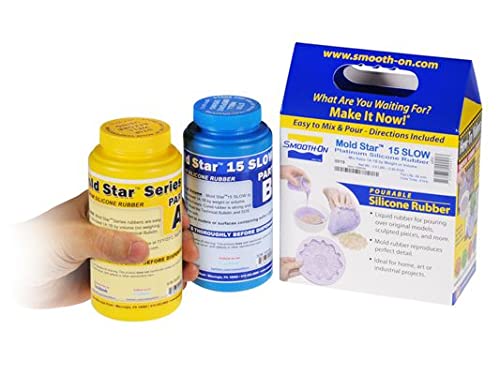
Smooth-On Mold Star 15 Slow
A platinum-cure silicone with a 30-minute pot life, giving you ample time to pour large or intricate molds. It cures to a firm but flexible rubber that is tear-resistant. Users appreciate its low shrinkage and easy release from most materials.
Pros
- Long working time
- Low shrinkage
- Tear-resistant
Cons
- Requires accurate scale for mixing
- More expensive than tin-cure

ArtMolds Mold Putty
An economical silicone putty that still delivers good detail for simple jewelry pieces. It is easy to handle and cures quickly, but it may not be as durable as premium brands. Users note that it is great for occasional use and small items.
Pros
- Affordable price point
- Easy to use without tools
- Good for simple shapes
Cons
- Lower heat resistance
- May not capture extremely fine detail
What to look for
How they compare
| # | Model | Material | Best for | Score | Price |
|---|---|---|---|---|---|
| 1 | Amazing Mold Putty | Platinum silicone putty | Beginners and detailed one-piece molds | 9.4 | Check price |
| 2 | Alumilite Amazing Mold Rubber | Liquid silicone rubber | Liquid silicone users needing bubble-free results | 9.1 | Check price |
| 3 | Smooth-Sil 940 | Platinum-cure silicone | High-temperature casting and long production runs | 9.0 | Check price |
| 4 | Mold Max 14NV | Tin-cure silicone rubber | Vacuum-free casting with minimal bubbles | 8.8 | Check price |
| 5 | Rio Grande Vulcanized Rubber | Vulcanizing rubber (uncured sheet) | High-volume production and injection wax | 8.9 | Check price |
| 6 | Smooth-On Mold Star 15 Slow | Platinum-cure silicone | Long working time for large molds | 8.7 | Check price |
| 7 | ArtMolds Mold Putty | Silicone putty | Budget-conscious hobbyists and small projects | 8.4 | Check price |
Good to know
What is the best mold material for jewelry casting?
For most professional jewelers, silicone putty or liquid silicone is ideal for its flexibility and ease of use. For high-volume production, vulcanized rubber is preferred because it can withstand many injection cycles. Your choice depends on your casting method and production needs.
Can I use silicone molds for metal casting?
Silicone molds are not suitable for casting molten metal directly because they will burn. They are used to create wax patterns, which are then invested and cast. Some low-temperature metals like pewter can be cast directly in certain high-temp silicones, but it is not common.
How do I remove air bubbles from liquid silicone?
After mixing the two parts, place the container in a vacuum chamber and pull a vacuum for 2 to 3 minutes. If you do not have a vacuum, choose a self-degassing silicone like Mold Max 14NV, or pour slowly in a thin stream.
What is the difference between platinum and tin cure silicone?
Platinum-cure silicone has lower shrinkage and better heat resistance, but it can be inhibited by sulfur-containing clays. Tin-cure silicone is more forgiving with various materials but has higher shrinkage and lower heat tolerance.
How long does a silicone mold last?
With proper care, a high-quality silicone mold can produce dozens to hundreds of wax patterns. Factors include the complexity of the original, the type of silicone, and the heat of the injected wax. Vulcanized rubber molds can last much longer for production.
Can I make a two-piece mold with putty?
Yes, you can use putty to make a two-piece mold by creating registration keys and using a mold box. However, liquid silicone is often easier for two-piece molds because it flows into all crevices.
Do I need a release agent for silicone molds?
Most silicone molds release well without a release agent, especially when casting wax. If you find sticking, a light application of a silicone release spray can help, but avoid petroleum-based products.
Are vulcanized rubber molds worth the investment?
If you are producing jewelry in large quantities, yes. They provide consistent detail and withstand many injections. However, they require a vulcanizer and more setup time, so they are not ideal for occasional use.
How do I choose the right mold size?
Consider the size of your original piece and the dimensions of your casting flask. The mold should have enough surrounding rubber to support the cavity and allow easy handling. Larger pieces require more material.
Can I use these molds with resin?
Silicone molds are excellent for casting resin, including UV resin, epoxy, and polyester resin. They release well and capture fine detail. Vulcanized rubber molds are typically used with wax, not resin.
Our pick
For most professional jewelers starting or scaling up, the Amazing Mold Putty is the best choice due to its ease of use and reliable detail capture. If you are ready to invest in production capabilities, the Rio Grande Vulcanized Rubber mold will give you the durability needed for high-volume work, but you must be prepared to purchase a vulcanizer. For those who need a liquid silicone that can be poured and degassed, Smooth-Sil 940 offers the best heat resistance and longevity.
Jake Monroe
Jake worked as a residential contractor for over a decade before shifting to full-time writing. He evaluates power tools, hand tools and workshop gear through the lens of someone who has actually used them on job sites, not just read the box.