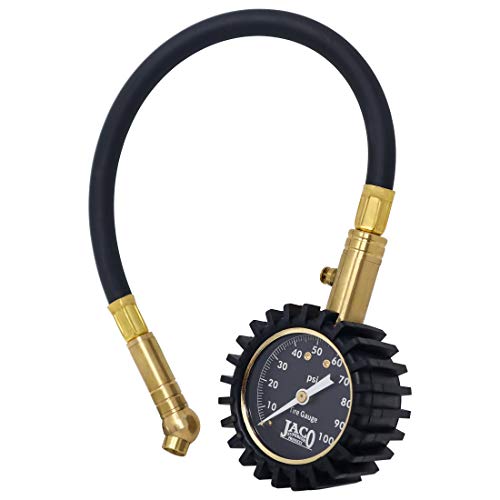
Professional Tire Pressure Gauges for Road Trip Peace of Mind
For road trips, the AstroAI Digital Tire Pressure Gauge stands out as the top pick. It offers a bright backlit display, a handy flashlight, and a 100 PSI range, making it easy to check pressures at night or in dim rest areas. Its main limitation is that the angled head can be awkward in tight valve positions, but overall it provides reliable accuracy for most drivers.
Proper tire pressure is critical for safe and fuel-efficient road trips. Underinflated tires can overheat and fail, while overinflated ones reduce traction. A reliable gauge helps you maintain the right pressure, especially when temperatures change across states.
Professional gauges go beyond simple pencil types. They offer better accuracy, durable construction, and features like digital displays, backlights, and bleed valves. This roundup highlights the best options to keep in your glovebox for long journeys.
What we recommend
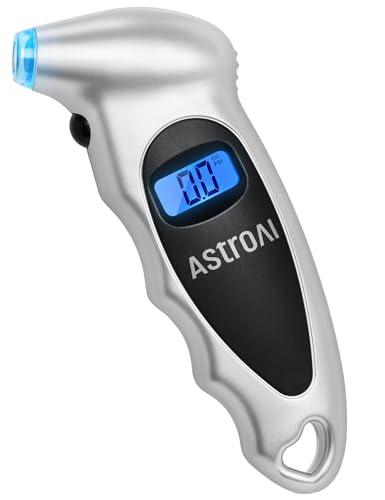
AstroAI Digital Tire Pressure Gauge
This digital gauge reads from 0 to 100 PSI with 0.1 PSI resolution. It features a backlit LCD and an integrated LED flashlight, perfect for nighttime checks. The angled head fits most valve stems, and the auto-off function saves battery.
Pros
- Bright backlit display and flashlight
- Accurate to 0.1 PSI
- Auto-off to preserve battery
Cons
- Angled head can be awkward on some valves
- Batteries not included
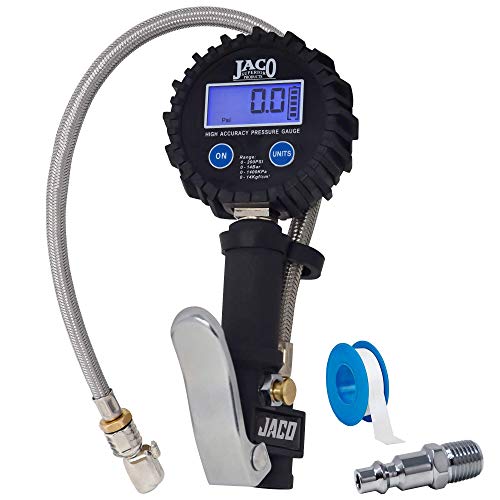
JACO FlowPro Digital Tire Pressure Gauge
The FlowPro is a heavy-duty digital gauge with a 0-150 PSI range and 0.1 PSI accuracy. Its dual-foot chuck works on both snap-in and screw-on valves, and it has a large backlit display. The housing is rubberized for a secure grip.
Pros
- High accuracy for professional needs
- Dual-foot chuck fits both valve types
- Durable rubberized body
Cons
- Slightly heavier than other models
- Price is higher

Milton S-921 Single Chuck Tire Gauge
The Milton S-921 is a classic analog gauge with a 0-120 PSI range. It has a heavy-duty brass construction and a large 2-inch dial with a bleeder valve for precise adjustments. No batteries needed, so it always works.
Pros
- No battery required
- Rugged brass construction
- Bleeder valve allows easy pressure release
Cons
- Analog scale not as precise as digital
- Dial can be hard to read in low light

Accutire MS-4350B Digital Tire Gauge
The Accutire MS-4350B is an affordable digital gauge with a 0-100 PSI range. It features a large LCD and a swivel head for easy access to valves. It also has a built-in flashlight and a pressure hold function.
Pros
- Very affordable
- Swivel head reaches awkward valves
- Built-in flashlight
Cons
- Resolution is only 0.5 PSI
- Plastic body feels less durable

TireTek Pro Series Heavy Duty Digital Tire Gauge
The TireTek Pro Series handles up to 150 PSI, making it suitable for trucks and RVs. It has a backlit display, a 3-light LED system for low, normal, and high pressure, and a non-slip rubber grip. The head rotates 360 degrees.
Pros
- High range for larger vehicles
- Color-coded pressure alerts
- Ergonomic grip
Cons
- Not as precise as 0.1 PSI gauges
- Larger size may be bulky

MotoPower Digital Tire Pressure Gauge
The MotoPower gauge features a simple one-button operation and a large backlit display. It measures from 0 to 100 PSI in 0.1 increments. The ergonomic design includes a non-slip grip and a built-in light.
Pros
- Very easy to operate
- Compact and comfortable to hold
- Accurate readings
Cons
- No bleeder valve
- Plastic construction
Thunderbolt Digital Tire Pressure Gauge
The Thunderbolt gauge combines digital accuracy with a large analog-style dial for easy reading. It covers 0-100 PSI and has a backlit display. The head is angled for better access, and it includes a protective rubber boot.
Pros
- Large, easy-to-read display
- Backlit for dark conditions
- Rubber boot protects against drops
Cons
- Bulky design
- Requires batteries
Side by side
| # | Model | Range | Best for | Score | Price |
|---|---|---|---|---|---|
| 1 | AstroAI Digital Tire Pressure Gauge | 0-100 PSI | Best overall for road trips | 9.4 | Check price |
| 2 | JACO FlowPro Digital Tire Pressure Gauge | 0-150 PSI | Best for precise readings | 9.2 | Check price |
| 3 | Milton S-921 Single Chuck Tire Gauge | 0-120 PSI | Best analog gauge for durability | 9.0 | Check price |
| 4 | Accutire MS-4350B Digital Tire Gauge | 0-100 PSI | Best budget pick | 8.8 | Check price |
| 5 | TireTek Pro Series Heavy Duty Digital Tire Gauge | 5-150 PSI | Best for commercial vehicles | 8.7 | Check price |
| 6 | MotoPower Digital Tire Pressure Gauge | 0-100 PSI | Best for ease of use | 8.5 | Check price |
| 7 | Thunderbolt Digital Tire Pressure Gauge | 0-100 PSI | Best for large dial visibility | 8.3 | Check price |
Before you buy
Frequently asked questions
What is the ideal tire pressure for road trips?
Check the manufacturer’s recommendation, usually found on a sticker inside the driver’s door or in the owner’s manual. Common values are between 30 and 35 PSI for passenger cars, but your vehicle may differ. Always use the vehicle’s recommended pressure, not the maximum printed on the tire sidewall.
How often should I check my tire pressure during a long trip?
It’s wise to check at the start of each day, especially if temperatures change significantly. Also check after long drives or if you notice a change in handling. A quick check at every fuel stop is a good habit.
Can I use a tire pressure gauge on my RV or trailer?
Yes, but you need a gauge with a higher PSI range. Many RVs and trailers require 50 to 80 PSI or more. The TireTek Pro Series, with its 150 PSI range, is suitable for such vehicles. Always match the gauge’s range to your tire requirements.
Why does my digital gauge give different readings than the gas station air pump?
Gas station pumps are often less accurate and may be subject to wear. Digital gauges with 0.1 PSI resolution are typically more precise. Also, pressures can vary with temperature and measurement time. For consistency, use the same gauge each time.
How do I know if my tire pressure gauge is accurate?
You can compare it with a known-good gauge or check it at a tire shop. Some digital gauges can be recalibrated, but budget models may not. If you suspect inaccuracy, replace the gauge, as proper pressure is crucial for safety.
What does a bleeder valve do?
A bleeder valve allows you to release air from the tire without removing the gauge completely. This is helpful when you overinflate slightly. Press the small button or lever to let out air until you reach the desired pressure.
Are analog gauges as accurate as digital ones?
High-quality analog gauges can be accurate within 1-2 PSI, but digital gauges often read to 0.1 PSI. For most drivers, analog is sufficient, but if you need precise pressure, especially for performance or towing, digital is better.
Can I leave my tire pressure gauge in the car during extreme heat or cold?
Most gauges are designed to withstand typical car interiors, but extreme temperatures can affect battery life in digital models. It’s best to store them in the glovebox or a cooler spot. Analog gauges are less sensitive to temperature.
What is the best way to store a tire pressure gauge?
Keep it in a protective case or a compartment to avoid damage. Avoid tossing it loose in the trunk where it can be jostled. If it has batteries, remove them if you won’t use it for long periods to prevent corrosion.
Do I need a separate gauge for my spare tire?
No, you can use the same gauge. However, many spares have a different recommended pressure, so check the label or manual. Ensure your gauge can handle the pressure range of the spare as well.
The bottom line
For most road trippers, the AstroAI Digital Tire Pressure Gauge is the best choice. It balances accuracy, ease of use, and price. If you prefer no batteries and rugged durability, get the Milton S-921 analog gauge. For those towing heavy loads, the TireTek Pro Series provides the needed range. Choose based on your vehicle and preferences, but always prioritize accuracy and reliability.
Tony Russo
Tony trained as an automotive technician and spent years in service and parts retail before moving into writing. He focuses on garage tools, car care products and accessories from a hands-on maintenance perspective.