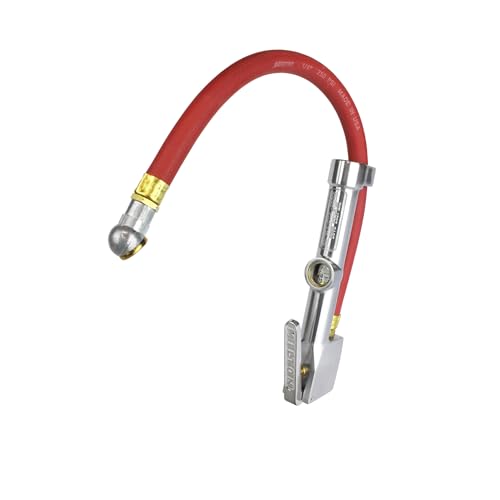
Shop Smart: Professional Tire Pressure Gauges for Mechanics
The Accutire MS-4021B stands out as the top pick for professional mechanics due to its dual-head design that fits both standard and high-pressure tires, plus its sturdy build and accurate readings. It is ideal for shops that need a reliable gauge for everyday use. However, it lacks a bleeder valve, which may be a limitation for some precision tasks.
Professional mechanics need a tire pressure gauge that delivers precise readings every time. With so many options on the market, choosing the right one can be overwhelming. We compared top-rated models to help you make an informed decision.
From analog dials to digital displays, each gauge offers unique benefits. Some are built to withstand harsh shop environments, while others provide extra features like backlit screens and bleed valves. Our roundup highlights the strengths and limitations of each.
Our top picks

Accutire MS-4021B
The Accutire MS-4021B is a professional-grade dual-head gauge that reads both standard and high-pressure tires up to 150 PSI. Its large backlit LCD and 360-degree swivel head make it easy to use in tight spaces. The rugged rubberized casing protects it from drops and impacts.
Pros
- Dual head fits all tire types
- Backlit display for dark conditions
- Durable rubberized body
Cons
- No bleeder valve for pressure release
- Battery may drain if left on
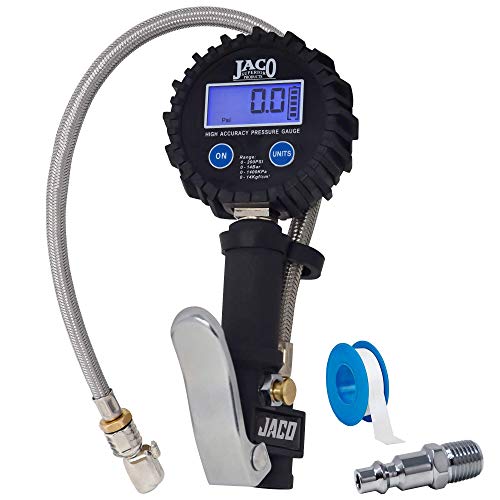
JACO FlowPro Digital
The JACO FlowPro Digital features a brass bleeder valve for precise pressure adjustment, making it a favorite among mechanics who need exact settings. Its angled head and large LCD display are user-friendly, and the unit is built with a shockproof housing.
Pros
- Integrated bleeder valve
- High accuracy within 0.5 PSI
- Angled head for easy access
Cons
- Slightly heavier than others
- Requires two batteries

Milton S-505
The Milton S-505 is a classic analog gauge with a large 2.5-inch dial and a geared brass movement for accuracy. It measures up to 160 PSI and comes with a 12-inch hose and chuck. The rubber boot protects it from drops.
Pros
- Large easy-to-read dial
- Geared movement for long life
- Protective rubber boot
Cons
- No bleeder valve
- Analog may be less precise than digital
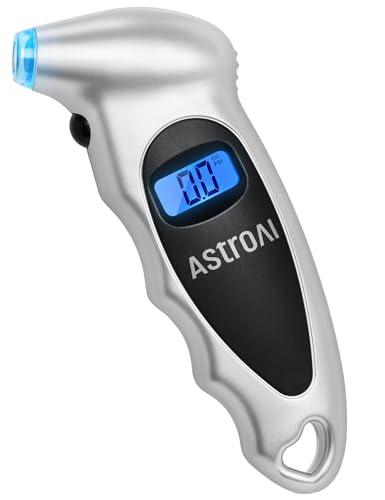
AstroAI Digital Tire Gauge
The AstroAI Digital Tire Gauge offers solid performance at an affordable price. It features a backlit LCD, a 90-degree angled head, and a range of 5-150 PSI. The lightweight design is comfortable for daily use, and it includes a battery.
Pros
- Great value for the price
- Backlit display
- Angled head for tight spots
Cons
- No bleeder valve
- Plastic body less durable
TeraGauge TG50
The TeraGauge TG50 is built for heavy shop use with a solid metal barrel and a double-football chuck that seals well. It reads up to 150 PSI and has a large backlit display. The unit is IP67 rated, making it water and dust resistant.
Pros
- IP67 waterproof and dustproof
- Sturdy metal construction
- Backlit display for low light
Cons
- Heavier and bulkier
- No bleeder valve
Realtone Digital Tire Gauge
The Realtone Digital Tire Gauge delivers fast and accurate readings with a simple one-button operation. It has a compact design and a non-slip grip. The backlit LCD is easy to read, and it automatically powers off to save battery.
Pros
- One-button operation
- Compact and lightweight
- Auto-off saves battery
Cons
- No bleeder valve
- Limited to 150 PSI

Slime 2008
The Slime 2008 features both a digital display and an analog dial, giving mechanics flexibility. It has a range of 5-150 PSI and includes a built-in LED light. The gauge is powered by a single battery and has a protective rubber cover.
Pros
- Two reading options
- Built-in LED light
- Protective rubber cover
Cons
- Bulky design
- Analog dial may be less accurate
Before you buy
How they stack up
| # | Model | Pressure Range | Best for | Score | Price |
|---|---|---|---|---|---|
| 1 | Accutire MS-4021B | 5-150 PSI | Best Overall for Mechanics | 9.4 | Check price |
| 2 | JACO FlowPro Digital | 5-150 PSI | Best with Bleeder Valve | 9.2 | Check price |
| 3 | Milton S-505 | 0-160 PSI | Best Analog Dial | 9.0 | Check price |
| 4 | AstroAI Digital Tire Gauge | 5-150 PSI | Best Budget Option | 8.8 | Check price |
| 5 | TeraGauge TG50 | 5-150 PSI | Best Heavy-Duty | 8.7 | Check price |
| 6 | Realtone Digital Tire Gauge | 5-150 PSI | Best for Quick Readings | 8.5 | Check price |
| 7 | Slime 2008 | 5-150 PSI | Best for Dual Readings | 8.3 | Check price |
Frequently asked questions
How often should I calibrate my tire pressure gauge?
For professional use, calibrate your gauge every few months or whenever you notice inconsistent readings. If you drop it or expose it to extreme temperatures, calibration may be needed sooner. Many digital gauges hold calibration well, but it’s wise to check against a known accurate reference.
What is the difference between a bleeder valve and a non-bleeder gauge?
A bleeder valve allows you to release air from the tire without removing the gauge from the valve stem, enabling you to reduce pressure to the desired level. Non-bleeder gauges only measure pressure; to reduce it, you must remove the gauge and use a separate tool. Bleeder valves are preferred for precise pressure setting.
Are digital tire pressure gauges more accurate than analog ones?
Generally, digital gauges offer higher accuracy and are easier to read precisely. However, high-quality analog gauges with geared movements can be equally accurate. The key is to choose a reputable brand and ensure the gauge is calibrated regularly.
Can I use a tire pressure gauge meant for cars on trucks or motorcycles?
Most gauges have a PSI range that covers typical car, truck, and motorcycle pressures. However, for very high-pressure tires like those on heavy trucks (up to 120 PSI) or low-pressure tires like some off-road vehicles, ensure the gauge’s range is sufficient. For motorcycles, a gauge with a small chuck is easier to fit in tight spaces.
How do I know if my tire pressure gauge is accurate?
You can test your gauge against a known accurate source, such as a digital gauge at a tire shop or a reference gauge. Some gauges come with a calibration certificate. If you suspect inaccuracy, many manufacturers offer recalibration services or you can return the gauge to the manufacturer.
What is the ideal pressure range for a professional gauge?
For most professional mechanics, a gauge that reads from 5 to 150 PSI is sufficient. This covers passenger cars, light trucks, and many commercial vehicles. If you work on heavy-duty trucks or specialized equipment, consider a gauge with a higher maximum, like 160 PSI or more.
Do tire pressure gauges come with a warranty?
Many reputable brands offer warranties ranging from one year to a lifetime. For example, JACO provides a 5-year warranty on their digital gauges. Always check the warranty details before purchasing, as it indicates the manufacturer’s confidence in their product.
Can I use a tire pressure gauge for other inflatables?
Yes, you can use a tire pressure gauge for other inflatables like bicycle tires, air mattresses, or sports balls, as long as the pressure range is suitable. However, for very low pressures, a specialized low-pressure gauge is more accurate.
What are the benefits of a dual-head gauge?
A dual-head gauge features two chucks: one for standard tires and one for high-pressure or large-valve applications. This eliminates the need for adapters and speeds up work when dealing with different vehicle types. It’s a convenient feature for busy shops.
How should I store my tire pressure gauge?
Store your gauge in a clean, dry place away from extreme heat or cold. Avoid leaving it in direct sunlight for long periods. Keep the protective cap on if it has one, and ensure the gauge is not under stress or pressure when not in use.
Our pick
For most professional mechanics, the Accutire MS-4021B is the best choice due to its dual-head versatility, accurate digital readout, and rugged construction. If you require a bleeder valve for precision pressure adjustments, the JACO FlowPro Digital is an excellent alternative. For those who prefer analog, the Milton S-505 offers reliable performance with a large dial. Ultimately, choose a gauge that fits your specific workflow and budget, but prioritize accuracy and durability to ensure dependable service for years.
Tony Russo
Tony trained as an automotive technician and spent years in service and parts retail before moving into writing. He focuses on garage tools, car care products and accessories from a hands-on maintenance perspective.