Choosing a Professional Battery Tester by Test Method
Topdon BT600 covers 12V and 24V systems with Bluetooth app reporting, the strongest all-around pick. Dealership bays suit the Midtronics PBT300, which outputs an SOH% reading. FOXWELL BT705 adds a built-in printer for an instant receipt with no phone required.
Topdon BT600 stands out among professional battery testers by covering 12V and 24V systems and turning results into a shareable Bluetooth report. It skips a built-in printer, so shops wanting an instant paper receipt may prefer a different pick.
Conductance and load test results are not directly comparable, and CCA ratings shift with battery chemistry, which makes shop testers tricky to compare. We weighed test method, CCA range, voltage and chemistry support, and reporting output against owner notes on accuracy and durability.
What we recommend

Topdon BT600
Conductance testing reads internal resistance in seconds across 12V and 24V systems, spanning a 100 to 3000 CCA range. Bluetooth pairs with the TopDiag app for PDF reports that a shop can hand to a customer or file for records. Cranking and charging voltage checks run from the same unit.
Pros
- Wide CCA range covers cars through light trucks
- Bluetooth app generates shareable PDF reports
- Also checks cranking and charging system voltage
Cons
- No built-in thermal printer
- App pairing needed for full report output

Midtronics PBT300
Dealership service bays rely on this conductance tester for state of health (SOH%) and state of charge (SOC%) readings. A rugged handheld case survives daily counter use better than consumer-grade units. An optional printer accessory attaches when a customer needs a physical result.
Pros
- Rugged housing built for daily shop use
- Reports SOH% alongside the CCA result
- Established brand in dealership service bays
Cons
- Printer sold as a separate accessory
- No native 24V truck support
FOXWELL BT705
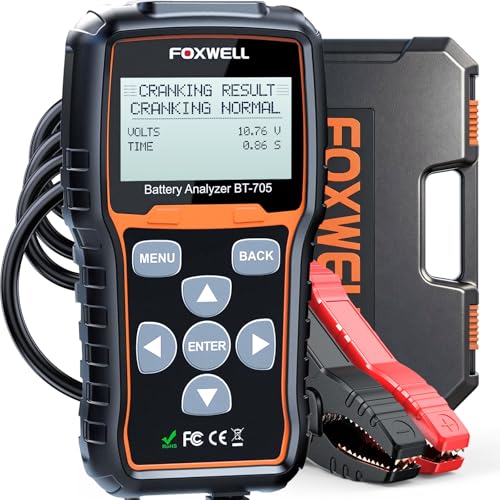
A built-in thermal printer produces a receipt on the spot, skipping any phone or app step. Conductance testing covers 12V and 24V systems across a 100 to 2000 CCA range. A color LCD displays SOH and CCA results side by side.
Pros
- Built-in printer needs no phone or app
- Covers both 12V and 24V systems
- Color screen shows CCA and SOH together
Cons
- Printer paper is a recurring cost
- Bulkier than app-only testers

Autel MaxiBAS BT506
Conductance battery testing pairs with charging and starting system diagnostics in one handheld unit. Bluetooth links to the MaxiBAS app, where results save into cloud-based fleet records. Mixed light and medium duty fleets benefit from 12V and 24V support in one tool.
Pros
- Cloud fleet reporting through the companion app
- Tests charging and starting systems too
- Works across 12V and 24V fleet vehicles
Cons
- Requires a paired smartphone or tablet
- Steeper learning curve than standalone units
KONNWEI KW600
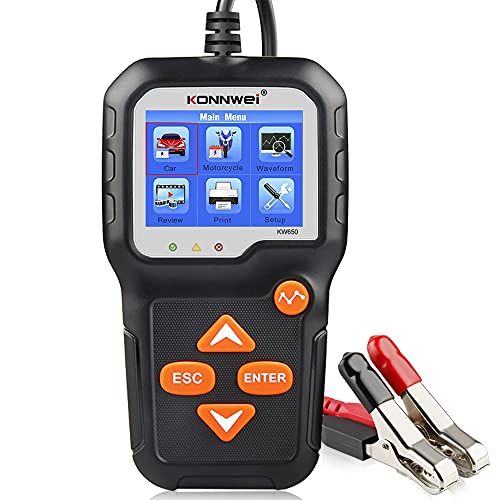
Flooded, AGM, gel, and lithium (LiFePO4) battery types all appear directly in this tester’s menu. Conductance testing spans 12V and 24V systems across a 100 to 2000 CCA range. A USB port exports readings to a computer for simple record keeping.
Pros
- Menu-selectable lithium battery setting
- Covers flooded, AGM, and gel chemistries
- USB export simplifies record keeping
Cons
- No Bluetooth or app option
- Smaller screen than app-paired testers

Schumacher BT100
An actual load test draws current to show how a battery performs under real demand, unlike a conductance estimate. A digital display reads CCA and voltage directly, up to 1000 CCA on 12V batteries. Dial-based operation needs no setup or software.
Pros
- Load test method reflects real-world draw
- Simple dial needs no setup or app
- Digital display reads clearly in a shop
Cons
- 12V only, no 24V truck support
- Lower CCA ceiling than conductance testers

Ancel BA101
An entry-level conductance tester spans a 30 to 1200 CCA range, sized for smaller cars and motorcycles. An LCD screen shows voltage, CCA, and a pass or fail health reading. No app or printer complicates the design, just a clamp-on tester for quick checks.
Pros
- Low cost entry into conductance testing
- Simple clamp-on operation, no setup
- Covers small batteries down to 30 CCA
Cons
- No 24V or fleet reporting features
- CCA ceiling too low for heavy trucks
The lineup, side by side
| # | Model | Test method | Best for | Score | Price |
|---|---|---|---|---|---|
| 1 | Topdon BT600 | Conductance | Best overall | 9.4 | Check price |
| 2 | Midtronics PBT300 | Conductance | Best for shop use | 9.1 | Check price |
| 3 | FOXWELL BT705 | Conductance | Best value | 8.8 | Check price |
| 4 | Autel MaxiBAS BT506 | Conductance | Best for fleet reporting | 8.6 | Check price |
| 5 | KONNWEI KW600 | Conductance | Best for AGM and lithium batteries | 8.3 | Check price |
| 6 | Schumacher BT100 | Load test | Best for load testing | 8.1 | Check price |
| 7 | Ancel BA101 | Conductance | Best budget | 8.0 | Check price |
What matters most
What to look for in a professional battery tester Two test methods dominate the professional market. Conductance testing reads internal resistance almost instantly and puts little wear on the battery. Load testing draws real current to simulate cranking demand, taking longer but showing behavior under an actual electrical load. CCA range matters too: a 100 to 3000 CCA tester covers motorcycles through heavy trucks, while budget units often cap near 1200 CCA.
Best testers for shop and dealership use Independent shops and dealerships need a tester that survives daily drops and repeated counter use. Midtronics PBT300 is built for that handling and outputs an SOH% reading customers can understand at a glance. Built-in printers, like the one on the FOXWELL BT705, skip the phone-pairing step entirely. Shops billing by the diagnostic often prefer a paper printout over an app screen for their records.
Can one tester handle 24V commercial fleets? Trucks, buses, and other commercial vehicles often run 24V systems built from two 12V batteries in series. A tester needs to switch modes, not just read a single battery. Autel MaxiBAS BT506 handles 24V setups and syncs results into an app built for tracking a fleet over time. Confirming 24V support before buying matters, since not every tester includes it.
AGM and lithium compatibility: what changes Modern vehicles increasingly ship with AGM or gel batteries, and some shops now service lithium (LiFePO4) packs in powersports and marine gear. A tester built only for flooded lead-acid can misread these chemistries and return a false failure. KONNWEI KW600 lists flooded, AGM, gel, and lithium settings directly in its menu, keeping readings accurate across types. Selecting the correct chemistry profile before testing avoids a skewed result.
Common questions
What is the difference between conductance and load testing?
Conductance testers send a small AC signal through the battery and estimate health from internal resistance in seconds. Load testers like the Schumacher BT100 draw real current to see how voltage holds under demand.
How accurate are conductance battery testers?
Readings correlate closely with CCA ratings on most flooded and AGM batteries, according to manufacturer specifications. Batteries with uneven internal damage sometimes need a load test to confirm a borderline result.
Can a battery tester check 24V truck systems?
Not every model does. Topdon BT600, FOXWELL BT705, and Autel MaxiBAS BT506 all switch to a 24V mode, while the Midtronics PBT300 and Schumacher BT100 stay limited to 12V and 6V.
Which battery tester works best in a dealership service bay?
Midtronics PBT300 fits that setting, with a rugged case and an SOH% readout technicians can log. Shops wanting a printed receipt without an app should look at the FOXWELL BT705 instead.
Do battery testers work on AGM and lithium batteries?
Only with a matching chemistry setting. KONNWEI KW600 lists flooded, AGM, gel, and lithium profiles directly in its menu, and skipping that step on a lithium pack can produce a misleading fail.
Is a built-in printer worth it on a battery tester?
FOXWELL BT705 hands a customer a receipt without pairing a phone, though the printer adds bulk and a recurring paper cost. App-based reporting on the Topdon BT600 saves space but needs a smartphone nearby.
What CCA range do professional shops actually need?
Shops servicing everything from motorcycles to light trucks benefit from a wide range like the Topdon BT600’s 100 to 3000 CCA. Budget testers such as the Ancel BA101 cap near 1200 CCA, fine for small cars only.
Battery tester vs multimeter: which should a shop use?
A multimeter only reads voltage, which does not reveal performance under load. A dedicated tester reads CCA, health, and often SOH% in one step, better suited to regular diagnostics.
Which battery tester suits AGM and lithium chemistries best?
KONNWEI KW600 lists those settings directly in its menu, keeping conductance readings accurate across flooded, AGM, gel, and lithium packs.
The bottom line
Topdon BT600 remains the strongest all-around pick, covering 12V and 24V systems while turning results into a shareable app report. Dealership techs wanting a physical readout without pairing a phone should choose the FOXWELL BT705 for its built-in printer instead. Shops testing AGM or lithium packs are better served by the KONNWEI KW600, which lists those chemistries directly in its menu.
Tony Russo
Tony trained as an automotive technician and spent years in service and parts retail before moving into writing. He focuses on garage tools, car care products and accessories from a hands-on maintenance perspective.