Battery Testers That Earn Their Place in a Home Garage
Autel MaxiBAT BT506 fits a home garage doing work for others, combining conductance measurement with an adaptive load and a full cranking plus charging report. TOPDON BT200 covers similar ground through a phone app. ANCEL BA101 answers a simple pass or replace question in seconds.
Autel MaxiBAT BT506 is the tester to buy once you diagnose more than your own car. Conductance measurement plus an adaptive load produces state of health, state of charge and internal resistance in a single pass. Garages doing paid work get the most from that, since results export as a customer record. For a one car household it is far more capability than the job needs.
Battery faults hide well. A pack can rest at 12.6 volts and still collapse under cranking load, which is why voltage alone condemns nothing. We compared CCA measurement ranges, supported chemistries including AGM, EFB, gel and lithium iron phosphate, and whether each unit also tests the starter and alternator. Record keeping mattered too, so printing and app logging were weighed alongside owner reports on clamp quality and lead length.
What matters most
How battery testers work Two methods dominate the shelf. Conductance testers push a small alternating signal through the battery and calculate internal resistance, which correlates with cold cranking ability. Carbon pile testers, such as the Schumacher BT-100, apply a real 100 amp draw and show the voltage sag directly on a meter. Speed and safety favour conductance, especially on AGM packs still bolted into the car. Nothing beats a load test for settling an argument about a sulphated battery, because you watch the actual behaviour under demand. Autel splits the difference on the BT506 by adding an adaptive load to a conductance reading.
Reading CCA, state of health and internal resistance Cold cranking amps printed on the label is a rating, not a measurement. Compare what the tester reads against that label figure, and a pack sitting well below its rating is on the way out regardless of resting voltage. Internal resistance climbing across successive tests is the earliest warning you get, which is why the KW208 and BT506 both display it. State of charge and state of health are separate numbers. A fully charged battery can still show poor health, and a healthy battery can read flat after a week of short trips.
Testing AGM, EFB and lithium batteries Start stop vehicles run AGM or EFB batteries whose charge acceptance curves differ from flooded lead acid. Tell the tester which type it is looking at, because the wrong selection returns a misleading verdict and can condemn a good battery. Lithium iron phosphate behaves differently again, and only the Autel BT506 lists explicit LiFePO4 support in this group. Owners report that testing a lithium pack on a lead acid setting usually produces a nonsense CCA figure. BA101, BT200, BT705 and BT506 all carry AGM and EFB modes, so chemistry coverage is rarely the deciding factor between them.
Do you need 24 volt cranking and charging tests? Only if vans, trucks, tractors or plant machinery come through the garage. Those run two 12 volt batteries in series, and native 24 volt testing on the BT705, BT200 and BST500 saves disconnecting the pair before every check. Cars and motorcycles never need it. A no start fault is also rarely the battery alone, so cranking tests matter more than the voltage rating. Capturing the lowest voltage during start exposes a dragging starter, while a charging test checks alternator output at idle and at raised revs. Ripple readings, reported by the FOXWELL BT705, point straight at a failed diode.
The top picks, ranked

Autel MaxiBAT BT506 Battery Tester
Conductance measurement pairs with an adaptive load method here, so weak batteries that fool a plain resistance check still get caught. Coverage spans 100 to 2000 CCA across flooded, AGM, EFB, gel and lithium iron phosphate packs. Cranking and charging tests run through the same workflow, and results pass to a phone or an Autel tablet over Bluetooth.
Pros
- Adaptive load method reduces false passes on tired batteries
- Covers lithium iron phosphate packs that most rivals skip
- Reports export as shareable files for a customer record
Cons
- Bluetooth pairing needs repeating after long idle periods
- Far more diagnostic depth than a single family car requires

TOPDON BT200 Battery Tester
Display duty moves to your phone, which leaves room for full test graphs instead of a cramped readout. Range covers 100 to 2000 CCA on 12 volt batteries, while cranking and charging tests handle both 12 and 24 volt systems. Each result saves against a vehicle tag in the app, building a history no masking tape note can match.
Pros
- Phone screen shows fuller graphs than any small onboard LCD
- Reads 24 volt charging systems on vans and light trucks
- Saved reports build a dated battery history per vehicle
Cons
- A flat phone battery leaves you with no readout at all
- No physical screen for a quick roadside check

ANCEL BA101 Automotive Battery Load Tester
Clamp on and a pass or replace verdict arrives in seconds, with no pairing or menu wading first. Coverage runs 100 to 2000 CCA on 12 volt flooded, AGM and gel batteries. Reverse polarity protection forgives a careless clamp order, which matters on a cold driveway in poor light.
Pros
- Works out of the box with zero setup or pairing
- Draws power from the battery under test, so no cells to replace
- Small enough to live permanently in a door pocket
Cons
- Produces no printed slip for customer paperwork
- Short leads make boot mounted batteries awkward to reach
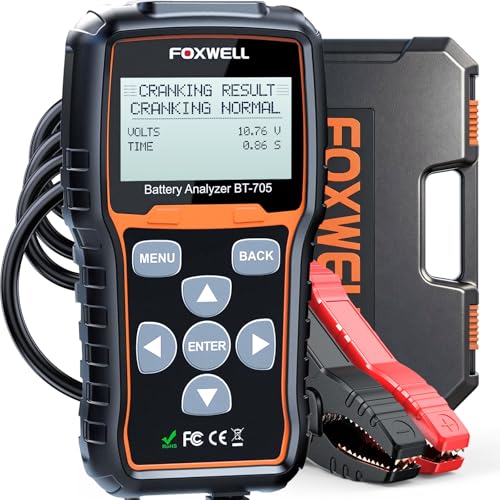
FOXWELL BT705 Battery Analyzer
Vans, tractors and light trucks often run two batteries in series, and this analyser tests them natively at 24 volts. Range reaches 2000 CCA, with a 3.5 inch colour screen reporting cranking voltage and alternator ripple in plain language. Built in thermal printing hands over a result slip with no phone involved.
Pros
- Native 24 volt testing suits vans and farm machinery
- Ripple reading exposes a failed alternator diode pack
- Prints a slip without pairing anything first
Cons
- Printer paper rolls become a consumable to restock
- Bulkier than the pocket sized handhelds here

KONNWEI KW208 Battery Tester
One button drives the entire test, so anyone helping in the garage can run it unsupervised. Readings cover 100 to 2000 CCA at 12 volts, reporting state of health as a percentage alongside internal resistance. Cranking and charging checks are included, which narrows a no start fault without a second tool. Leads run around 100cm.
Pros
- 100cm leads reach boot and under seat battery locations
- Internal resistance figure tracks ageing across repeat tests
- Multi language menus work in a shared workshop
Cons
- No logging or export of any kind
- Small monochrome screen washes out in direct sun

Schumacher BT-100 Battery Load Tester
Instead of estimating from conductance, this applies a genuine 100 amp draw and shows the voltage sag on an analogue meter. That method remains the most direct way to watch a battery behave under real demand. It handles 6 and 12 volt lead acid batteries plus a charging system check, with no firmware or pairing anywhere in the process.
Pros
- Applies a real load rather than inferring from resistance
- Nothing to update, pair or charge before a test
- Doubles as a charging system voltage check
Cons
- Heat builds fast, so tests need cooling gaps between them
- Shows no CCA figure and no state of health percentage

ANCEL BST500 Battery Tester with Printer
Every test becomes a slip you can staple to a job card, thanks to the integrated thermal printer. Coverage reaches 2000 CCA at 12 volts, with 24 volt cranking and charging support for commercial vehicles. A 3.5 inch colour screen walks through battery, starter and alternator checks in a fixed sequence, so steps are hard to skip.
Pros
- Printed slips document the verdict for a customer on the spot
- Guided sequence stops the charging test being forgotten
- Handles 24 volt cranking on commercial vehicles
Cons
- Thermal slips fade if they sit in a hot van
- Heavier in the hand than a basic handheld
Compared at a glance
| # | Model | Test range | Best for | Score | Price |
|---|---|---|---|---|---|
| 1 | Autel MaxiBAT BT506 Battery Tester | 100 to 2000 CCA, 6V and 12V batteries | Best overall | 9.4 | Check price |
| 2 | TOPDON BT200 Battery Tester | 100 to 2000 CCA at 12V | Best value | 9.2 | Check price |
| 3 | ANCEL BA101 Automotive Battery Load Tester | 100 to 2000 CCA at 12V | Best budget | 8.9 | Check price |
| 4 | FOXWELL BT705 Battery Analyzer | 100 to 2000 CCA, 12V and 24V | Best for 12V and 24V systems | 8.7 | Check price |
| 5 | KONNWEI KW208 Battery Tester | 100 to 2000 CCA at 12V | Best simple handheld | 8.5 | Check price |
| 6 | Schumacher BT-100 Battery Load Tester | 100 amp carbon pile load | Best carbon pile load tester | 8.3 | Check price |
| 7 | ANCEL BST500 Battery Tester with Printer | 100 to 2000 CCA at 12V | Best for printed records | 8.0 | Check price |
Good to know
What is the best battery tester for a home garage?
Autel MaxiBAT BT506 if you want professional grade results and exportable reports. TOPDON BT200 delivers most of the same testing through a phone app. Anyone checking one or two family cars will be well served by the ANCEL BA101 and its instant verdict.
How do I know if my car battery is bad or the alternator?
Run a cranking test, then a charging test. A pack that sags heavily during cranking but charges normally is the fault. Steady cranking voltage combined with poor output at raised revs points at the alternator, and a ripple reading confirms a diode failure.
Conductance vs load testers: which is more accurate?
Conductance is quicker, safer and better suited to AGM batteries still fitted in the car. Carbon pile load testers show real world sag and remain the reference for heavily sulphated packs. Many professionals keep both, leading with conductance and reaching for the load tester to settle a doubtful result.
Can these testers check AGM and start stop batteries?
Yes, provided you select the correct type first. BA101, BT200, BT705 and BT506 all list AGM and EFB modes. Leave a tester in flooded mode on an AGM battery and the result skews enough to condemn a perfectly good pack.
Do I need a 24 volt battery tester?
Only for vans, trucks, tractors or plant machinery running two 12 volt batteries in series. FOXWELL BT705, TOPDON BT200 and ANCEL BST500 handle those systems natively. Cars and motorcycles are covered entirely by 12 volt testing.
Should a battery be charged before testing?
A deeply discharged pack returns an unreliable reading, so bring it up before judging capacity. Conductance testers can still flag a dead cell at low charge, which is useful for a quick screen. For a fair verdict, test after a full charge and a short rest off the charger.
Is a printer on a battery tester worth it?
It earns its place if you charge customers or want a dated record per vehicle. FOXWELL BT705 and ANCEL BST500 both print slips at the car. For personal use, an app log on the TOPDON BT200 does the same job without paper rolls to restock.
How often should I test a car battery?
Twice a year is sensible, before winter and ahead of a long trip. Batteries past three years deserve more frequent checks, since internal resistance climbs faster near the end of life. Test after any jump start too, because a pack that will not recover often looks fine at rest.
Can a battery tester damage a car’s electronics?
Conductance units draw almost nothing and are safe to use with the battery connected. Carbon pile testers such as the BT-100 pull 100 amps, so follow the instructions and keep tests short. Reverse polarity protection on the BA101 also guards against a clamp going on the wrong post.
Our take
Autel MaxiBAT BT506 is the right call for a home garage that works on other people’s cars, since adaptive load testing, lithium support and exportable reports take the guesswork out of a condemn or keep decision. Choose the TOPDON BT200 if reading results on a phone suits you and 24 volt charging checks matter. Anyone with a single family car should stop at the ANCEL BA101, because the deeper diagnostics will sit unused in a drawer.
Tony Russo
Tony trained as an automotive technician and spent years in service and parts retail before moving into writing. He focuses on garage tools, car care products and accessories from a hands-on maintenance perspective.


