Pressure Canners Compared: Capacity, Gauges, Cooktops
Presto 23-Quart Pressure Canner and Cooker 01781 remains the sensible default, holding seven quart jars or twenty pints double stacked. All American 921 seals metal to metal, so no gasket ever needs replacing. Presto Precise Digital 02144 runs off a countertop outlet when a heavy canner on glass is not an option.
Presto 23-Quart Pressure Canner and Cooker 01781 is where most home canners should start, since it takes seven quart jars or twenty pints stacked and its dial gauge reads an exact pressure. Sealing rings need replacing every few seasons and the gauge wants an annual accuracy check. Cooks with glass or induction hobs should buy the stainless 01784 instead, because raw aluminium causes problems on both surfaces.
Pressure canning is the only method approved for low acid foods, so the pot has to hold a verified temperature rather than simply get hot. We compared jar capacity, gauge type, seal design, base material and cooktop compatibility across seven models. Each maker’s stated processing guidance was checked against USDA recommendations published by the National Center for Home Food Preservation.
The shortlist, ranked

Presto 23-Quart Pressure Canner and Cooker 01781
Seven quart jars sit flat in one layer, or twenty pints stack across two levels with a rack between them. A dial gauge reports the exact pressure instead of rocking at a fixed weight, and that precision earns its keep at elevation. Cast aluminium holds the weight down but rules the pot out on most induction hobs.
Pros
- Stacking pints doubles the yield of one run
- Dial reading allows fine altitude adjustment
- Sealing rings and spare parts stay easy to source
Cons
- Dial gauge needs testing once a year for accuracy
- Aluminium base will not work on induction
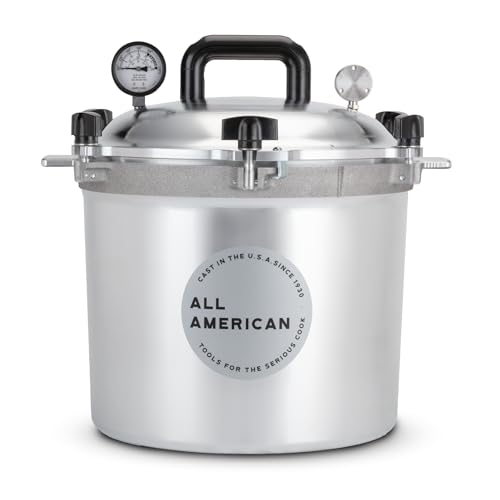
All American 921 Pressure Canner
A machined metal to metal seal takes the place of a rubber gasket, so there is no consumable part to perish. Six wing nuts clamp the lid evenly, and both a weighted regulator and a geared steam gauge come fitted. Cast aluminium at this thickness makes the pot heavy, which is why many owners leave it parked on one burner.
Pros
- No gasket to replace, harden or misplace
- Weighted regulator stays accurate if the dial drifts
- Built heavily enough to outlast several cheaper canners
Cons
- Awkward to lift once loaded with quart jars
- Wing nuts must be tightened in sequence every batch

Presto 23-Quart Induction Compatible Pressure Canner 01784
Stainless steel over an encapsulated base fixes both problems aluminium creates on modern hobs: magnetic incompatibility and marks on glass. Jar capacity matches the aluminium 01781, so batch sizes stay the same. Heating is slower, which stretches the time spent bringing a full load up to pressure and adds to the burner watch.
Pros
- Runs on induction and smooth top ranges
- Holds the same twenty stacked pints as the 01781
- Stainless will not react with acidic foods
Cons
- Takes longer to reach pressure than aluminium
- Heavier when empty than the aluminium equivalent

Presto Precise Digital Pressure Canner 02144
Power comes from a countertop outlet rather than a burner, which matters in kitchens where a heavy canner on glass is out of bounds. Preset programs run heat up, processing and cool down in sequence, removing the burner babysitting that puts people off canning. Four quart jars is the ceiling, and altitude limits apply, so read the manual against your elevation first.
Pros
- Leaves the cooktop free for everything else
- Automatic cycle removes manual pressure regulation
- Doubles as a pressure cooker and steam canner
Cons
- Takes roughly a third of a 23 quart load
- Altitude restrictions rule it out at higher elevations

Presto 16-Quart Pressure Canner and Cooker 01755
A narrower base sits properly on a standard burner, so heat meets metal instead of spilling up the sides. Seven pint jars handles a weekend batch of beans, soup or stock without committing to a full harvest day. Quart jars do fit, just fewer of them, which caps its usefulness for a large garden.
Pros
- Sits on a standard burner with no overhang
- Lighter to lift, wash and store than 23 quart models
- Works as an everyday pressure cooker between seasons
Cons
- Not tall enough to stack a second layer of pints
- Runs out of room fast on a big harvest day

Mirro 92122A 22-Quart Pressure Cooker and Canner
A three piece weighted regulator selects 5, 10 or 15 psi and rocks audibly once pressure arrives, so nothing needs annual calibration. Cast aluminium keeps the weight down and moves heat quickly through the base. Finish quality sits below Presto and All American, and the handles run hot, so heavy gloves stop being optional.
Pros
- Weighted regulator skips yearly gauge testing
- Audible rocking confirms pressure without watching a dial
- Light for a canner of this capacity
Cons
- Handles heat up during long processing runs
- Fit and finish trails the premium canners

All American 941 Pressure Canner
Volume is the whole argument here, with 19 quart jars going in where most canners manage seven. Sealing works the same way as the 921, metal to metal with wing nuts and no gasket. Sheer size makes it impractical on a standard domestic range, so this one belongs to growers processing serious quantities on a strong burner.
Pros
- Processes nearly three standard loads at once
- Gasket free seal with no consumable parts
- Holds up to repeated season long use
Cons
- Too large and heavy for most home ranges
- Swallows a lot of cupboard space out of season
Side by side
| # | Model | Capacity | Best for | Score | Price |
|---|---|---|---|---|---|
| 1 | Presto 23-Quart Pressure Canner and Cooker 01781 | 23 quarts | Best overall | 9.4 | Check price |
| 2 | All American 921 Pressure Canner | 21.5 quarts | Best premium | 9.2 | Check price |
| 3 | Presto 23-Quart Induction Compatible Pressure Canner 01784 | 23 quarts | Best for glass and induction cooktops | 9.0 | Check price |
| 4 | Presto Precise Digital Pressure Canner 02144 | 12 quarts | Best countertop electric | 8.8 | Check price |
| 5 | Presto 16-Quart Pressure Canner and Cooker 01755 | 16 quarts | Best for small batches | 8.6 | Check price |
| 6 | Mirro 92122A 22-Quart Pressure Cooker and Canner | 22 quarts | Best budget | 8.3 | Check price |
| 7 | All American 941 Pressure Canner | 41.5 quarts | Best for large harvests | 8.0 | Check price |
How to pick the right one
Why low acid foods need a pressure canner Boiling water stops at 212F at sea level, and that will not make green beans, meat, stock or most vegetables safe. Raising the internal temperature to roughly 240F is the point of pressure canning, and USDA guidance sets that threshold for low acid foods. Water bath canning stays correct for high acid items such as jam, pickles and tomatoes with added acid. Extra boiling time never substitutes for pressure. Match the method to the food first, then pick the pot.
Dial gauge versus weighted regulator Dial gauges display an exact number, which helps when altitude calls for a specific setting. They also drift with age, so extension services recommend an annual test. Weighted regulators on the Mirro and All American models rock at a fixed pressure and never need calibration. Precision at elevation argues for a dial. Simplicity and no yearly errand argue for a weight.
Capacity, stacking and how much you actually put up Twenty pints stacked in two layers, or seven quarts flat, is the practical sweet spot for a home garden, and that is what a 23 quart canner delivers. Sixteen quart models cannot stack at all, so a pint batch tops out at seven. All American 941 jumps to 19 quart jars for growers whose harvest arrives in crates rather than baskets. Above 1,000 feet, processing pressure rises on a published schedule, and dial gauges step in finer increments than weighted ones. Buyers at elevation should confirm their canner is rated for it before ordering.
Canning on glass, induction and countertop electric Most canners are cast aluminium, which is light and conducts heat fast. Induction hobs will not detect it, and glass tops can be marked by its weight and rough base. Presto 01784 answers that with a stainless encapsulated base and keeps the same jar count. Check the maximum permitted weight in your cooktop manual, since a loaded canner runs heavy. Where no suitable burner exists, a validated countertop unit such as the Presto Precise Digital is the realistic route, at a third of the batch size.
Good to know
Can you use a regular pressure cooker for canning?
Not unless the manufacturer validates that model for canning. Standard cookers and multicookers heat and vent differently, so processing times from tested recipes do not carry over. Use a pot the maker lists for low acid food processing.
What foods require a pressure canner?
Green beans, corn, carrots, potatoes, meat, poultry, seafood and stock all need pressure. Jam, pickles and acidified tomatoes stay safe in a water bath. For anything uncertain, follow National Center for Home Food Preservation guidance for that specific food.
Does a dial gauge need testing every year?
Yes, and many county extension offices do it free. Gauges drift with use, and a reading two pounds low means under processed jars. Weighted regulators such as those on the Mirro and All American canners need no calibration at all.
Will a pressure canner work on a glass top stove?
Some will. Cast aluminium models are often discouraged because of weight and base finish. A flat bottomed stainless canner such as the Presto 01784 is the safer pick, and it also works on induction. Look up the weight limit in your cooktop manual before loading jars.
Is an electric pressure canner safe for green beans and meat?
Only a model validated for low acid canning with published processes, which is what separates the Presto Precise from a general multicooker. Altitude limits apply to electric units. Read the manual’s elevation statement before trusting it with meat.
How many jars fit in a 23 quart pressure canner?
Seven quart jars in a single layer, or twenty pint jars stacked across two levels with a rack between them. A 16 quart canner takes about seven pints and cannot stack. The All American 941 holds 19 quart jars in one load.
Do you adjust pressure for altitude?
Yes. Past roughly 1,000 feet, processing pressure steps up on a published schedule. Dial gauges allow finer increments, while weighted regulators jump between 5, 10 and 15 psi. Using sea level pressure at elevation under processes the food.
How often should a canner gasket be replaced?
Presto style sealing rings usually last a few seasons, less if they harden or start leaking steam. Store the lid resting upside down on the pot so the ring is never compressed. All American canners sidestep the whole issue with a metal to metal seal.
Which pressure canner is best for beginners?
Presto 01781 keeps the learning curve short, with a dial gauge, widely available parts and instructions written around USDA processes. Its weight rules it out on glass tops, where the 01784 does the same job. Start with pints before attempting a full quart load.
Final word
Presto 23-Quart Pressure Canner and Cooker 01781 is the buy for a typical home garden, because it stacks twenty pints and its spare parts never go hunting. Step up to the All American 921 if you can lift it and want a canner with no gasket in its future. Glass and induction owners should take the stainless 01784, while anyone short of a spare burner will can more often with the Presto Precise Digital than with a stovetop pot they never haul out.
Dana Whitfield
Dana spent eight years buying and merchandising for a regional kitchenware retailer before moving into editorial work. She has handled thousands of SKUs across cookware, small appliances and kitchen organization, and focuses on the practical differences that matter once a product is actually in daily use.