Which Premium Math Toys Earn Their Shelf Space?
Osmo Genius Starter Kit leads for ages six to ten, reading physical number tiles through the tablet camera so answers get instant feedback. Magna-Tiles Clear Colors build geometry sense that carries from preschool into primary. For the widest skill range in one box, Learning Resources MathLink Cubes win.
Osmo Genius Starter Kit is the pick here for six to ten year olds. Number tiles and tangram pieces sit on the table while the tablet reads them, so a child practises without an adult checking every answer. One catch limits it: a compatible iPad or Fire tablet is required and not included, which rules it out for screen-free homes.
Paying more should buy durability, open-ended play and years of use rather than nicer packaging. We compared published age ranges, piece counts, the specific concepts each set targets and the materials used, then weighed parent and teacher feedback on which boxes stayed in rotation past the first month.
The top picks, ranked

Osmo Genius Starter Kit for iPad
A mirrored reflector clips over the tablet camera and reads whatever the child lays on the table. Numbers turns addition and multiplication into a game loop, while Tangram drills shape reasoning against a timer. Five activities ship in the box, covering math, physics and spelling.
Pros
- Hands stay on physical tiles throughout screen play
- Five activities span number, spatial and word skills
- Instant feedback lets children self-correct unsupervised
Cons
- Needs a supported tablet, so check the list first
- Base fits set device sizes, and upgrades can break the fit

Magna-Tiles Clear Colors 100 Piece Set
Magnetic squares and triangles teach symmetry, nets and area comparison years before those words reach a classroom. One box serves a three year old stacking towers and an eight year old folding a cube net flat. Sealed ABS edges and riveted magnets explain why these survive years of floor play.
Pros
- Open-ended building stretches across five or more years
- Sealed magnets stay put, unlike cheaper tile brands
- Translucent panels double as a light table activity
Cons
- Contains no numerals or arithmetic content on its own
- Tiles spread across a room, so storage needs a deep bin

Learning Resources MathLink Cubes Activity Set
Cubes snap together on all six faces, so children build bars for counting, patterns, addition and place value in tens. Activity cards hand parents a starting point instead of a blank table. Dishwasher safe plastic handles sticky hands, though the small pieces rule out toddler households.
Pros
- Covers more distinct math skills than any other pick
- Same manipulative primary teachers already use
- Activity cards solve the blank-page problem for parents
Cons
- Small parts make it unsuitable under three years
- Plain cubes look duller than themed sets on a shelf
hand2mind Rainbow Fraction Tiles
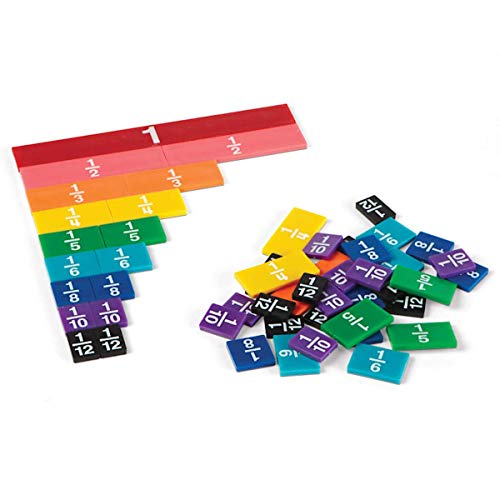
Fifty one tiles run from one whole down to one twelfth in nine colour-coded denominations. Lay three sixths beside one half and equivalence stops being a rule to memorise. Scope is deliberately narrow, which makes this a supplement to a main set rather than a replacement.
Pros
- Turns fraction equivalence into something a child can see
- Colour coding matches common classroom fraction kits
- Thick tiles are easy for small hands to line up
Cons
- Single-topic scope limits long-term replay
- Loose tiles scatter without a storage tray

Learning Resources Sum Swamp Addition and Subtraction Game
Two number dice and one operation die set each turn, then players move along a swamp board while solving what they rolled. Odd and even shortcuts slip number properties in without announcing a lesson. Two to four players makes it a family game rather than solo drill.
Pros
- Daily arithmetic practice hides inside a board game
- Odd and even shortcuts teach number properties quietly
- Rounds wrap up in roughly fifteen minutes
Cons
- Number range gets outgrown around age nine
- Requires a second player, so solo practice is out

ThinkFun Math Dice Junior
Roll the 12-sided target die, then combine five scoring dice to reach that number. Multiple routes to the same total reward flexible thinking rather than one memorised method. Cloth bag, scoring track and dice fit a coat pocket, making this the restaurant and airport set.
Pros
- Packs to pocket size with no board or setup
- Plays solo or as a two player race
- Several correct answers exist for most rolls
Cons
- Offers little visual or tactile variety
- Dice go missing quickly once the bag is lost

Learning Resources Pretend and Play Calculator Cash Register
A working solar calculator sits in the register, surrounded by play bills and coins. Pricing, totalling and counting change all happen inside one shop game, which gives a young child a reason to add. Currency follows US bills and coins, so buyers elsewhere should check before ordering.
Pros
- Money skills arrive through role play instead of drill
- Solar calculator removes batteries from the equation
- Grows with the child as shop prices get harder
Cons
- Play money covers US denominations only
- Plastic coins scatter and disappear under furniture
What matters most
What makes a math toy worth the premium Three qualities justify spending more. Durability leads, because sealed magnets and thick moulded plastic outlast thin printed card by years. Open-ended design follows: a set used at four and again at nine repays its cost several times over. Curriculum fit closes the list. Linking cubes and colour-coded fraction tiles appear in real classrooms, so a child meets the same model at school rather than a competing one.
Matching a math toy to your child’s age Preschoolers need counting, sorting and shape recognition, which Magna-Tiles and the play register handle through free play. Between five and eight, arithmetic takes over, and Sum Swamp plus MathLink Cubes sit squarely in that band. From about eight upward, fractions and mental flexibility matter more, which is where hand2mind tiles and Math Dice Junior earn a place. Buying two years ahead usually produces an unopened box.
Tablet-linked sets or physical manipulatives Osmo gives instant feedback, so a child iterates without an adult marking each answer. Physical sets never need updates, cost nothing to run and work in a car. A sensible split is one tablet-linked set for independent practice and one open-ended physical set for family play. Skip anything with no physical component if screen time already causes arguments at home.
The skills home math sets usually skip Fractions and money get the least attention at home, and both cause trouble later. Visual models fix the first: laying two quarters over one half settles equivalence faster than any worksheet. Cash handling is vanishing from daily life, so a play register does genuine work teaching coins and change. Already confident with counting and adding? Buy for one of these gaps instead of a fourth counting set.
How they compare
| # | Model | Ages | Best for | Score | Price |
|---|---|---|---|---|---|
| 1 | Osmo Genius Starter Kit for iPad | 6 to 10 years | Best overall | 9.4 | Check price |
| 2 | Magna-Tiles Clear Colors 100 Piece Set | 3 years and up | Best for geometry and spatial skills | 9.2 | Check price |
| 3 | Learning Resources MathLink Cubes Activity Set | 5 years and up | Best value | 9.0 | Check price |
| 4 | hand2mind Rainbow Fraction Tiles | 6 years and up | Best for fractions | 8.8 | Check price |
| 5 | Learning Resources Sum Swamp Addition and Subtraction Game | 5 to 8 years | Best for first arithmetic | 8.6 | Check price |
| 6 | ThinkFun Math Dice Junior | 6 years and up | Best for travel | 8.3 | Check price |
| 7 | Learning Resources Pretend and Play Calculator Cash Register | 3 years and up | Best for money math | 8.0 | Check price |
Good to know
What is the best premium math toy overall?
Osmo Genius Starter Kit takes our top spot for ages six to ten. Physical tiles plus tablet feedback hold attention while covering numbers, tangrams and problem solving.
Which math toys are best for a 5 year old?
MathLink Cubes and Sum Swamp both target early counting and arithmetic. Magna-Tiles also land well at five, since shape and symmetry play needs no reading.
Are Magna-Tiles really a math toy?
Yes, in the geometry sense. Building with squares and triangles teaches symmetry, nets, area comparison and spatial reasoning, all groundwork for formal geometry later.
Do I need a tablet for Osmo?
You do. Osmo requires a compatible iPad or Fire tablet, sold separately. Check the device list before ordering, because base sizes differ between kit versions.
How do I teach fractions at home?
Start with a visual model. hand2mind Rainbow Fraction Tiles let a child lay two quarters across one half and see equivalence before any written notation appears.
Osmo vs MathLink Cubes: which should I buy first?
Choose MathLink Cubes for a five to seven year old still building number sense. Osmo makes more sense once independent practice and instant feedback become the priority.
Are expensive math toys worth it?
They are when the set stays in rotation for years. Open-ended kits like Magna-Tiles repay the outlay through replay, while single-topic sets suit one specific gap.
Which math toys work without any screens?
Six of these seven picks run fully offline. Only Osmo needs a tablet, and Math Dice Junior travels on nothing more than a cloth bag and a scoring track.
What math toys suit a child who says they hate math?
Games disguise the practice best. Sum Swamp turns sums into turns on a board, and Math Dice Junior rewards several right answers rather than one correct method.
Can these math toys be shared between siblings?
Magna-Tiles and MathLink Cubes handle mixed ages easily, since both are open-ended. Sum Swamp needs players in a similar range, or the older child wins every round.
The verdict
Osmo Genius Starter Kit is the buy when a compatible tablet is already in the house, because its feedback loop keeps a child practising with no adult beside them. Screen-free households should put the money into Magna-Tiles Clear Colors, one set that works from preschool towers through primary geometry. Chasing a specific problem rather than general enrichment? hand2mind Rainbow Fraction Tiles clear up more real confusion than any all-purpose kit here.
Rachel Simmons
Rachel previously worked in child-product retail and brings a practical, detail-first eye to gear reviews, focusing on safety standards, ease of use and the fine print that matters most for new caregivers.