Geography Toys Kids Actually Use After the New Wears Off
Educational Insights’ GeoSafari Jr. Talking Globe wins for interactive audio quizzes covering more than 1,000 facts, best for kids ages 4 to 8. Melissa & Doug’s USA Map Wooden Puzzle suits toddlers building shape recognition. Professor Noggin’s World Geography Card Game works best for mixed-age family game nights with tiered difficulty.
GeoSafari Jr.’s Talking Globe stands out for kids ages 4 to 8 who respond to audio prompts, thanks to more than 1,000 recorded facts triggered by a stylus. Its main limitation is that younger kids in that range may need help navigating the quiz menu. Melissa & Doug’s wooden USA puzzle fits toddlers better, and Professor Noggin’s card game wins for mixed-age family nights.
Geography knowledge sticks better through play than through memorized capital lists, though toy quality varies in accuracy and durability. Age range, content depth, format, and owner reports on durability guided this ranking.
The shortlist, ranked
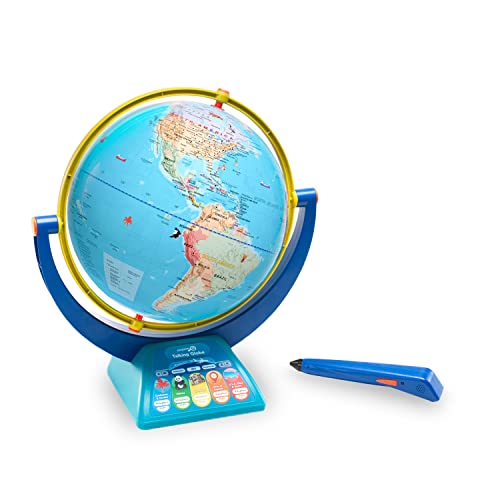
Educational Insights GeoSafari Jr. Talking Globe
Touching the included stylus to a country triggers a recorded fact about that spot. GeoSafari Jr. holds more than 1,000 facts on countries, capitals, and landmarks. A built-in quiz mode raises the difficulty as a child’s recall improves.
Pros
- Stylus interaction keeps kids engaged longer than a static globe
- Over 1,000 recorded facts span countries, capitals, and landmarks
- Quiz mode builds recall without relying on a screen
Cons
- Needs AAA batteries that require periodic replacement
- Kids near age 4 may need help navigating the quiz menu

Replogle Explorer 12-Inch Globe
Raised relief on this globe lets kids feel mountain ranges while tracing borders. A 12-inch diameter fits enough label detail without crowding a young reader. Its weighted base keeps the globe from tipping on a desk or shelf.
Pros
- Raised relief adds a tactile learning layer
- Weighted base resists tipping during regular handling
- Classic design also works as a shelf display
Cons
- Skips any audio or interactive quiz component
- Small print can challenge younger readers
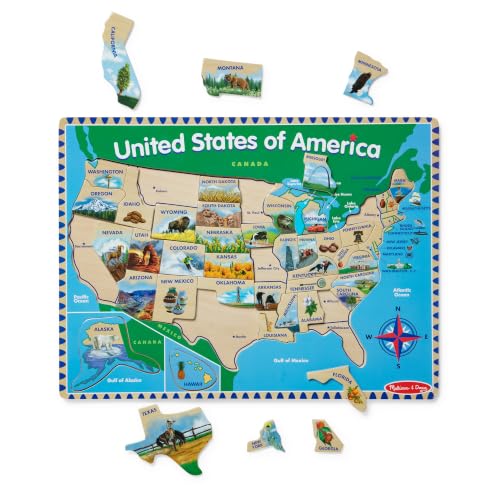
Melissa & Doug USA Map Wooden Puzzle
Each state gets its own wooden piece in this 45-piece puzzle. Thick pieces suit small hands better than thin cardboard cutouts. A completed puzzle doubles as a wall map for ongoing reference.
Pros
- Chunky wood pieces are easy for small hands to grip
- One piece per state links shape to location
- Solid construction survives years of repeated play
Cons
- Covers only the United States, not world geography
- Pieces skip capitals or extra facts

Professor Noggin’s World Geography Card Game
Four difficulty tiers sit on every card, letting younger and older kids compete fairly. Categories rotate through capitals, landmarks, and physical features across continents. Group play turns geography review into a shared activity instead of solo study.
Pros
- Four difficulty tiers per card suit mixed-age groups
- Group format fits family night or a classroom
- Compact box travels easily in a bag
Cons
- Younger players often need a reading adult nearby
- Replay value drops once questions become familiar

Ravensburger World Map 200-Piece Puzzle
Two hundred pieces challenge kids who have outgrown toddler floor puzzles. Illustrated animals and landmarks mark each region for added context. A finished size near 27 by 20 inches suits a shared family puzzle table.
Pros
- Higher piece count matches older kids’ skill level
- Illustrated landmarks add context beyond plain borders
- Sturdy board resists warping mid-assembly
Cons
- Too advanced for most kids under about 7
- Takes longer to finish than smaller puzzles

Waypoint Geographic Blue Ocean Illuminated Globe
Political borders show by daylight, then switch to physical terrain once this globe lights up at night. Dual mapping suits older kids studying both boundaries and landforms. A plug-in cord keeps it lit through longer homework sessions.
Pros
- Two map modes teach borders and landforms separately
- Plug-in light supports evening study sessions
- Detailed labeling suits upper-elementary and middle-school kids
Cons
- Cord placement limits where the globe can sit
- Handles rough play less well than solid plastic globes

GeoToys GeoPuzzle World
Continent-shaped pieces replace tiny country cutouts, sized for toddler hands. A companion poster shows the finished map for self-correction while building. An included fact booklet gives parents animal and landmark trivia to read aloud per continent.
Pros
- Continent-shaped pieces suit toddlers better than fine country detail
- Companion poster helps kids self-correct while assembling
- Fact booklet adds a read-aloud learning layer
Cons
- Larger piece size means less country-level detail
- Cardboard-style pieces wear faster than solid wood
The lineup, side by side
| # | Model | Format | Best for | Score | Price |
|---|---|---|---|---|---|
| 1 | Educational Insights GeoSafari Jr. Talking Globe | Interactive talking globe with stylus | Best overall | 9.4 | Check price |
| 2 | Replogle Explorer 12-Inch Globe | Traditional raised-relief globe | Best for visual learners | 9.2 | Check price |
| 3 | Melissa & Doug USA Map Wooden Puzzle | Wooden floor or table puzzle | Best for early learners | 9.0 | Check price |
| 4 | Professor Noggin’s World Geography Card Game | Trivia card game | Best for family game night | 8.7 | Check price |
| 5 | Ravensburger World Map 200-Piece Puzzle | Jigsaw puzzle | Best for older kids | 8.5 | Check price |
| 6 | Waypoint Geographic Blue Ocean Illuminated Globe | Illuminated globe, lights at night | Best for day-and-night study | 8.2 | Check price |
| 7 | GeoToys GeoPuzzle World | Chunky jigsaw puzzle | Best for toddlers new to geography | 8.0 | Check price |
What to look for
What matters most in a geography toy Age range printed on the box counts more than a toy’s marketing label. Kids who respond to sound over static images do better with audio toys like GeoSafari Jr.’s Talking Globe. Puzzle formats build fine motor skills alongside location memory. Card games add a social layer that solo puzzles and globes skip.
Best toys by age group Three-year-olds handle chunky, continent-level pieces better than fine country detail, which is why GeoToys’ GeoPuzzle World starts there. Kids around 5 to 8 benefit from talking globes or state-level puzzles that introduce names and facts. Kids past age 8 can manage denser jigsaws, such as Ravensburger’s 200-piece world map. Mixed-age family nights work best with tiered card games like Professor Noggin’s, since difficulty adjusts per player.
Do interactive globes teach geography better than traditional ones? Audio quizzes hold attention longer for kids who tire of quiet study. Traditional puzzles and static globes skip batteries and charging, and they cost less to replace. Raised-relief details, like those on Replogle’s Explorer, add a tactile layer no audio toy replicates. Pairing one interactive toy with one hands-on puzzle covers more learning styles than either alone.
Using geography toys alongside school lessons Elementary geography units typically move through capitals, continents, then landmarks in that order. A talking globe or card game reinforces capital recall outside homework time. Puzzles build spatial awareness of where states or countries sit relative to each other, a skill flat maps teach more slowly. Reading GeoToys’ included fact booklet aloud turns puzzle time into an extra geography lesson.
Questions worth asking
What age should kids start learning geography through toys?
Continent-shaped puzzles, like GeoToys’ GeoPuzzle World, work from around age 3. Talking globes and card games suit kids from age 4 through the school years.
Are talking globes better than traditional globes for learning?
Talking globes add audio quizzes that hold younger kids’ attention longer. Traditional globes, like Replogle’s, cost less and add tactile raised relief instead.
Can toddlers use geography puzzles safely?
Yes. Chunky continent-shaped pieces, sized for toddler hands, avoid the choking risk that finer country-level puzzles carry.
Which geography toys work best for homeschooling?
Talking globes and tiered card games suit homeschool review, since both reinforce capitals and landmarks without a formal lesson plan.
Do geography card games need an adult to play?
Professor Noggin’s game runs smoother with an adult or older reader present, since younger kids may need help reading the question cards.
How do illuminated globes work?
A plug-in light inside the globe reveals a physical terrain map once lit, switching from the political map visible by day.
What is the difference between a political map and a physical map globe?
Political maps show country borders and capitals. Physical maps show terrain instead, like mountains, deserts, and rivers.
Are wooden geography puzzles better than cardboard ones?
Wooden puzzles, like Melissa & Doug’s, generally outlast cardboard-style pieces under repeated handling, though both suit occasional use.
Our take
GeoSafari Jr.’s Talking Globe earns the top spot for its mix of audio quizzes and quiz-based recall, a strong fit for kids ages 4 to 8. Parents of toddlers should start with GeoToys’ GeoPuzzle World instead, since continent-shaped pieces suit small hands better than a globe’s fine detail. Families wanting one toy the whole table can use will get the most repeat play from Professor Noggin’s tiered card game.
Rachel Simmons
Rachel previously worked in child-product retail and brings a practical, detail-first eye to gear reviews, focusing on safety standards, ease of use and the fine print that matters most for new caregivers.