12V RV Water Pumps That Keep Pressure Steady at the Tap
SEAFLO’s 55 Series 12V pump suits most trailers with 5.5 GPM flow and a built-in pressure switch. Shurflo’s 4008 costs more but cycles quieter near sleeping areas. Flojet’s Triplex handles fifth wheels with two bathrooms best. Budget rigs can start with the SEAFLO Mini instead.
SEAFLO’s 55 Series 12V pump leads this list by balancing 5.5 GPM flow with a built-in pressure switch most small to mid-size RVs need. It works without a separate accumulator tank. Shurflo’s 4008 costs more but cycles quieter in cargo bays near sleeping areas, so noise-sensitive owners should look there instead.
Spec sheets alone rarely predict real-world pressure, so we compared listed GPM and PSI ratings against owner feedback on noise and reliability. Self-priming lift height and mounting footprint narrowed the field further, since a pump that cannot draw from a low tank causes more service calls than a slightly noisier one.
Before you buy
What to look for in a portable RV water pump Flow rate and pressure determine daily comfort more than any other spec. GPM tells you how many fixtures can run together before a shower slows to a trickle. PSI affects how strong a showerhead or faucet feels, not just whether water moves. Self-priming height matters when the pump sits above or level with a low tank. Check inlet and outlet fitting size against existing plumbing before buying, since 3/8 inch barbs are common but not universal.
How to match flow rate to your RV size A teardrop trailer with one sink rarely needs more than 1 to 2 GPM. Mid-size travel trailers with a shower and kitchen sink usually run better on 3 to 4 GPM pumps. Fifth wheels and toy haulers with two bathrooms benefit from 4.5 GPM or higher, since simultaneous use drops pressure fast on smaller pumps. Undersized pumps cycle constantly under load, and that shortens motor life over a season of daily use.
Best setups for boondocking and off-grid camping Off-grid rigs draw from tanks that run low between fill-ups, so self-priming lift height becomes a priority. A pump rated for 8 or 9 feet of lift keeps working as the tank empties. Current draw also matters on solar or limited battery setups, since a high-GPM pump pulls more amps per minute of use. Pairing a strainer or inline filter with the pump protects the diaphragm from sediment picked up at remote fill stations.
Noise, mounting and installation notes Diaphragm pumps cycle on and off, and that clicking travels through thin RV walls near sleeping areas. Rubber mounting isolators or foam pads under the housing cut vibration noise significantly. Routing the pressure switch away from direct contact with cabinet walls reduces rattling. Most 12V pumps wire directly to the house battery through an inline fuse, and swapping a failed pump usually reuses the existing hose barbs and mounting holes.
The best picks, ranked

SEAFLO 12V 55 Series Water Pump
This diaphragm pump delivers 5.5 GPM at 45 PSI, enough for a shower and a sink running together. An internal pressure switch cycles the motor automatically, skipping the need for a separate accumulator tank. Owners report reliable service in travel trailers and camper vans.
Pros
- Strong flow supports multi-fixture use
- Built-in pressure switch skips a separate tank
- Runs on standard 3/8 inch barbed fittings
Cons
- Draws noticeable current at full flow
- Needs a solid mounting surface to limit vibration

Shurflo 4008-101-A65 Water Pump
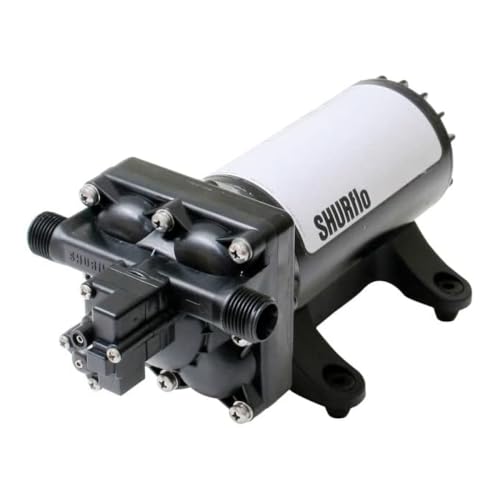
Shurflo built this pump around a rubber diaphragm and internal bypass that cuts motor-cycling noise inside the cabin. It moves 3.0 GPM at 45 PSI, enough for a single-bathroom trailer or van conversion. The bypass valve also limits pressure spikes when a faucet closes fast.
Pros
- Cycles quieter than diaphragm competitors
- Internal bypass smooths pressure changes
- Compact size fits small storage bays
Cons
- GPM trails higher-flow options here
- Costs more per gallon of flow than SEAFLO models

SEAFLO Mini 12V 1.0 GPM Water Pump
This compact pump targets small teardrop trailers, truck campers and DIY water systems where space and current draw stay minimal. Output tops out near 1.0 GPM at 40 PSI, enough for a single hand-wash sink. Its small footprint fits inside a cabinet without extra bracketry.
Pros
- Low current draw suits small battery banks
- Fits tight cabinets and DIY builds
- Two-wire install keeps setup simple
Cons
- Flow rate too low for two fixtures at once
- Motor noise stands out given its small housing

Flojet Triplex 12V 03526144A Water Pump
Flojet’s triplex piston design holds steadier pressure than single-diaphragm pumps when several fixtures draw water together. It rates at 4.5 GPM and 45 PSI, aimed at larger fifth wheels and toy haulers with multiple bathrooms. An all-metal head resists wear better than plastic-bodied alternatives.
Pros
- Holds steadier pressure under simultaneous fixture use
- Metal pump head resists wear
- Handles larger multi-bathroom layouts
Cons
- Larger footprint needs more mounting space
- Draws more current than smaller pumps
SEAFLO 12V 42 Series Water Pump
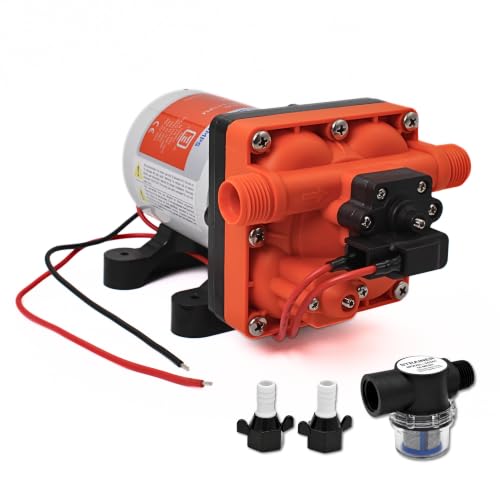
The 42 Series pairs 4.0 GPM output with a 9 foot self-priming lift, useful when a fresh tank sits low relative to the pump. Boondockers cite consistent starts even after a tank runs near empty and refills. A built-in strainer keeps sediment from remote fill sources out of the diaphragm.
Pros
- Strong self-priming lift for low or uneven tanks
- Inlet strainer filters remote-fill sediment
- Good flow-to-current ratio for solar setups
Cons
- Pressure switch clicks stay audible in quiet campsites
- Some listings ship without mounting screws

Aquatec CDP 6800 Water Pump
Aquatec’s CDP 6800 targets small camper vans and marine heads needing dependable flow from a narrow housing. It moves 1.8 GPM at 60 PSI, higher pressure than most pumps this size, which helps low-flow showerheads perform better. The compact body mounts with two screws in most cabinets.
Pros
- Higher PSI improves shower performance at low GPM
- Small size fits narrow van cabinets
- Two-screw mount keeps install simple
Cons
- GPM too low for RVs with two bathrooms
- Replacement diaphragm kits cost extra

Rule 12V RV Water Pump (2.9 GPM)
Rule built its name in marine bilge pumps, and this water pump carries that reputation at a middle price point. It supplies 2.9 GPM at 40 PSI, enough for one sink and an outdoor shower nozzle. Owners note straightforward wiring and a bracket that fits standard RV pump bays.
Pros
- Balances flow and pressure for the price
- Fits standard RV pump mounting brackets
- Two-wire hookup keeps wiring straightforward
Cons
- Skips a built-in bypass valve
- Fewer accessory kits available than SEAFLO or Shurflo
The lineup, side by side
| # | Model | Flow Rate | Best for | Score | Price |
|---|---|---|---|---|---|
| 1 | SEAFLO 12V 55 Series Water Pump | 5.5 GPM | Best overall | 9.4 | Check price |
| 2 | Shurflo 4008-101-A65 Water Pump | 3.0 GPM | Best for quiet operation | 9.1 | Check price |
| 3 | SEAFLO Mini 12V 1.0 GPM Water Pump | 1.0 GPM | Best budget | 8.7 | Check price |
| 4 | Flojet Triplex 12V 03526144A Water Pump | 4.5 GPM | Best for high flow/large RVs | 9.0 | Check price |
| 5 | SEAFLO 12V 42 Series Water Pump | 4.0 GPM | Best for boondocking/off-grid | 8.9 | Check price |
| 6 | Aquatec CDP 6800 Water Pump | 1.8 GPM | Best 12V compact | 8.4 | Check price |
| 7 | Rule 12V RV Water Pump (2.9 GPM) | 2.9 GPM | Best value | 8.6 | Check price |
Common questions
How do I choose the right GPM for my RV water pump?
Match GPM to how many fixtures run at once. One sink needs 1 to 2 GPM, while a shower and kitchen sink together need 3.5 GPM or more to avoid pressure drop.
What PSI is normal for an RV water pump?
Most portable RV pumps run between 40 and 60 PSI. Pumps below 40 PSI can feel weak at the showerhead, while pumps near 60 PSI push water more forcefully through low-flow fixtures.
Can a portable water pump run off a battery bank?
Yes, nearly all 12V RV water pumps wire directly to a house battery or battery bank through an inline fuse. Lower-GPM pumps draw less current, which helps on solar-only setups.
Is a self-priming RV water pump worth it for boondocking?
Self-priming pumps rated for 8 feet or more of lift keep drawing water even as a low or uneven tank empties. That matters most for off-grid camping without a fill-up nearby.
Which RV water pump runs the quietest?
Pumps with an internal bypass valve, like the Shurflo 4008, cycle less abruptly and produce less audible clicking than basic diaphragm pumps without one.
What fitting size do RV water pumps use?
Most portable 12V RV pumps use 3/8 inch barbed inlet and outlet fittings, though some compact models use 1/2 inch. Check existing plumbing before ordering hose adapters.
How long do 12V RV water pumps typically last?
Diaphragm-style pumps commonly run several seasons of regular use before the diaphragm needs replacement. Most manufacturers sell rebuild kits rather than requiring a full pump swap.
Do RV water pumps need a separate accumulator tank?
Pumps with a built-in pressure switch, such as the SEAFLO 55 Series, do not require a separate accumulator tank. Some setups still add one to smooth out pressure pulses further.
SEAFLO vs Shurflo: which brand fits a quieter RV setup?
SEAFLO pumps generally deliver higher flow for the price, while Shurflo’s bypass design cycles with less audible clicking. Noise-sensitive cabin layouts favor Shurflo; multi-fixture flow favors SEAFLO.
Final word
The SEAFLO 12V 55 Series remains the strongest all-around pick, combining 5.5 GPM flow with a built-in pressure switch that fits most travel trailers and camper vans without extra parts. Owners who prioritize a quiet cabin over raw flow should choose the Shurflo 4008 instead. Anyone running a larger fifth wheel with two bathrooms should skip the compact options and go with the Flojet Triplex for steadier simultaneous-fixture pressure.
Tony Russo
Tony trained as an automotive technician and spent years in service and parts retail before moving into writing. He focuses on garage tools, car care products and accessories from a hands-on maintenance perspective.