RV Water Pumps Compared by Flow Rate and Noise Level
SHURflo 4048-153-E75 Revolution leads for balanced flow and quiet cycling. SEAFLO 33-Series delivers strong value at a lower amp draw. VEVOR 12V RV Water Pump covers tight budgets. All three are self-priming 12 volt demand pumps built for existing RV plumbing.
Full-time RVers running a shower and kitchen sink together get steady 4.0 GPM flow from the SHURflo 4048-153-E75 Revolution, without needing a separate pressure tank. Higher current draw is the tradeoff versus smaller pumps. Owners in compact trailers find similar comfort from the lighter, cheaper options below.
GPM and PSI ratings interact with plumbing diameter, tank height, and how many fixtures run at once, which makes picking a pump tricky. We compared published flow rates, shutoff pressure, amp draw, and owner feedback on noise and priming reliability across these seven pumps. That comparison produced distinct picks by rig size and use case, not a single ranked list.
What matters most
What to look for in an RV water pump Flow rate in GPM and shutoff pressure in PSI set how strong water feels at each fixture. Most RV demand pumps run 3.0 to 4.0 GPM at a 45 PSI cutoff, though three-chamber and high-output designs push past that range. Self-priming ability matters when the fresh tank sits below the pump or runs low. Amp draw determines how much battery capacity a boondocking trip can spare for the pump alone.
Matching flow rate to rig size A teardrop or pop-up with one sink needs only 3.0 GPM, so a compact pump like the SHURflo 4008-101-A65 avoids wasted capacity and battery drain. Single-bathroom travel trailers run comfortably on 3.3 to 3.5 GPM pumps such as the SEAFLO 33-Series or VEVOR unit. Two-bathroom fifth wheels and Class A motorhomes benefit from continuous-duty pumps like the Flojet Triplex or higher-output units such as the SHURflo Revolution or Aquatec 5850.
How do you keep an RV water pump quiet? Rubber isolation mounts and flexible hose connections cut vibration transfer into cabinetry more than the motor itself does. Mounting the pump on a rubber pad instead of bolting it directly to plywood reduces resonance through the floor. An accumulator tank smooths pressure spikes and reduces the short, rapid cycling many owners call the most annoying pump noise. Short, direct plumbing runs with fewer elbows also lower strain on the motor.
Boondocking, winterizing, and edge cases Off-grid campers should weigh amp draw against solar and battery capacity, since a pump cycling all day adds up over a weekend. Self-priming pumps like the Dometic SFDF3.5 handle low tank levels better during multi-day boondocking stretches. Run RV antifreeze through the pump before winterizing rather than draining it dry, since running a diaphragm pump dry for extended periods can damage the seals. Owners switching tanks seasonally should confirm the pump’s inlet fitting matches existing plumbing before installing a replacement.
The best picks, ranked
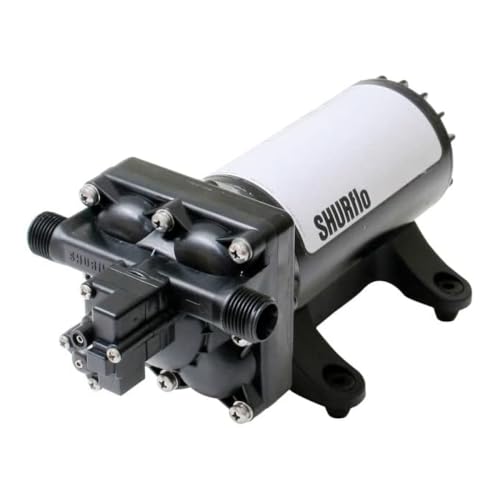
SHURflo 4048-153-E75 Revolution
SHURflo’s Revolution-series demand pump targets full-time RV use with multiple fixtures running together. Internal check valves smooth the pressure curve, cutting the rapid cycling common in older diaphragm pumps. Owners report steady shower flow even while the kitchen faucet runs at the same time.
Pros
- Delivers 4.0 GPM for simultaneous fixture use
- Smoother pressure curve reduces pump chatter
- Self-primes from several vertical feet below the tank
Cons
- Draws more current than smaller 3.0 GPM pumps
- Larger mounting footprint than budget models

SEAFLO 33-Series 12V Water Pump
SEAFLO’s 33-Series pairs a 3.3 GPM diaphragm pump with a compact motor housing sized for tight under-sink cabinets. An inline strainer ships with the pump to protect the diaphragm from tank sediment. Single-bathroom trailer owners report consistent pressure without needing a bypass accumulator.
Pros
- Compact housing fits tight installation spaces
- Inline strainer protects against sediment damage
- Lower amp draw than 4.0 GPM demand pumps
Cons
- Flow drops noticeably when two fixtures run together
- Diaphragm service kit is a separate purchase

VEVOR 12V RV Water Pump
VEVOR’s self-priming diaphragm pump handles basic RV fresh water needs at a lower cost than name-brand demand pumps. A built-in pressure switch manages cut-in and cutoff without a separate accumulator tank. Smaller travel trailers and van conversions with one or two fixtures fit this pump well.
Pros
- Lowest cost entry point among the pumps compared here
- Self-primes without a separate accumulator tank
- Straightforward four-bolt mounting bracket
Cons
- Shorter reported service life than SHURflo or Flojet
- Pressure switch cycles more noticeably at low flow

Flojet Triplex 03526-144A
Flojet’s Triplex 03526-144A runs a three-chamber design instead of the usual two-diaphragm layout, smoothing output and reducing pulsing at the faucet. Continuous duty ratings target larger fifth wheels with two bathrooms. A 35 PSI shutoff sits below the SHURflo Revolution’s, so peak pressure feels softer at the shower head.
Pros
- Three-chamber design smooths pulsing flow
- Rated for continuous duty in larger rigs
- Handles two bathrooms without major pressure drop
Cons
- 35 PSI shutoff trails 45 PSI competitors
- Bulkier housing than single-diaphragm pumps

Aquatec 5850 Series RV Water Pump
Aquatec builds the 5850 series around a permanent-magnet motor and rubber isolation mounts that cut vibration transfer into cabinetry. Boondockers describe it as noticeably quieter than standard diaphragm pumps at a similar flow rate. A 70 PSI shutoff adds headroom for long plumbing runs in larger motorhomes.
Pros
- Rubber isolation mounts reduce vibration noise
- 70 PSI shutoff suits long plumbing runs
- Consistent flow reported even at low tank levels
Cons
- Costs more than standard SHURflo or SEAFLO pumps
- Higher flow than most single-bathroom trailers need

Dometic SFDF3.5 Fresh Water Pump
Dometic’s SFDF3.5 replaced the brand’s older SeaLand-branded pump and self-primes from several vertical feet below the mount. A built-in bypass prevents backflow when connected to city water. Boondockers running low tank levels report reliable priming without manual bleeding.
Pros
- Self-primes from tank levels below the pump
- Built-in bypass protects against city water backflow
- Reliable priming reported even at low tank levels
Cons
- Amp draw spikes during priming compared to SHURflo
- Replacement parts are less widely stocked than SHURflo

SHURflo 4008-101-A65 Standard Pump
SHURflo’s 4008-101-A65 standard-duty pump runs smaller and lighter than the Revolution series above. Its 3.0 GPM output fits pop-up campers, teardrops, and van builds with a single fixture. Lower amp draw eases the load on smaller battery banks and solar setups.
Pros
- Compact size fits small rigs and van conversions
- Lowest amp draw of the pumps compared here
- Long production history keeps parts easy to find
Cons
- 3.0 GPM flow struggles with two fixtures at once
- No three-chamber smoothing like the Flojet Triplex
The lineup, side by side
| # | Model | Flow Rate | Best for | Score | Price |
|---|---|---|---|---|---|
| 1 | SHURflo 4048-153-E75 Revolution | 4.0 GPM | Best overall | 9.4 | Check price |
| 2 | SEAFLO 33-Series 12V Water Pump | 3.3 GPM | Best value | 9.1 | Check price |
| 3 | VEVOR 12V RV Water Pump | 3.5 GPM | Best budget | 8.8 | Check price |
| 4 | Flojet Triplex 03526-144A | 3.5 GPM | Best for continuous duty in large rigs | 8.6 | Check price |
| 5 | Aquatec 5850 Series RV Water Pump | 5.5 GPM | Best for quiet operation | 8.4 | Check price |
| 6 | Dometic SFDF3.5 Fresh Water Pump | 3.5 GPM | Best self-priming for boondocking | 8.2 | Check price |
| 7 | SHURflo 4008-101-A65 Standard Pump | 3.0 GPM | Best for small rigs | 8.0 | Check price |
Good to know
What GPM is best for an RV water pump?
Most single-bathroom trailers run well on 3.0 to 3.5 GPM. Rigs with two bathrooms or simultaneous fixture use benefit from 4.0 GPM or higher, like the SHURflo Revolution or Aquatec 5850.
How do you make an RV water pump quieter?
Mount the pump on a rubber isolation pad, add an accumulator tank to reduce cycling, and use flexible hose instead of rigid plumbing at the pump connections.
Can an RV water pump run dry?
Running a diaphragm pump dry for more than a few seconds can overheat the motor and damage the diaphragm seals. Shut off the pump switch once the fresh tank reads empty.
Is a self-priming RV water pump worth it?
Self-priming pumps like the Dometic SFDF3.5 draw water up from a tank mounted below the pump, which matters for low-profile trailers and near-empty tanks during boondocking.
SHURflo vs SEAFLO, which RV water pump is better?
SHURflo’s Revolution series delivers higher flow and smoother pressure for multi-fixture use. SEAFLO’s 33-Series costs less and fits smaller installation spaces with adequate flow for one bathroom.
What PSI should an RV water pump shut off at?
Most RV demand pumps cut off between 35 and 45 PSI. A lower shutoff like the Flojet Triplex’s 35 PSI feels softer at the shower head than a 45 PSI pump.
How many amps does a 12 volt RV water pump draw?
Draw typically ranges from about 5.5 amps on smaller 3.0 GPM pumps to over 9 amps on higher-flow 4.0 GPM models, which matters for boondocking battery budgets.
Which RV water pump works best for boondocking?
The Dometic SFDF3.5 self-primes reliably from low tank levels. The Aquatec 5850’s lower vibration noise suits campers parked close to neighbors off-grid.
Our take
SHURflo 4048-153-E75 Revolution is the strongest all-around pick for RVers running multiple fixtures who want steady pressure without excess pump noise. Owners on a tight budget or outfitting a small teardrop trailer should choose the SHURflo 4008-101-A65 instead, since its 3.0 GPM output and compact size match smaller tanks and shorter plumbing runs. Boondockers who prioritize quiet operation over raw flow will get more value from the Aquatec 5850 Series.
Tony Russo
Tony trained as an automotive technician and spent years in service and parts retail before moving into writing. He focuses on garage tools, car care products and accessories from a hands-on maintenance perspective.