Which Portable Jump Starter Actually Revives a Dead Battery?
NOCO Boost Plus GB40 suits most petrol engines and fits in a glovebox. HULKMAN Alpha85 adds a color display and faster USB-C charging for larger vehicles and cold climates. NOCO Boost Pro GB150 handles diesel trucks, vans, and boats that overwhelm smaller packs.
Most drivers should keep the NOCO Boost Plus GB40 in the trunk. Want a screen and more headroom? The HULKMAN Alpha85 delivers both at a fair step up in size. Large diesel trucks and boats need the extra cranking power of the NOCO Boost Pro GB150 instead.
Peak amp numbers are measured differently across brands, so a bigger figure does not guarantee a stronger start. We compared stated engine limits, battery capacity in amp hours, clamp safety features, and how long each pack holds a charge in storage. Owner feedback on cold weather starts shaped the final ranking.
How to choose
How many amps does a jump starter actually need? Brands measure peak amps under different test conditions, so numbers do not compare cleanly across manufacturers. A stated maximum engine size, in liters and by fuel type, is the manufacturer’s real commitment. Match that figure to your engine and treat the amp headline as marketing.
Does a diesel engine need a bigger jump starter? Diesel engines run higher compression and demand far more cranking current than petrol. That is why every spec sheet lists separate petrol and diesel limits, often with the diesel number roughly half the petrol one. Size up rather than buying at the edge of a diesel rating, especially in cold climates.
Why does cold weather kill jump starter performance? Lithium cells lose available output as temperature drops, right when a battery is most likely to fail. Owners report noticeably weaker performance below freezing. Storing the pack indoors rather than in an unheated trunk, or choosing one with a warming mode, makes a real difference.
How often should you charge a jump starter in storage? A jump starter left flat in a trunk for two years becomes a paperweight exactly when you need it. Lithium packs self discharge slowly, and most manufacturers suggest topping up every three to six months. A model with a charge readout rather than simple LEDs makes checking that status far easier.
Our top picks
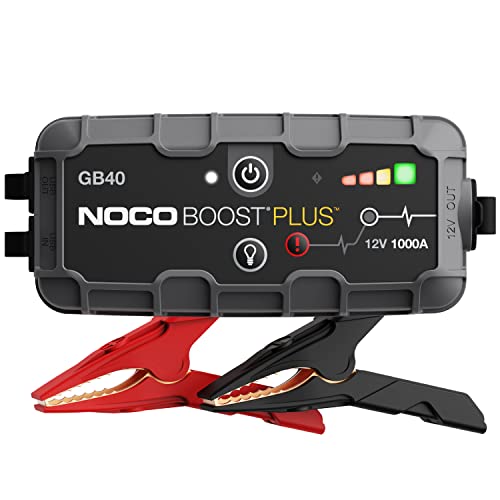
NOCO Boost Plus GB40
This 1000 amp pack covers most petrol engines up to 6 liters and small diesels up to 3 liters, all in a glovebox sized case. Spark proof clamps and reverse polarity protection guard against a tired driver connecting cables wrong in the dark. A manual override still starts cars with a battery too flat for automatic detection.
Pros
- Fits in a glovebox
- Spark proof clamps reduce user error
- Holds charge for months in storage
Cons
- Micro USB charging is slow
- Not rated for large diesel engines

HULKMAN Alpha85
HULKMAN’s Alpha85 pairs a 2000 amp peak with a color screen that shows charge level and clamp connection status. USB-C charges the 20000mAh battery far faster than older micro USB packs. Owners report solid cold weather starts on larger petrol engines and mid size diesels.
Pros
- Color display cuts roadside guesswork
- USB-C charging beats micro USB by a wide margin
- Owners report strong cold weather starts
Cons
- Bulkier than a glovebox pack
- Clamp cables run shorter than some rivals

NOCO Boost Pro GB150
Trucks, vans, boats, and big diesels overwhelm smaller jump starters, which is exactly where the GB150 steps in. Heavy gauge clamps sit on long cables that reach batteries buried under trim panels. Weight and size are the tradeoff, so buy this pack for its output, not for backup peace of mind.
Pros
- Starts engines other packs cannot
- Long heavy cables reach hard to access batteries
- Rugged case suits workshop and fleet use
Cons
- Heavy and awkward to store in a car
- Overkill for a small petrol commuter

GOOLOO GT4000S
GOOLOO’s GT4000S claims a 4000 amp peak, giving it headroom on larger diesels without professional unit bulk. A 26800mAh battery doubles as a power bank with fast USB-C output for camping trips. Lit clamp indicators confirm a correct connection before you turn the key.
Pros
- High claimed output for its size
- Doubles as a capable power bank
- Clamp indicators confirm connection before cranking
Cons
- Peak amp claims are hard to compare across brands
- Case is bulkier than its capacity suggests

NOCO Boost X GBX55
Slow charging was the main complaint about older NOCO packs, so the Boost X line switched to USB-C Power Delivery in and out. Output sits between the GB40 and the professional grade packs, covering most petrol engines and mid size diesels. A 400 lumen light actually works for roadside repairs, unlike token LEDs on cheaper units.
Pros
- Fast USB-C recharge time
- Bright light useful for actual repairs
- Same spark proof clamp design as the GB40
Cons
- Costs more than the GB40 for modest extra output
- Larger than it appears in photos

DBPOWER 800A Portable Car Jump Starter
Small and mid size petrol engines are the target here, with no extras beyond the essentials. An LCD shows remaining charge, and a built in torch adds compass and strobe modes for emergencies. Owners report reliable starts on four cylinder cars, though diesel and freezing mornings push past its limits.
Pros
- Low outlay for a complete kit
- Charge readout beats simple LED dots
- Light enough for a small car’s glovebox
Cons
- Not rated for diesel engines
- Output drops noticeably in cold weather
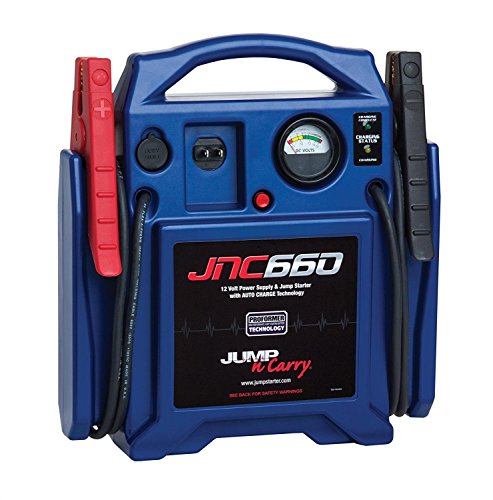
Clore Automotive Jump-N-Carry JNC660
Sealed lead acid chemistry replaces lithium here, built into a case meant for daily shop abuse rather than a glovebox. Sustained cranking output beats a brief peak, which is why service departments keep these on the floor. Weight and the need for constant charging mean it belongs in a garage, not a trunk.
Pros
- Strong sustained cranking rather than a short peak
- Built for repeated daily use
- Very long heavy duty cables
Cons
- Heavy and not portable in any real sense
- Needs to stay on charge to stay healthy
How they compare
| # | Model | Peak amps | Best for | Score | Price |
|---|---|---|---|---|---|
| 1 | NOCO Boost Plus GB40 | 1000A | Best overall | 9.4 | Check price |
| 2 | HULKMAN Alpha85 | 2000A | Best value | 9.2 | Check price |
| 3 | NOCO Boost Pro GB150 | 3000A | Best for large engines | 9.0 | Check price |
| 4 | GOOLOO GT4000S | 4000A | Best high output value | 8.8 | Check price |
| 5 | NOCO Boost X GBX55 | 1750A | Best for fast recharging | 8.6 | Check price |
| 6 | DBPOWER 800A Portable Car Jump Starter | 800A | Best budget | 8.3 | Check price |
| 7 | Clore Automotive Jump-N-Carry JNC660 | 1700 peak, 425 cranking | Best for workshop use | 8.0 | Check price |
Common questions
How many amps do I need to jump-start a car?
Skip the amp number first and check the stated engine limit instead. A pack rated for up to a 6 liter petrol engine, like the NOCO Boost Plus GB40, covers most cars and small SUVs. Larger diesels, vans, and trucks need a unit rated specifically for them.
Can a jump starter damage my car’s electronics?
Modern packs include reverse polarity protection and spark proof clamps that will not deliver power until they sense a correct connection. That design prevents the classic wiring mistakes. Always connect positive first, then negative to an unpainted metal ground point rather than the battery’s negative terminal, per the manual.
How long does a jump starter hold its charge in storage?
Quality lithium packs typically hold a useful charge for several months to a year in storage, though heat and cold both shorten that window. Manufacturers generally suggest topping up every three to six months. Sealed lead acid units, like the Clore Jump-N-Carry JNC660, need to stay on charge almost continuously.
Will a jump starter work on a completely dead battery?
Often yes, through a manual override or boost mode built into most packs for batteries too flat to detect automatically. A battery that flat may already be damaged, so treat the start as a way to get home rather than a fix.
Can I use a jump starter as a phone power bank?
Most packs include USB output for exactly that purpose. Charging a phone eats into the reserve needed for a start, so top the pack back up afterward instead of leaving it half empty in the trunk.
How many jump starts can I get from one charge?
Manufacturers commonly quote twenty to forty starts from a full charge on a healthy pack. A single start on a badly discharged battery in cold weather uses far more than one in mild conditions, so treat the quoted figures as a best case.
Is lithium or lead-acid better for a jump starter?
Lithium is lighter and more portable, which is why it dominates consumer packs today. Lead acid units deliver stronger sustained cranking and tolerate repeated daily use, which is why workshops still stock them. For a car trunk, lithium is the practical choice.
Can I bring a jump starter on a plane?
Lithium jump starters generally exceed the watt hour limits airlines allow in carry on batteries, and they are barred from checked baggage too. Check the specific watt hour rating against airline policy before traveling. Expect the answer to be no for anything with real jump starting capability.
What size jump starter do I need for a diesel truck?
Look for a stated diesel limit at or above your engine’s displacement, not just a high peak amp claim. The NOCO Boost Pro GB150 covers diesels up to 8 liters, well past what compact packs like the GB40 handle. Cold climates call for sizing up even further.
The bottom line
NOCO Boost Plus GB40 remains the right buy for most drivers, small enough for a trunk and rated for the engines most people own. Want a clearer roadside interface and more headroom? The HULKMAN Alpha85 adds a color display and much faster USB-C charging. Large diesels, vans, and boats need the NOCO Boost Pro GB150 rather than a compact pack pushed past its limit.
Tony Russo
Tony trained as an automotive technician and spent years in service and parts retail before moving into writing. He focuses on garage tools, car care products and accessories from a hands-on maintenance perspective.

