7 Jump Starters Powerful Enough for V8 Trucks and SUVs
NOCO’s Boost Plus GB40 covers petrol engines to six litres and fits a glovebox, which suits most drivers. Hulkman’s Alpha85 adds a 20000mAh pack and a status screen for larger engines. Avapow’s A58 arrives with case and cables for a car that mostly sits parked.
NOCO’s Boost Plus GB40 is the pack we would leave in a typical petrol car, small enough to forget about until the morning it matters. Hulkman’s Alpha85 buys more capacity and a screen that tells you what is happening. Avapow’s A58 covers a rarely driven second car without much thought.
Headline amp figures are the problem. Peak amperage is measured over milliseconds under lab conditions and says nothing about turning a cold diesel on a January morning. Manufacturers also measure it differently, so two 2000A packs can behave nothing alike. Rankings below use stated engine limits in litres, pack capacity in milliamp hours, clamp and polarity protection, cable gauge, and what owners report after a winter of use.
Before you buy
What do jump starter amp ratings actually mean? Peak amperage describes a spike lasting milliseconds, measured however the manufacturer chooses. No standard governs it, so the number is close to useless for comparison. Two figures carry real weight instead. Stated maximum engine size, quoted separately for petrol and diesel, tells you what the maker will stand behind. Pack capacity in milliamp hours tells you how many attempts you get before it dies. A unit rated for 6 litres petrol and 3 litres diesel, like the GB40, communicates more than a 4000A headline. Size against your largest vehicle, since the pack that starts a van will always start a hatchback.
How much jump starter do you need for a diesel? Diesels compress air far harder than petrol engines, so the starter motor draws considerably more current to turn them over. Cold multiplies that. Glow plug cycles add another drain before cranking even begins. A compact petrol focused pack usually flattens itself in two attempts on a 2.5 litre diesel van. Step up to the NOCO Boost HD GB70, the GOOLOO GT4000S or the lead acid Jump-N-Carry JNC660 if a diesel lives on your driveway. Check the diesel figure specifically, because most units quote a diesel ceiling well below the petrol one.
Which jump starter safety features matter? Reverse polarity protection is the one that saves alternators and fuses. Good units simply refuse to pass current until red meets positive, so a wrong connection produces nothing rather than sparks. Spark proof clamps and short circuit cutoff cover the rest of the roadside chaos. Manual override deserves attention too. Batteries below roughly two volts are invisible to detection circuits, and without a way to force output the pack will insist a dead battery is not connected. NOCO’s implementation is the benchmark here, and several rivals copy the idea with varying success.
How should you store a jump starter through winter? Lithium packs shed charge slowly on a shelf and lose usable output as temperature drops, which is precisely when the call comes. Top up every three months and put a reminder somewhere you will see it. Keeping the unit in the cabin rather than an unheated boot makes a measurable difference on a freezing morning, and holding it in your hands for a minute before use warms the cells enough to help. Lead acid boosters such as the JNC660 behave differently: they want a maintenance charger permanently, but tolerate repeated long cranks better than lithium.
The shortlist, ranked

NOCO Boost Plus GB40
GB40 is the default answer for petrol cars up to around six litres, and it fits in a glovebox alongside the manual. Clamps refuse to output until polarity is correct, so touching them together does nothing at all. Manual override handles a battery too flat for the detection circuit to see, which is the failure mode that leaves cheaper packs useless.
Pros
- Clamps stay inert until wired correctly
- Glovebox sized rather than boot sized
- Manual override starts deeply drained batteries
Cons
- Micro USB charging takes hours to refill
- Three litre diesel ceiling rules out vans

Hulkman Alpha85
A 20000mAh cell sits behind a screen showing charge percentage, output state and fault codes, which removes the guesswork from a roadside attempt. Engine ceiling reaches 8.5 litres petrol and 6 litres diesel, well past the compact NOCO. USB-C handles charging in both directions, so the pack refills from a laptop charger rather than an overnight trickle.
Pros
- Screen reports charge state and connection faults
- Diesel ceiling reaches six litres
- USB-C refills far faster than micro USB
Cons
- Too bulky for a glovebox
- Case and cables want a boot cubby

NOCO Boost HD GB70
GB70 keeps the GB40 safety architecture and adds thicker cable and heavier clamps that bite through terminal corrosion. Stated ceilings climb to 8 litres petrol and 6 litres diesel, which covers most pickups and vans. Cold mornings are where the extra headroom shows, since a chilled battery raises internal resistance and swallows current.
Pros
- Real margin for diesel vans and pickups
- Thick cable resists voltage drop under load
- Same polarity protection as the GB40
Cons
- Heavy to carry around a vehicle
- Oversized for a small petrol car

GOOLOO GT4000S
GT4000S pairs a 26800mAh cell with the highest stated ceilings here, at 10 litres petrol and 8 litres diesel. Extra headroom matters in a hard freeze, when a cold soaked battery needs more current than the same engine takes in summer. USB-C Power Delivery runs both directions, so it doubles as a laptop and phone bank on a long drive.
Pros
- Largest output margin for freezing starts
- 26800mAh runs phones and laptops for days
- Power Delivery charging in both directions
Cons
- Too bulky for daily glovebox carry
- Supplied case and cables feel basic
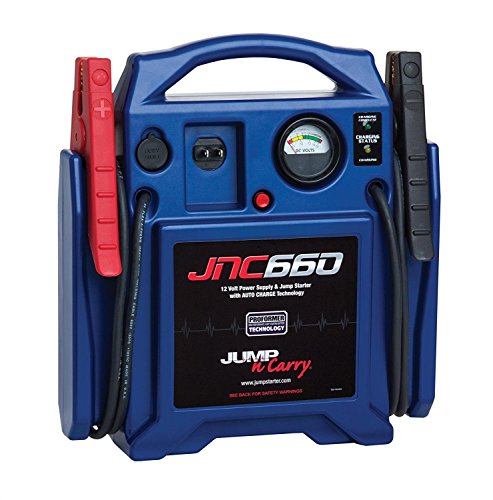
Clore Automotive Jump-N-Carry JNC660
Sealed lead acid rather than lithium, which changes the character completely: 425 cranking amps delivered steadily instead of a brief burst. Cables run 46 inches, long enough to reach a battery buried under a wheel arch or behind a trim panel. Garages keep these on a maintenance charger, where owners report they outlive several lithium packs.
Pros
- Sustained cranking, not a two second burst
- 46 inch cables reach awkward battery locations
- Survives daily commercial handling
Cons
- Far too heavy to carry as emergency kit
- Lead acid self discharges and needs regular topping up

DBPOWER 800A Portable Jump Starter
800A peak and a 6.5 litre petrol ceiling put this squarely with small cars, motorbikes and mowers. Size is the appeal, since it lives in a door pocket rather than taking a boot cubby. A built in torch with strobe and SOS modes plus dual USB output means it earns its space between emergencies.
Pros
- Small enough for a door pocket
- Torch and phone charging get used between jumps
- Single button operation under stress
Cons
- No diesel rating at all
- Little margin left on a cold morning

Avapow A58
A58 states 8 litres petrol and 6 litres diesel, which covers ordinary family cars with room to spare. Reverse polarity protection and a work light come as standard, and the box includes a case and cables so nothing else is needed. It suits a second car that sits unused for weeks, where a pack rarely gets used but must work when it does.
Pros
- Stated ceilings cover most family cars
- Case and cables supplied in the box
- Polarity protection built into the clamps
Cons
- Housing and clamps feel lighter than NOCO’s
- Holds charge less well over months of storage
How they stack up
| # | Model | Peak amps | Best for | Score | Price |
|---|---|---|---|---|---|
| 1 | NOCO Boost Plus GB40 | 1000A | Best overall | 9.4 | Check price |
| 2 | Hulkman Alpha85 | 2000A | Best value | 9.2 | Check price |
| 3 | NOCO Boost HD GB70 | 2000A | Best for trucks and large diesels | 9.0 | Check price |
| 4 | GOOLOO GT4000S | 4000A | Best for cold climates | 8.7 | Check price |
| 5 | Clore Automotive Jump-N-Carry JNC660 | 1700A | Best for workshops | 8.5 | Check price |
| 6 | DBPOWER 800A Portable Jump Starter | 800A | Best compact option | 8.2 | Check price |
| 7 | Avapow A58 | 2500A | Best budget | 8.0 | Check price |
Common questions
How many amps do I need to jump start a car?
A typical family petrol car is covered by a pack rated around 1000A peak with a stated six litre petrol limit. Diesels, pickups and cold climates justify 2000A or more with a matching diesel figure. Read the engine limit rather than the peak number.
Can a jump starter damage my car’s electronics?
Not when reverse polarity and short circuit protection are present, as they are on all seven picks. Damage almost always comes from clamps fitted backwards, and these units block output until the connection is right. Older unprotected boosters are where the horror stories come from.
How do you connect a jump starter correctly?
Red clamp goes to the positive terminal. Black clamp goes to bare metal on the engine block or chassis, not the negative terminal, which keeps any spark away from battery gases. Switch the unit on, wait for the ready light, then crank. Leave thirty seconds between attempts.
Will a jump starter work on a completely dead battery?
Often, using manual override or boost mode. Detection circuits cannot see a battery below roughly two volts and will report no connection until you force output. A battery with a shorted cell or a cracked case is beyond any jump starter.
How often should you recharge a jump starter?
Every three months for lithium packs. Lead acid boosters like the JNC660 prefer sitting on a maintenance charger continuously. Finding the pack flat during an actual emergency is the single most common complaint owners report.
Do jump starters work in freezing weather?
They work, but output falls as the cells cool while the engine simultaneously demands more current. Buying more capacity than you strictly need covers that gap. Storing the pack inside the cabin rather than the boot is the cheapest improvement available.
Can I use a jump starter on a motorcycle or lawn mower?
Yes. Small engines need a fraction of the current a car takes, so a compact unit such as the DBPOWER 800A handles them without effort. Check the clamps fit the smaller terminals without touching the frame.
Is a jump starter better than jumper cables?
For most drivers, yes, because it needs no second vehicle and no cooperative stranger at midnight. Cables still earn their place as a backup and take almost no space. Carrying both covers the case where the pack itself is flat.
How long does a jump starter last?
Lithium packs typically hold useful capacity for three to five years, degrading faster if stored fully drained or baked in a summer car. Lead acid boosters last longer under a maintenance charger. Both should be tested annually rather than assumed working.
Can you fly with a lithium jump starter?
Only in carry on baggage, never checked luggage. Airlines commonly require approval above 100 watt hours, and some refuse larger packs outright. Check the watt hour rating printed on the case and confirm with the airline before travelling.
Final word
NOCO’s Boost Plus GB40 remains the sensible default for a petrol car, combining glovebox size with the most forgiving clamp system in this group. Move to the Hulkman Alpha85 or the NOCO Boost HD GB70 if a diesel or a hard winter is involved. Avapow’s A58 makes sense for a rarely driven second car where the pack will mostly sit in the boot.
Tony Russo
Tony trained as an automotive technician and spent years in service and parts retail before moving into writing. He focuses on garage tools, car care products and accessories from a hands-on maintenance perspective.