How to Choose a Pole Saw for Tall Tree Branches
The Greenworks 40V 8-Inch Pole Saw balances reach, cordless power and value, our top overall pick. The Sun Joe SWJ800E is the best budget corded option. The DEWALT DCPS620B leads for cordless cutting strength and professional-grade build quality.
For most homeowners, the Greenworks 40V 8-Inch Cordless Pole Saw is the best choice, with the Sun Joe SWJ800E for tight budgets and the DEWALT DCPS620B for serious cutting power.
Reach, weight and cutting power constantly work against each other, so pole saws are trickier to shop for than they look. A tool that feels light in the store can strain your arms after ten overhead cuts. We compared published specifications, owner feedback and manufacturer reach and bar-length figures, weighing real-world balance and runtime over headline numbers alone.
The top picks, ranked

Greenworks 40V 8-Inch Cordless Pole Saw (20672)
Reach, power and simplicity meet in the middle here, which is what most homeowners actually need. Owners report clean cuts on limbs up to roughly eight inches thick. A tool-free extension makes storing this saw far easier than a fixed-length model.
Pros
- Cordless freedom with no gas or cords
- Tool-free extension shaft
- Works within the wider Greenworks 40V battery lineup
Cons
- Battery and charger sometimes sold separately
- Runtime drops on thick hardwood limbs

Sun Joe SWJ800E 8-Inch Electric Pole Saw
Corded power means dependable cutting without paying for batteries. Running on wall power, this saw never fades mid-cut. Owners say it handles routine branch pruning around the yard with little fuss.
Pros
- Consistent power with no battery to charge
- Long overhead reach for the money
- Lightweight for extended pruning sessions
Cons
- Tethered to an extension cord
- Cord management can be awkward on tall limbs

DEWALT DCPS620B 20V MAX XR Pole Saw
Anyone already holding DEWALT 20V MAX batteries gets brushless cutting muscle from this saw. Based on specifications it delivers strong chain speed. Owners describe it as durable enough for regular property maintenance rather than occasional use.
Pros
- Brushless motor for efficient cutting
- Shares batteries across the DEWALT 20V system
- Sturdy build aimed at frequent use
Cons
- Sold as a bare tool without battery
- Heavier once a large battery is attached
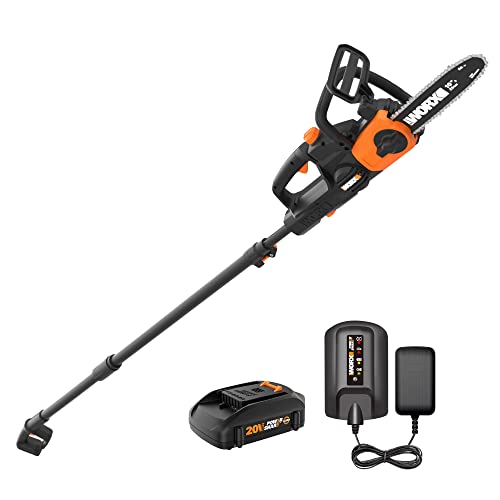
WORX WG323 20V 2-in-1 Cordless Pole Saw
This saw converts between a pole saw and a handheld chainsaw, useful for tackling both high limbs and ground-level cleanup with one tool. An auto-tension chain system cuts down on fiddling for casual users. Owners rate the conversion as genuinely quick rather than a gimmick.
Pros
- Converts to a handheld chainsaw
- Auto-tension chain reduces maintenance
- Shares batteries with the WORX PowerShare range
Cons
- Front-heavy when fully extended
- Modest runtime on a single small battery

EGO Power+ PSA1000 10-Inch Pole Saw Attachment
An attachment rather than a standalone saw, the PSA1000 snaps onto the EGO Power Head, a smart buy for anyone already running the EGO multi-head system. Owners praise the smooth cutting once paired with a larger battery. It needs the separate power head to run at all.
Pros
- Long 10-inch bar for bigger limbs
- Shares one power head across EGO attachments
- Strong cutting with a high-capacity battery
Cons
- Requires the separate EGO power head
- Total cost climbs once fully outfitted

Ryobi ONE+ RY43160 8-Inch Electric Pole Saw
Simplicity and low weight define this saw, which owners appreciate for routine trimming of thinner branches. It fits the broad Ryobi ecosystem, appealing to anyone who already leans on Ryobi tools around the house. Cutting power stays modest by design.
Pros
- Light and easy to control overhead
- Straightforward for occasional users
- Backed by a widely available brand
Cons
- Better suited to smaller branches
- Less cutting power than premium rivals
Fiskars Extendable Pole Saw & Pruner 393951-1001
No battery or cord enters the picture with this manual saw and pruner, a proven choice for quiet, maintenance-free pruning. Owners rely on it for precision cuts near the house where a powered chain feels like overkill. Thick limbs take considerably more effort to clear.
Pros
- No battery, cord or fuel required
- Precise control for careful cuts
- Combines a saw and a pruning head
Cons
- Slower going on thick limbs
- Manual sawing takes more effort
How they compare
| # | Model | Bar length | Best for | Score | Price |
|---|---|---|---|---|---|
| 1 | Greenworks 40V 8-Inch Cordless Pole Saw (20672) | 8 inches | Best overall | 9.4 | Check price |
| 2 | Sun Joe SWJ800E 8-Inch Electric Pole Saw | 8 inches | Best budget | 9.1 | Check price |
| 3 | DEWALT DCPS620B 20V MAX XR Pole Saw | 8 inches | Best cordless power | 8.9 | Check price |
| 4 | WORX WG323 20V 2-in-1 Cordless Pole Saw | 10 inches | Best 2-in-1 | 8.7 | Check price |
| 5 | EGO Power+ PSA1000 10-Inch Pole Saw Attachment | 10 inches | Best for EGO owners | 8.5 | Check price |
| 6 | Ryobi ONE+ RY43160 8-Inch Electric Pole Saw | 8 inches | Best for light pruning | 8.3 | Check price |
| 7 | Fiskars Extendable Pole Saw & Pruner 393951-1001 | WoodZig saw blade plus pruner | Best manual option | 8.1 | Check price |
How to choose
How high does a pole saw need to reach? The single most common regret owners report is buying a pole saw that cannot reach the limbs they wanted to cut. Measure the height of target branches, and remember your own height and arm span add several feet to a saw’s pole length. Plan on a longer telescoping model, or consider a professional, for limbs above 15 feet rather than overreaching from a ladder.
How do you weigh cutting power against arm fatigue? Cutting power matters, but so does how a saw feels after ten overhead cuts. Corded and higher-voltage cordless models cut faster through thick wood, yet run heavier and more tiring held above your head. Lighter tools reduce arm strain but bog down in dense hardwood. Weigh branch thickness and session length honestly before prioritizing raw power.
Does battery brand matter for a cordless pole saw? With cordless pole saws, the battery platform often matters more than the saw itself. Owning tools from Greenworks, DEWALT, EGO, WORX or Ryobi already means staying in that ecosystem lets you share batteries and chargers, lowering real cost. Bare-tool listings save money up front but require a compatible battery, so read the listing before assuming a charger comes included.
What maintenance and safety steps keep a pole saw running well? A pole saw is a chainsaw on a stick, and deserves the same respect. Keep the chain sharp and properly tensioned, oil the bar as the manual directs, and wear eye protection and a hard hat when cutting overhead. Never cut directly above yourself or near power lines, and let limbs fall clear of your footing. Manufacturer guidance on maximum branch diameter exists for a reason.
Frequently asked questions
How high can a pole saw actually reach?
Most pole saws in this roundup reach roughly 9 to 15 feet of pole length, with your own height adding several more feet of effective reach. Corded models like the Sun Joe often extend highest, while compact cordless saws sit at the shorter end.
What size branches can a pole saw cut?
As a general rule based on specifications, an 8 to 10 inch bar handles limbs up to about 6 to 8 inches thick. Cutting closer to the maximum runs slower and harder on the chain, so many owners stick to branches well under that limit.
Corded vs cordless pole saw: which is better?
Corded saws deliver steady power and never run out of charge, suited to stationary trimming near an outlet. Cordless models offer freedom to roam the yard but depend on battery runtime, so the right choice comes down to how far you need to move.
Do you need to oil a pole saw chain?
Yes. Like any chainsaw, a powered pole saw needs bar and chain oil to run smoothly and last. Most models have a reservoir you top up, and following the manufacturer’s oiling schedule reduces wear and helps prevent binding.
Can a pole saw replace a chainsaw?
Not entirely. Pole saws excel at overhead pruning and reaching limbs from the ground, but they run lighter-duty than a full chainsaw and are not meant for felling trees or bucking large logs. Two-in-one models like the WORX WG323 blur the line for smaller jobs.
How heavy is too heavy for overhead use?
Weight tolerance is personal, but many owners find saws around 7 to 9 pounds manageable for extended overhead work, while heavier tools tire the arms quickly. A large cordless battery adds weight right where it strains most.
Is a manual pole saw worth considering?
For quiet, close-in pruning of thinner branches, a manual pole saw and pruner like the Fiskars is a reliable, maintenance-free option. It asks more physical effort but eliminates batteries, cords, fuel and chain oil, a tradeoff some owners strongly prefer.
What safety gear should you use with a pole saw?
At minimum, wear eye protection and a hard hat when cutting overhead, plus gloves for grip. Keep bystanders clear, avoid cutting near power lines, and never stand directly beneath the limb being cut so falling wood cannot land on you.
Do pole saws come with a battery included?
It varies. Several premium cordless models, including the DEWALT DCPS620B, sell as bare tools without a battery or charger. Check the listing carefully, especially if you do not already own a compatible battery platform.
Our pick
For most homeowners the Greenworks 40V 8-Inch Cordless Pole Saw offers the best mix of reach, power and value, while the corded Sun Joe SWJ800E is the smart budget pick. Choose the DEWALT DCPS620B for maximum cordless cutting strength if you already own compatible batteries.
Sierra Daniels
Sierra's background is in landscape design and nursery retail. She focuses on lawn and garden equipment, outdoor furniture and gear durability, weighing published specs against how materials actually hold up outside.


