Photo Scanners Compared for Speed and Image Quality
Epson’s Perfection V600 leads this group, scanning prints, slides and negatives with strong detail and built in dust removal. Canon’s CanoScan LiDE 400 costs less and handles prints only, skipping film entirely. Facing a shoebox of loose photos? The Epson FastFoto FF-680W clears a large batch in a fraction of the time.
Three scanners stand out for digitizing old photos: the Epson Perfection V600, the Canon CanoScan LiDE 400, and the Epson FastFoto FF-680W. Together they cover printed photos, 35mm slides, negatives and fast batch scanning for anyone facing a large archive. Each suits a different starting point, from a single drawer of prints to boxes accumulated over decades.
Picking the right scanner is harder than it looks, since prints and film need genuinely different hardware. We separated flatbed scanners built for film and delicate prints from feed scanners built for volume, then compared resolution, dust and scratch tools, and how much fiddling each model demands before a clean scan comes out.
The top picks, ranked

Epson Perfection V600 Photo Scanner
This flatbed scans prints, 35mm slides and negatives at 6400 by 9600 dpi, enough detail for large reprints. Built in infrared dust removal cleans up scratched or dusty film automatically. Mixed home archives with both prints and film rarely need a second device once this one is on the desk.
Pros
- Handles prints, slides and negatives in one unit
- Infrared dust removal cleans film automatically
- 6400 by 9600 dpi resolution suits enlargements
Cons
- Scans one image at a time, unlike feed scanners
- Film holders take a session or two to learn

Canon CanoScan LiDE 400
A single USB cable powers this slim flatbed, so no separate power brick clutters the desk. Resolution tops out at 4800 by 4800 dpi, plenty for prints and documents at normal sizes. Film and slides fall outside its range, since it lacks a transparency unit entirely.
Pros
- Sharp print scans for the price
- Runs from one USB cable with no adapter
- One touch buttons speed up repeat scans
Cons
- No support for film or slides
- Bundled software is basic compared to rivals

Epson FastFoto FF-680W
Loose prints feed through this scanner at about one photo per second, clearing a shoebox in an afternoon. Both the front image and any handwritten notes on the back get captured automatically. Wireless transfer sends finished scans straight to a phone or computer without cables.
Pros
- Fast enough for hundreds of prints in one sitting
- Captures notes written on the back of photos
- Wireless transfer skips the cable step
Cons
- Cannot scan slides or negatives
- Rollers pose some risk to very fragile prints

Plustek OpticFilm 8200i SE
Dedicated entirely to 35mm film, this scanner captures slides and negatives at 7200 dpi, well past what a flatbed manages. Infrared correction lifts dust and scratches without extra editing. Serious film archivists pick it specifically for detail a flatbed’s transparency unit cannot match.
Pros
- 7200 dpi resolution built specifically for film
- Infrared correction removes dust and scratches
- Detail exceeds flatbed transparency units
Cons
- Limited to 35mm slides and negatives only
- Scans one frame at a time, which is slow
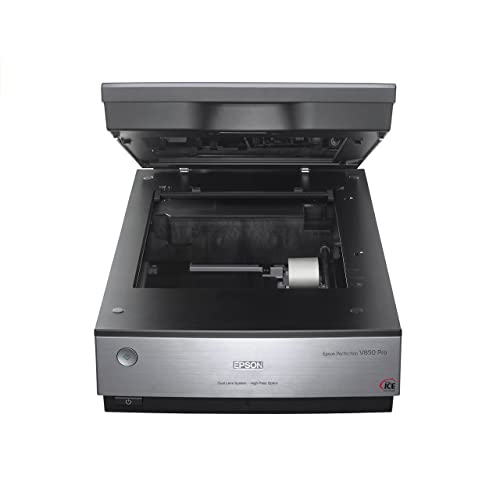
Epson Perfection V850 Pro
Dual lenses switch automatically between settings tuned for film and settings tuned for reflective prints. Premium holders keep medium and large format film flat for sharper results than snap in trays. Archivists and professionals buy this model when volume and top end quality both matter.
Pros
- Dual lens system optimizes for film versus prints
- Premium holders support multiple film formats
- Top tier detail among flatbed scanners
Cons
- Priced well above casual home use
- Takes up significant desk space

Canon CanoScan LiDE 300
Everyday prints and documents scan well at 2400 by 4800 dpi, though film is not part of this scanner’s job. One USB cable handles both power and data, keeping setup simple. Auto scan shortcuts turn repeat jobs into a single button press.
Pros
- Low cost entry point for print scanning
- Single cable setup with no extra adapter
- Compact enough for a small desk
Cons
- No film or slide capability
- Resolution trails the pricier LiDE 400

Kodak Slide N Scan Film and Slide Scanner
A built in screen lets this standalone device convert slides and negatives without ever connecting to a computer. Finished files save directly to a memory card for easy transfer. Detail falls short of a dedicated flatbed, but the tradeoff buys real convenience for casual archives.
Pros
- Works entirely without a computer
- Straightforward for a first time user
- Fast for casual slide collections
Cons
- Less detail than flatbed or film scanners
- Editing options are limited on device
The lineup, side by side
| # | Model | Type | Best for | Score | Price |
|---|---|---|---|---|---|
| 1 | Epson Perfection V600 Photo Scanner | Flatbed | Best overall | 9.4 | Check price |
| 2 | Canon CanoScan LiDE 400 | Flatbed | Best value | 9.0 | Check price |
| 3 | Epson FastFoto FF-680W | Sheet feed | Best for bulk photos | 9.1 | Check price |
| 4 | Plustek OpticFilm 8200i SE | Dedicated film scanner | Best for film and slides | 8.8 | Check price |
| 5 | Epson Perfection V850 Pro | Flatbed | Best for professionals | 8.7 | Check price |
| 6 | Canon CanoScan LiDE 300 | Flatbed | Best budget | 8.3 | Check price |
| 7 | Kodak Slide N Scan Film and Slide Scanner | Standalone film converter | Best for slides and negatives | 8.0 | Check price |
How to choose
Do you need a scanner for prints, film, or both? Printed photos reflect light, so almost any flatbed can capture them. Film works differently. Light has to pass through a slide or negative, which only a transparency unit or a dedicated film scanner provides. Sort your collection first: prints alone open up budget flatbeds, while any film narrows the field considerably.
How much scanning resolution do you actually need? Small originals benefit most from high dpi, since you enlarge them a great deal afterward. A 35mm negative gains real detail from 4800 dpi and above. Standard printed photos already hold less detail than a mid range flatbed captures, so a very high dpi number on a print scanner rarely pays off.
Flatbed quality or feed scanner speed? One image at a time is the flatbed tradeoff, and it delivers the sharpest result for film and delicate prints. Feed scanners such as the FastFoto push through a stack in roughly a second per photo. Choose based on volume: a few dozen prints suit a flatbed, while hundreds favor a feeder.
What do dust removal and color restoration fix? Decades in a box leave film and prints dusty, scratched, and faded. Infrared dust removal spots damage the software can correct automatically, saving hours of manual retouching. This feature helps film far more than prints, since scratches on negatives show up magnified in every print made from them.
Common questions
Which scanner is best for old slides?
A dedicated film scanner like the Plustek OpticFilm handles slides with the most detail, while the Epson V600 covers slides alongside prints in one device. For a simpler process without a computer, the Kodak Slide N Scan works well.
Can a photo scanner handle negatives too?
Only scanners with a transparency unit or a dedicated film design read negatives. The Epson V600, the V850 Pro, the Plustek, and the Kodak all manage it, but the Canon LiDE models do not.
What resolution do I need to scan prints?
Around 600 dpi already captures the full detail held in a standard printed photo. High dpi numbers matter mainly for small film originals headed for a large enlargement.
How do I scan a large box of photos fast?
A feed scanner such as the Epson FastFoto processes about one print per second and grabs the back of each photo too. That beats a flatbed by a wide margin for loose prints in good shape.
Will scanning damage fragile old photos?
Flatbeds are the safer choice, since the photo sits still on the glass. Feed scanners pull prints through rollers, which risks brittle or torn originals, so keep those on a flatbed instead.
Do photo scanners remove dust and scratches automatically?
Several models include infrared dust and scratch correction, and it works best on film. The Epson V600, the V850 Pro, and the Plustek all offer it, cutting down manual cleanup considerably.
Do I need a computer to scan old photos?
Most flatbed and feed scanners connect to a computer to run. The Kodak Slide N Scan is the exception, working on its own screen and saving straight to a memory card.
Can faded colors be restored during scanning?
Some scanner software includes color restoration that revives faded prints and film as part of the scan. Results depend on how far the original has faded, but noticeable improvement is common.
Is a flatbed or a dedicated film scanner better for 35mm negatives?
A dedicated film scanner like the Plustek OpticFilm resolves finer detail than a flatbed’s transparency unit. A flatbed like the Epson V600 is the better choice if you also need to scan prints.
How long does it take to digitize a full shoebox of photos?
A feed scanner clears several hundred prints in under an hour at roughly one photo per second. A flatbed handling the same box, especially with film mixed in, can take a full day or more.
Final word
Most home archives are best served by the Epson Perfection V600, which captures prints, slides and negatives with strong detail and useful dust removal in one machine. Choose the Canon CanoScan LiDE 400 instead if prints are all you have and cost matters more than film support. Facing hundreds of loose photos? The Epson FastFoto FF-680W clears that backlog fastest.
Marcus Chen
Marcus covered consumer electronics for enthusiast tech publications for six years before joining ChoiceCrest. He specializes in translating manufacturer spec sheets into plain-language buying advice, with a focus on audio, computing accessories and smart-home gear.