Paper Cutters That Cut a Straight Line Every Time
Swingline’s ClassicCut Lite 9312 suits everyday office trimming in a compact, guarded package. The Dahle 508 rotary trimmer gives cleaner edges on photos and card stock. Thicker stacks need the X-ACTO 26234 guillotine, which the others cannot handle.
Most desks are best served by the Swingline ClassicCut Lite 9312. Photographers and crafters get cleaner results from the Dahle 508 rotary trimmer, and genuinely thick stacks call for the X-ACTO 26234 guillotine.
Paper cutters are harder to pick than they look, because sheet capacity figures assume thin copier paper. The same trimmer that slices twenty sheets cleanly will chew a single piece of glossy card. We compared cutting mechanisms, guarding, alignment accuracy and what owners report about blade life to rank the seven below.
The best picks, ranked
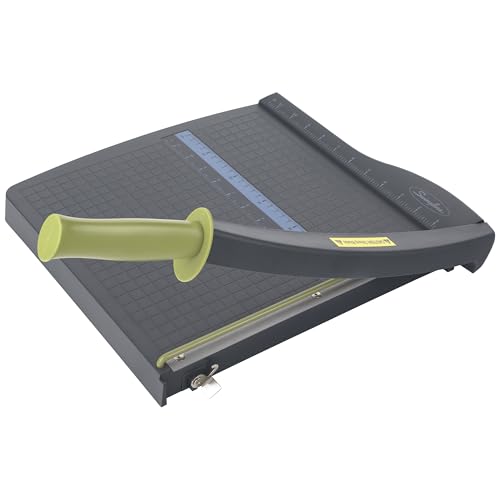
Swingline ClassicCut Lite Paper Trimmer 9312
A guillotine style trimmer with a fully guarded blade and a clamp that holds the stack while you cut, which keeps the edge square. Its self sharpening blade holds an edge across a lot of ordinary office work. Owners report the guard is the reason it stays out on a shared desk.
Pros
- Guarded blade is safe around others
- Clamp keeps the stack from shifting
- Grid makes repeat cuts consistent
Cons
- Capacity is modest for thick stacks
- Base flexes if you push a heavy stack

Dahle 508 Personal Rolling Trimmer
A rotary trimmer whose circular blade runs inside a rail, so nothing is exposed and the cut is a clean shear rather than a chop. That produces the tidiest edges here on photo paper and card. Owners report the blade lasts a long time and replacement cartridges are straightforward to fit.
Pros
- Cleanest edge on photo and card stock
- Blade is fully enclosed in the rail
- Rail keeps the cut perfectly straight
Cons
- Low sheet capacity per pass
- Slower than a guillotine on volume work
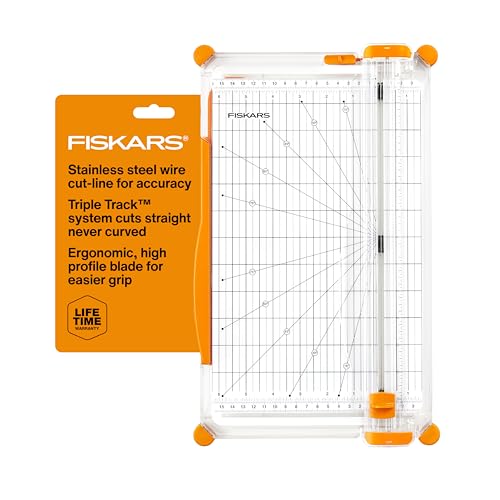
Fiskars 12 Inch SureCut Deluxe Craft Paper Trimmer
A rotary craft trimmer with a fold out arm and a cutline guide that shows exactly where the blade will travel, removing the guesswork on scrapbook and card projects. Blade cartridges swap between cutting and scoring. Owners report the visible cutline is what separates it from cheaper craft trimmers.
Pros
- Cutline guide makes placement obvious
- Scoring cartridge for card folding
- Swing out arm supports larger sheets
Cons
- Light construction for heavy office use
- Only a few sheets per pass

X-ACTO 26234 Commercial Grade Guillotine Trimmer
A traditional guillotine on a solid wooden base with a long steel blade, built to cut through stacks rather than a few sheets at a time. A latch holds the blade closed when not in use. Based on specifications, it targets print rooms and workshops rather than a shared open desk.
Pros
- Cuts far thicker stacks than trimmers
- Heavy base stays put during the cut
- Steel blade holds up to volume work
Cons
- Exposed blade needs respect and storage care
- Bulky and heavy to move

Swingline ClassicCut Ingento Guillotine Trimmer 1152
A long serving guillotine design on a solid maple base with a full length steel blade and an alignment grid. It is the machine that has sat in school and office print rooms for decades. Owners report it cuts square and stays accurate provided the blade tension screw is kept adjusted.
Pros
- Cuts square through substantial stacks
- Durable base and blade for years of use
- Back stop supports repeat sizes
Cons
- Needs periodic tension adjustment
- Not suitable for unsupervised classroom use

Firbon A4 Paper Cutter
A compact sliding trimmer aimed at home offices and small craft projects, with a guarded rail and a fold out extension for longer sheets. It handles a few sheets at a time rather than stacks. Owners report it suits occasional use rather than continuous volume.
Pros
- Very inexpensive for a guarded trimmer
- Compact enough for a drawer
- Extension supports longer sheets
Cons
- Few sheets per pass
- Light plastic body flexes under pressure

Westcott TrimAir Titanium Wood Trimmer 15871
A wood base trimmer with a titanium bonded blade built to hold an edge longer than standard steel under regular use. Its wooden base gives stability that plastic trimmers lack. Owners report the blade coating does extend the interval between replacements on ordinary office paper.
Pros
- Blade coating extends usable life
- Stable wooden base for square cuts
- Handles more sheets than light trimmers
Cons
- Heavier than plastic trimmers to store
- Replacement blades cost more
Side by side
| # | Model | Type | Best for | Score | Price |
|---|---|---|---|---|---|
| 1 | Swingline ClassicCut Lite Paper Trimmer 9312 | Guillotine trimmer with guard | Best overall | 9.4 | Check price |
| 2 | Dahle 508 Personal Rolling Trimmer | Rotary rail trimmer | Best for photos and card | 9.2 | Check price |
| 3 | Fiskars 12 Inch SureCut Deluxe Craft Paper Trimmer | Rotary craft trimmer | Best for crafts | 9.0 | Check price |
| 4 | X-ACTO 26234 Commercial Grade Guillotine Trimmer | Commercial guillotine | Best for thick stacks | 8.8 | Check price |
| 5 | Swingline ClassicCut Ingento Guillotine Trimmer 1152 | Guillotine trimmer | Best for print rooms | 8.6 | Check price |
| 6 | Firbon A4 Paper Cutter | Sliding rail trimmer | Best budget | 8.3 | Check price |
| 7 | Westcott TrimAir Titanium Wood Trimmer 15871 | Wood base trimmer | Best for durability | 8.0 | Check price |
Before you buy
Rotary or guillotine: which type do you need? Rotary trimmers run a circular blade along a rail, shearing paper cleanly with no exposed edge. That makes them safer and better suited to photographs, card and glossy stock. Guillotines chop with a long lever blade and get through far more sheets per cut, which matters for a stack of handouts rather than a few photos. Most homes do fine with a rotary; most print rooms need a guillotine.
Why sheet capacity claims assume thin paper A trimmer rated for a given sheet count is almost always quoting standard copier paper. Card stock, photo paper and laminated sheets are denser, and pushing a rated stack through will bind the blade or produce a wandering cut. Halve the stated figure for card stock, and treat glossy photo paper as a single sheet job for the cleanest edge.
Does the blade need a guard? A classic guillotine with an unguarded blade is a genuinely serious tool. It should not sit on a desk in a home with children, or in a shared classroom without supervision. Guarded guillotines and enclosed rotary trimmers remove that concern almost entirely. Look for a guillotine with a full length guard and a blade latch rather than an open lever if you need heavy capacity and a safe machine.
What alignment features actually matter? The difference between square work and skewed work is usually the guides, not the blade. Look for a printed grid on the base, a fixed back stop for repeat cuts, and a clamp or hold down that stops the stack shifting as the blade comes down. A metal guide rail keeps a rotary blade travelling straight; plastic rails develop play and start to wander over time.
Common questions
What is the difference between a paper trimmer and a guillotine?
A trimmer usually means a rotary or sliding blade running along a rail, cutting a few sheets at a time with an enclosed blade. A guillotine uses a long lever blade that chops down through a stack. Guillotines handle far more paper per cut, and trimmers give cleaner, safer edges.
Which type is best for photographs?
A rotary trimmer, because the shearing action leaves a clean edge without the slight crushing a chopping blade can cause on glossy stock. Cut photo paper one sheet at a time for the tidiest result.
How many sheets can a paper cutter really cut?
Fewer than the box states, once you leave standard copier paper behind. The rating assumes thin paper cut flat and clamped. Expect roughly half the stated figure with card stock or photo paper, and expect cut quality to fall off before the capacity limit does.
Can you replace the blade on a paper cutter?
On rotary trimmers, yes, and cartridge blades are usually simple to swap. On guillotines, blades can often be sharpened or replaced, but the job is better handled carefully or professionally, since the blade is long, heavy and extremely sharp.
Why is my cut edge ragged rather than clean?
Usually a dull blade, too many sheets at once, or the stack shifting during the cut. Try fewer sheets first, then check that the clamp or hold down is engaging. On a guillotine, a loose blade tension screw lets the blade drift away from the cutting bar.
Are paper cutters safe around children?
Guarded rotary trimmers with enclosed blades are reasonably safe with supervision. Open lever guillotines are not, and should be stored latched and out of reach. Classrooms should choose a trimmer with a full guard rather than a traditional guillotine.
Can a paper cutter cut card stock or laminate?
Most will cut card stock in small quantities, and rotary trimmers do it most cleanly. Laminated sheets are harder because the plastic grabs the blade, so cut single sheets slowly and expect faster blade wear. Very thick board needs a heavy guillotine rather than a desktop trimmer.
How do I cut perfectly straight every time?
Use the grid on the base rather than eyeballing, and set a back stop if the machine has one for repeat sizes. Hold or clamp the stack firmly, and make one continuous motion rather than sawing. On rotary trimmers, keep the blade cartridge seated properly in the rail.
Is a rotary trimmer better than scissors for craft projects?
For clean, straight lines on card stock or photo paper, yes. A rotary trimmer with a cutline guide beats scissors for accuracy and repeatable sizes, which matters most for scrapbooking and card making.
Our take
Swingline’s ClassicCut Lite 9312 suits the most desks, because a guarded blade and a clamped stack cover everyday office trimming without becoming a hazard. Anyone cutting photographs, card or craft materials should choose the Dahle 508 rotary trimmer instead for the cleaner edge. Step up to the X-ACTO 26234 guillotine only if you genuinely cut thick stacks, since it needs somewhere safe to live.
Marcus Chen
Marcus covered consumer electronics for enthusiast tech publications for six years before joining ChoiceCrest. He specializes in translating manufacturer spec sheets into plain-language buying advice, with a focus on audio, computing accessories and smart-home gear.


